
Categories
Golden Heart Foundation

A Conversation at Noon

“…He must needs go through Samaria” (John 4:1-45).

The Jews in Jesus’ day would often take the long way around Samaria, but Jesus felt compelled to go through Samaria.

Then, near the village of Sychar, He sends His disciples into the village for food and sits on Jacob’s well at noon (the sixth hour).

And He waits for a woman of Samaria to come.

No name is mentioned, just her gender and her genealogical status – A Samaritan woman (half Jew and considered by the Jews to be “unclean.”

He begins a conversation with her — at noon

She initially resists and is mistrusting of this Jewish teacher’s intentions.

She has been rejected, marginalized and devalued for all her life by these Jews and now life’s choices and situations have in a real sense separated her even from her own people.

This is why she goes to the well at the hottest part of the day:

  • To escape the judgmental glances
  • To avoid hearing the condemning voices
  • To protect her heart from witnessing happiness in others she doesn’t possess

Then this Jewish Rabbi, an interloper, sits on the well she needs to draw water from and has the audacity to cross a cultural divide and ask her for a drink of water — Who does he think he is?

She doesn’t respond positively. She might even be a little snippy with Jesus:

“You are a Jew,” she replied, “and I am a Samaritan woman. How can you ask me for a drink of water when Jews and Samaritans won’t have anything to do with each other?” 

Jesus answered, “You don’t know what God wants to give you, and you don’t know who is asking you for a drink. If you did, you would ask me for the water that gives life.” 

She doubles down: “Sir, you don’t even have a bucket, and the well is deep. Where are you going to get this life-giving water? Our ancestor Jacob dug this well for us, and his family and animals got water from it. Are you greater than Jacob?” 

Thus begins a conversation at noon that changes her life and sets the stage for Jesus to tell her what He has never told anyone else before:

The woman saith unto him, “I know that Messias cometh, which is called Christ: when he is come, he will tell us all things.”

Jesus saith unto her, “I that speak unto thee am He.”

Who is he…He is Jesus, the Christ…the Messiah!

Points to Consider:[1]

  • Confronting Reality Without Condemnation: Jesus revealed her personal history—having had five husbands and currently living with a man who was not her husband. Crucially, He did this to reveal himself, not to shame her. This “tender seeing” allowed her to move past her own guilt and recognize him as a prophet.
  • Clarifying True Worship: When she attempted to pivot to a religious debate about the proper place to worship (Mount Gerizim vs. Jerusalem), Jesus responded that true worship is “in spirit and in truth,” making the location irrelevant.
  • Full Revelation and Mission: Once she expressed hope for the coming Messiah, Jesus directly declared, “I who speak to you am He.”
  • The Depth of Her Change: Seen in her immediate reaction: she left her water jar behind—symbolizing her move from physical thirst to spiritual fulfillment—and ran to her village to testify – “Come see a Man that told me all ever that I did.”

[1] SOURCE: GOOGLE AI MODE: Query- explain the way that Jesus initially overcome the resistance and mistrust of the woman at the well, and her change of heart. Italicized.

Categories
Bridges

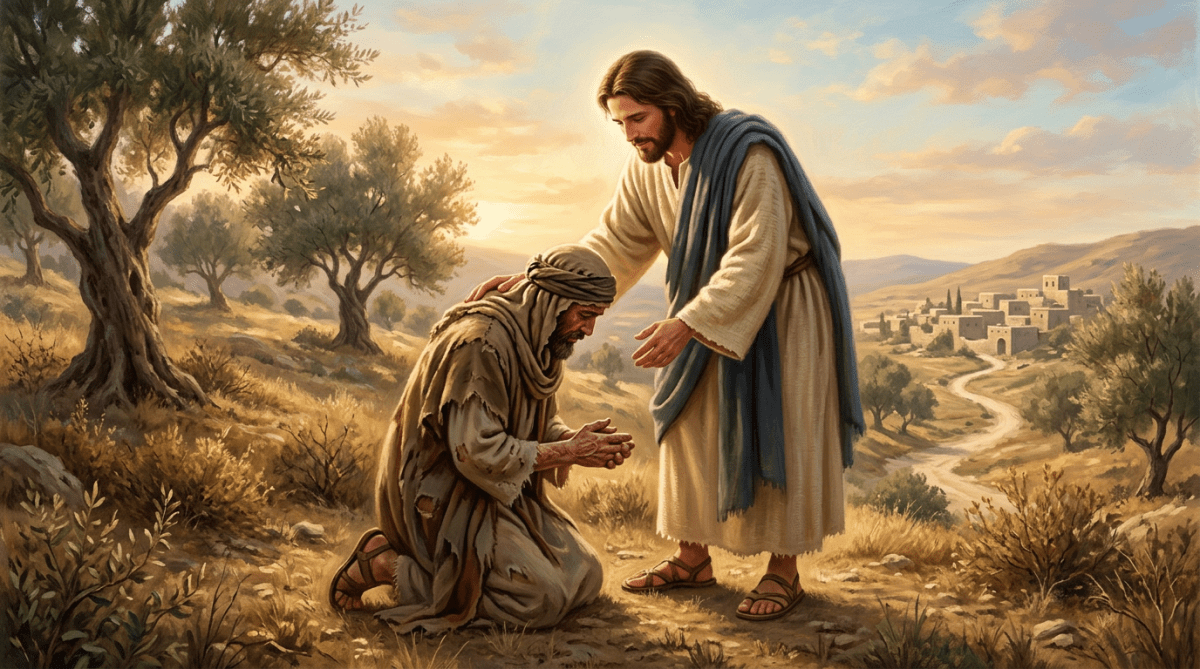
Jesus Heals the Leper

One of the first miracles of Jesus’ ministry is found in Mark 1:40-45, “(40) And there came a leper to him, beseeching him, and kneeling down to him, and saying unto him, If thou wilt, thou canst make me clean.  (41)  And Jesus, moved with compassion, put forth his hand, and touched him, and saith unto him, I will; be thou clean.  (42)  And as soon as he had spoken, immediately the leprosy departed from him, and he was cleansed.  (43)  And he straitly charged him, and forthwith sent him away;  (44)  And saith unto him, See thou say nothing to any man: but go thy way, shew thyself to the priest, and offer for thy cleansing those things which Moses commanded, for a testimony unto them.  (45)  But he went out, and began to publish it much, and to blaze abroad the matter, insomuch that Jesus could no more openly enter into the city, but was without in desert places: and they came to him from every quarter.”

Jesus Heals the Leper[1]

In Leviticus 13 & 14 (the two longest chapters in the book), “leprosy” is treated not just as a medical issue, but also as a spiritual defilement that manifests physically. It teaches us about the nature and consequences of sin.

Leprosy is a symbol of sin:

  • Sin is Deep-Rooted: In Leviticus 13:3 the infection must be “deeper than the skin.”
    • Why? Sin is a condition of the heart, not just outward behavior.
    • Man looks on the outwards, but God on the heart.
  • Sin Spreads and Corrupts: Leprosy spreads across the body, and sin is an infectious spiritual disease that grows like leaven and corrupts a person’s entire life.
  • Sin Numbs, Desensitizes and Disfigures: Leprosy (Hansen’s Disease) numbs the nerves.
    • This is akin to someone who has a “seared conscience” A person’s conscience is seared when they lose their sensitivity and become unfeeling and unaware of their own spiritual decay.
    • Because of the numbness the leper feels no pain until too late, and the result is missing appendages, lesions, open sores, etc.
  • Sin Alienates and Isolates: The requirement for lepers to be “put out of the camp” represents the separation from God and people caused by sin.
    • “Command the children of Israel, that they put out of the camp every leper…” (Num. 5:2).
    • Infected individuals were required to wear torn clothes, keep their hair unkempt, cover their mouths, and shout “Unclean, unclean” to warn others in their vicinity to keep away.

Jesus Heals the Leper

How?

He roots out sin through justification and sanctification.

  1. The New Birth – A New Heart – Justification
    • Ezekiel 36:24-27; Jeremiah 31:33-34; John 3:3-8; Acts 2:38; 1 Cor. 6:9-11
    • New Creature – new nature – new desires
  2. Conviction – the Sword of the Spirit – the Teacher – Sanctification
    • 2 Cor. 7:9-11; Hebrews 4:12; 2 Tim. 3:16-17; Titus 2:11-14; 1 Thess. 4:3-7
    • Conviction – clean conscience – sensitivity
  3. Your Contribution – Mortify (kill) the Deeds of the Body.
    • Romans 8:12
    • Colossians 3:5-10, “(5) So put to death the sinful, earthly things lurking within you. Have nothing to do with sexual immorality, impurity, lust, and evil desires. Don’t be greedy, for a greedy person is an idolater, worshiping the things of this world.  (6)  Because of these sins, the anger of God is coming.  (7)  You used to do these things when your life was still part of this world.  (8)  But now is the time to get rid of anger, rage, malicious behavior, slander, and dirty language.  (9)  Don’t lie to each other, for you have stripped off your old sinful nature and all its wicked deeds.  (10)  Put on your new nature, and be renewed as you learn to know your Creator and become like him.”
  4. Daily Cleansing – Relationsip
    • 1 Jn. 1:9; Ps. 51:10; Lk. 9:23; Pr. 28:13; Ps. 32:5; Jn. 13:10; Ja. 4:8; Ja.5:16
    • Psalms 139:23-24, “(23) Search me, O God, and know my heart: try me, and know my thoughts:  (24)  And see if there be any wicked way in me, and lead me in the way everlasting.”

Conclusion

Jesus healing the leper teaches us that He does not merely cover sin’s symptoms—He reaches into the heart, touches what is unclean, and makes the person completely new.

“Therefore, if any man be in Christ, he is a new creature: old things are passed away; behold, all things are become new” (2 Cor. 5:17).

Jesus restores relationships, reverses isolation, renews our  conscience

All we need to do is receive His touch, mortify daily the sin that tempts us, and walk in the newness of life.

Like the leper who was sent to the priest as a testimony, our transformed lives are meant to point others to Jesus – the Cleanser.

Jesus Heals the Leper – We are all lepers.

The Tailor and the Stained Coat

Imagine a man who has worn a once-fine coat until it is stained, threadbare, and reeking of neglect.

His neighbors avoid him because the coat announces his ruin.

A master tailor sees him, takes the coat, and does three things:

  1. He washes it until the grime is gone
  2. He repairs the torn seams and replaces the lining so the coat will keep its shape
  3. He presses it daily and teaches the man how to care for it so the repairs last.

The tailor’s work is not a one-time cosmetic fix but a complete restoration requiring the owner’s willingness to be helped and to maintain what has been given.

Jesus cleanses, mends, and trains us in our new lifestyle so that the healing endures and becomes a testimony to others.

Jesus Heals the Leper


[1] Italicized parts were done with the help of GOOGLE AI and/or Copilot.

Categories
Golden Heart Foundation

When Jesus was told, “No.”

The three prayers of Jesus in Gethsemane represent the ultimate moment of human vulnerability and divine submission:[1]

Matthew 26:36-46, “(36) Then cometh Jesus with them unto a place called Gethsemane, and saith unto the disciples, Sit ye here, while I go and pray yonder.  (37)  And he took with him Peter and the two sons of Zebedee, and began to be sorrowful and very heavy.  (38)  Then saith he unto them, My soul is exceeding sorrowful, even unto death: tarry ye here, and watch with me.  (39)  And he went a little further, and fell on his face, and prayed, saying, O my Father, if it be possible, let this cup pass from me: nevertheless not as I will, but as thou wilt.  (40)  And he cometh unto the disciples, and findeth them asleep, and saith unto Peter, What, could ye not watch with me one hour?  (41)  Watch and pray, that ye enter not into temptation: the spirit indeed is willing, but the flesh is weak.  (42)  He went away again the second time, and prayed, saying, O my Father, if this cup may not pass away from me, except I drink it, thy will be done. (43)  And he came and found them asleep again: for their eyes were heavy.  (44)  And he left them, and went away again, and prayed the third time, saying the same words.  (45)  Then cometh he to his disciples, and saith unto them, Sleep on now, and take your rest: behold, the hour is at hand, and the Son of man is betrayed into the hands of sinners.  (46)  Rise, let us be going: behold, he is at hand that doth betray me.”

Mark 14:32-42, “(35) …fell on the ground, and prayed that, if it were possible, the hour might pass from him. (36)  And he said, Abba, Father, all things are possible unto thee; take away this cup from me: nevertheless not what I will, but what thou wilt…. (39) And again he went away, and prayed, and spake the same words…. (41)  And he cometh the third time…”

Luke 22:42-46, “…if thou be willing, remove this cup from me: nevertheless not my will, but thine, be done.  (43)  And there appeared an angel unto him from heaven, strengthening him.  (44)  And being in an agony he prayed more earnestly: and his sweat was as it were great drops of blood falling down to the ground.”

Jesus repeated the same petition three separate times:

  • He asked, “My Father, if it is possible, may this cup be taken from me.”
  • The “cup” symbolized the weight of human sin and God’s wrath He was about to endure.
  • Each time, He concluded with a statement of total submission: “Yet not as I will, but as you will”.

Key Features of the Prayer:

  • Anguish – Jesus’ soul was “overwhelmed with sorrow to the point of death.”
  • Physical Toll – His sweat became like “great drops of blood falling to the ground” (a rare condition known as hematohidrosis caused by extreme stress).
  • Relationship – Jesus used the intimate term “Abba, Father” (Mark 14:36). He kept His personal relationship with God.

God did not remove the “cup,” but by the end of His prayer, Jesus was at peace and ready to face betrayal, abandonment and the cross.

The prayer in Gethsemane is perhaps the most profound example of a “No” from God.

Jesus did not get what He wanted from the Father.

Even for Jesus, prayer was not some type of magical spell spoken to change His circumstance, but a test of relationship as He willingly aligned His human will with unwanted divine purpose of the Father.

The Prayers of Jesus display for us the genuine tension between his human desire to avoid suffering and His divine mission.

“Let this cup pass from me” = a natural, holy desire to avoid the physical and spiritual agony of the cross.

The Divine “No” — You would never expect Jesus to get a “NO” from the Father — NEVER, but here it is, “No.”

God did not grant the request to bypass the cross. This demonstrates that an unanswered prayer (in the way we want it) is not a sign of God’s absence or displeasure—after all, Jesus is God’s “Beloved Son.”

This moment establishes a model for how to handle “unanswered” prayers:

  • Honesty: Jesus was brutally honest about what he wanted (“Take this cup”).
  • Trust: He ended with “Not my will, but yours,” acknowledging that
    God’s perspective was greater than his immediate suffering.
  • Submission: He moved from the posture of a petitioner to the posture
    of a participant in God’s plan, eventually rising from prayer with the
    resolve to face his arrest.

Hebrews 4:14-16, “(14) Seeing then that we have a great high priest, that is passed into the heavens, Jesus the Son of God, let us hold fast our profession.  (15)  For we have not an high priest which cannot be touched with the feeling of our infirmities; but was in all points tempted like as we are, yet without sin.  (16) Let us therefore come boldly unto the throne of grace, that we may obtain mercy, and find grace to help in time of need.”

In order to know ALL that humanity experiences, Jesus had to learn what it was like to hear the Father say, “No.”

“…in all points tempted like as we are…”

Hebrews 12:1-2, “(1) Wherefore seeing we also are compassed about with so great a cloud of witnesses, let us lay aside every weight, and the sin which doth so easily beset us, and let us run with patience the race that is set before us,  (2)  Looking unto Jesus the author and finisher of our faith; who for the joy that was set before him endured the cross, despising the shame, and is set down at the right hand of the throne of God.”


[1] Italicized parts were done with the help of GOOGLE AI and/or Copilot.