Categories
Golden Heart Foundation

A Conversation at Noon

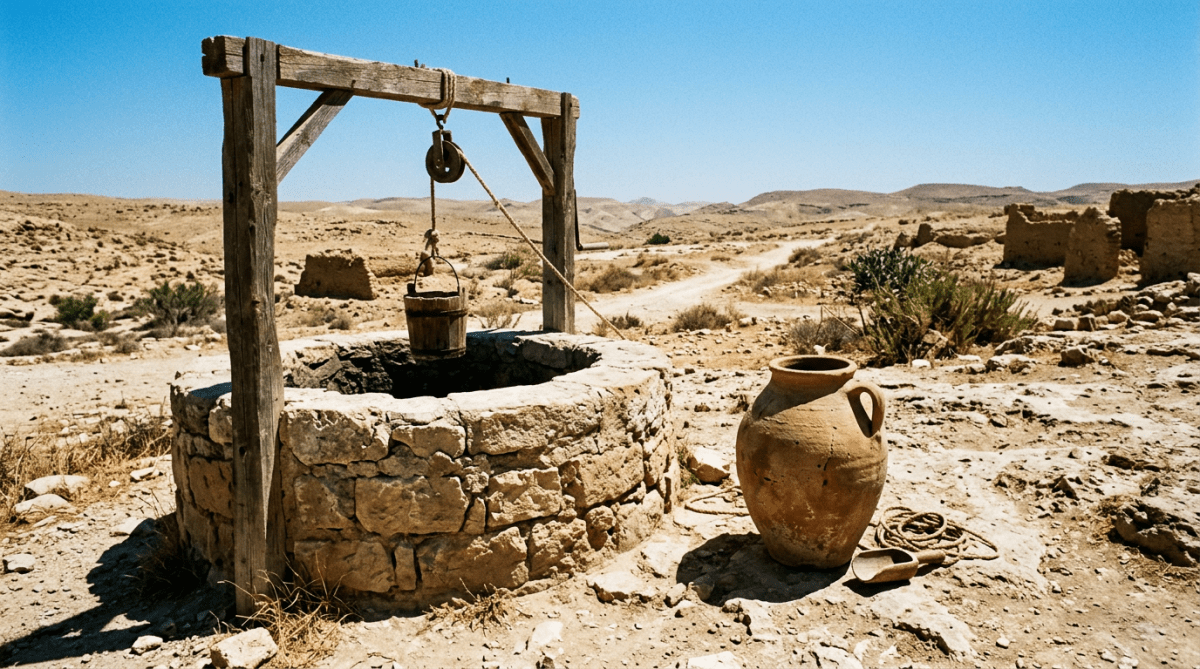
“…He must needs go through Samaria” (John 4:1-45).

The Jews in Jesus’ day would often take the long way around Samaria, but Jesus felt compelled to go through Samaria.

Then, near the village of Sychar, He sends His disciples into the village for food and sits on Jacob’s well at noon (the sixth hour).

And He waits for a woman of Samaria to come.

No name is mentioned, just her gender and her genealogical status – A Samaritan woman (half Jew and considered by the Jews to be “unclean.”

He begins a conversation with her — at noon

She initially resists and is mistrusting of this Jewish teacher’s intentions.

She has been rejected, marginalized and devalued for all her life by these Jews and now life’s choices and situations have in a real sense separated her even from her own people.

This is why she goes to the well at the hottest part of the day:

  • To escape the judgmental glances
  • To avoid hearing the condemning voices
  • To protect her heart from witnessing happiness in others she doesn’t possess

Then this Jewish Rabbi, an interloper, sits on the well she needs to draw water from and has the audacity to cross a cultural divide and ask her for a drink of water — Who does he think he is?

She doesn’t respond positively. She might even be a little snippy with Jesus:

“You are a Jew,” she replied, “and I am a Samaritan woman. How can you ask me for a drink of water when Jews and Samaritans won’t have anything to do with each other?” 

Jesus answered, “You don’t know what God wants to give you, and you don’t know who is asking you for a drink. If you did, you would ask me for the water that gives life.” 

She doubles down: “Sir, you don’t even have a bucket, and the well is deep. Where are you going to get this life-giving water? Our ancestor Jacob dug this well for us, and his family and animals got water from it. Are you greater than Jacob?” 

Thus begins a conversation at noon that changes her life and sets the stage for Jesus to tell her what He has never told anyone else before:

The woman saith unto him, “I know that Messias cometh, which is called Christ: when he is come, he will tell us all things.”

Jesus saith unto her, “I that speak unto thee am He.”

Who is he…He is Jesus, the Christ…the Messiah!

Points to Consider:[1]

  • Confronting Reality Without Condemnation: Jesus revealed her personal history—having had five husbands and currently living with a man who was not her husband. Crucially, He did this to reveal himself, not to shame her. This “tender seeing” allowed her to move past her own guilt and recognize him as a prophet.
  • Clarifying True Worship: When she attempted to pivot to a religious debate about the proper place to worship (Mount Gerizim vs. Jerusalem), Jesus responded that true worship is “in spirit and in truth,” making the location irrelevant.
  • Full Revelation and Mission: Once she expressed hope for the coming Messiah, Jesus directly declared, “I who speak to you am He.”
  • The Depth of Her Change: Seen in her immediate reaction: she left her water jar behind—symbolizing her move from physical thirst to spiritual fulfillment—and ran to her village to testify – “Come see a Man that told me all ever that I did.”

[1] SOURCE: GOOGLE AI MODE: Query- explain the way that Jesus initially overcome the resistance and mistrust of the woman at the well, and her change of heart. Italicized.

Categories
Bible Teaching

Dogma

Our dogma revolves around the great biblical truth that there is One God, also called “monotheism.” In his book, The Oneness of God, David K. Bernard, J.D. defines monotheism in this manner: “The belief in only one God is called monotheism, which comes from two Greek words: monos, meaning alone, single, one; and theos, meaning God.”

Ralph V. Reynolds simply stated that “there is only one Supreme Being who is God; He cannot be multiplied nor pluralized.” He further declared, “There are over fifty passages of Scripture that teach that God is one and that there is no other.”

In fact, the Word of God naturally assumes this universal truth. Genesis 1:1, “In the beginning God created…” God here is the transliterated form of Elohim, which means “plenitude of might,” or more simply, “one God whose characteristics are many.”

This thought is carried further in Deuteronomy 6:4, “Hear, O Israel: the LORD our God is one LORD.”

In Colossians 2:9 we are told that in Jesus dwells all the fullness of the Godhead (all the characteristics of God) bodily, and we (the Church) are complete in Him (Jesus).

When addressing Timothy, Paul wrote of a mystery, but then he further explained what that mystery was, “And without controversy great is the mystery of godliness: God was manifest in the flesh, justified in the Spirit, seen of angels, preached unto the Gentiles, believed on in the world, received up into glory” (1 Timothy 3:16). Only Jesus Christ fulfills those six points. Therefore, Jesus Christ of the New Testament is Elohim of the Old Testament, which further explains why we are told that Jesus Christ is the image of the invisible God and that all things exist and consist by him, Colossians 1:12-17.

So, we are dogmatic in our belief that there is only one God and Jesus is His name. He is our Creator, Sustainer, Redeemer, and Savior. Isaiah 9:6, “For unto us a child is born, unto us a son is given: and the government shall be upon his shoulder: and his name shall be called Wonderful, Counsellor, The mighty God, The everlasting Father, The Prince of Peace.” Only Jesus fulfills this messianic prophecy. He is the Father in Creation, the Son in Redemption, and the Holy Spirit in us today. Keep this great truth in mind and heart as you celebrate this Christmas season. Merry Christmas!


Bernard, David K. The Oneness of God. St. Louis: Word Aflame Press, 1983.

Reynolds, Ralph V. Truth Shall Triumph. Hazelwood, MO: Pentecostal Publishing House, 1965.

Originally posted on 20 December 2010 on https://thepillarandgroundoftruth.blogspot.com/2010/12/dogma.html

Categories
Bible Teaching

Saying the Name of Jesus

According to the late T. W. Barnes, many people pronounce the name of Jesus without really knowing how to say it. He specified four ways to say the name of Jesus:

  1. Say His name with love; the early church had great success, because they loved not their lives, they loved that Name. Love is powerful. Their love gave them reverence for the Name.
  2. Say His name with vision. Say it seeing the invisible. A woman said, “I resist the devil and he doesn’t leave.” Bro. Barnes asked her, “What do you look for? The Bible doesn’t say resist him and see him sitting on your shoulder; when you resist him you should see him running. The devil no doubt left you when you said in Jesus Name, but since you did not expect him to go, your thinking made you as miserable as if he stayed with you.”
  3. Say His name with faith. Religious leaders in Israel asked the disciples, “How did you heal the man crippled from his mother’s womb?” Peter answered, “…by the name of Jesus Christ…”
  4. Say His name while living a life of sacrifice. The disciples sacrificed everything for that name. We need to love it enough that no sacrifice is too great to make for Jesus.

-Nona Freeman, A Prophet in our Time (2007)

********************************

Why is there so much power in the Name of Jesus?  T. W. Barnes attributed it to the following reasons: 

  1. His Word is in it – John 1:1, “In the beginning was the Word…”
  2. His Blood is in it – Jesus is a blood name that redeems all people from sin and the effects of sin (sickness, disease, mental disorders, etc.).
  3. His Spirit is in it – The Holy Ghost that you received when you spoke in tongues the first time is that Spirit of Christ in you.
  4. The authority of heaven is in it – All power in Heaven and earth belongs to Jesus Christ.
  5. His faith is in it – He made everything by the power of His own Word; He spoke it and it happened.

Nona Freeman, A Prophet In Our Time (2007)


T. W. Barnes’ website: https://www.twbarnes.com/index.html

T. W. Barnes Memorial Page: https://www.leestoneking.com/T%20W%20Barnes%20Memorial.htm

Originally posted on 2 June 2010 on https://thepillarandgroundoftruth.blogspot.com/2010/06/tw-barnes-saying-name-of-jesus.html

Categories
Bible Teaching

Jesus Christ: Sonship

Isaiah 9:6 = Jesus is God

The Purpose of Sonship

God has always desired to fellowship with man, but sin came into the human family and separated God from man. The purpose of Sonship was so that God could provide the best means by which He and man could regain their fellowship, and to give dominion over the earth to man again. This fellowship is the result of the sacrifice of the Savior on Calvary. He could only do this by providing complete redemption for mankind. He is the Lamb that was slain from the foundation of the world, Rev. 13:8. In short, the Sonship is about God and man engaging in a loving and healthy relationship that is void of any hindrances (sin), which would separate each from the other. For that to take place a Mediator (the Son) had to provide reconciliation between God and man. This Mediator was realized in the person of Jesus Christ.

Who Fulfilled the Sonship

Jesus Christ fulfills the Sonship. In Colossians 2:9 we are told that in Jesus dwells all the fullness of the Godhead (all the characteristics of God) bodily, and we (the Church) are complete in Him (Jesus). Paul did say that the Gospel message was a mystery, but then he went on to explain what the mystery was: “And without controversy great is the mystery of godliness: God was manifest in the flesh, justified in the Spirit, seen of angels, preached unto the Gentiles, believed on in the world, received up into glory” (I Timothy 3:16). Only Jesus Christ fulfills these six points. Thus proving the adage, “Jesus Christ of the New Testament is Jehovah of the Old Testament.”


Originally posted on 5 June 2010 on https://thepillarandgroundoftruth.blogspot.com/2010/06/jesus-christ-sonship.html

Categories
Bible Teaching

Pursuing the Beloved of the Lord

Matthew 5:21-22, “Ye have heard that it was said by them of old time, Thou shalt not kill; and whosoever shall kill shall be in danger of the judgment: But I say unto you, That whosoever is angry with his brother without a cause shall be in danger of the judgment: and whosoever shall say to his brother, Raca, shall be in danger of the council: but whosoever shall say, Thou fool, shall be in danger of hell fire.”

Raca comes from an old Chaldean word meaning “O empty one, that is, thou worthless (as a term of utter vilification).”[1]

In a time of prayer, I heard the Voice of God speaking to me these words:

Raca. I said, “Don’t call that word on anyone’s life. My children are not Raca. My children are not cast away. My children are not forgotten just because they are not present. Pursue the absent as you sow for new.”


I believe that we are being reminded and called to once again go to the loved ones of God, and the Church, who’ve fallen and restore them.

As we plant seed hoping for a new harvest of souls it is important that we not forget those among us who are weaker, or have been injured.  Just as we put up stakes in a tomato patch to strengthen the plant and keep it from falling, or breaking, we also must remember that what may appear to be a falling member is really a fellow planting of the Lord that we who are spiritual need to edify and reinforce.

The safest place in town should be with the saints of Jesus Christ, and the safest place is with the saints of Jesus Christ.  His love compels us to not only fulfill the great commission, but to also make sure that everyone in the body of Christ makes the trip.

We don’t cutoff a leg because it is broken, or pluck out an eye because it has an irritant in it, and we don’t marginalize people who may be weak among us. In fact, it is in our weakness, the weakness of the body, that our strength is realized for “we then that are strong ought to bear the infirmities of the weak, and not to please ourselves” (Romans 15:1).

It is the will of God that we pursue and then bear the infirmities of the weak as we restore the fallen among us. 

What rights have we to condemn, judge, or to cast aside the children of our Lord, when He came into the world, not to condemn His children in it, but to save them? He has provided Himself a ransom for many. He has shown us His mercy, and having believed we walk in grace being patiently taught how to live a sober and godly life.  So, pass those lessons of love on to others who have fallen.

Who among us will strive to not only win a new soul to Jesus, but to also look for our missing brothers and sisters and speak words of love and restoration to them? They’re missing, but not forgotten, and just as the father looked for the return of his beloved younger son, we elder brothers should go with the same fervency and intensity that we put into the work of the field to find and bring our missing home.

Determine today, with me, that you will pursue the beloved of the Lord.


[1] According to Strong’s Hebrew & Greek Dictionaries (Entry # G4469)

Originally posted on 1 March 2011 on http://thepillarandgroundoftruth.blogspot.com/2011/02/pursuing-beloved-of-lord.html