Categories
Bible Preaching

Determined to Meet the Challenge

Text: Hebrews 11:32-12:2

(32)  And what shall I more say? for the time would fail me to tell of Gedeon, and of Barak, and of Samson, and of Jephthae; of David also, and Samuel, and of the prophets: (33)  Who through faith subdued kingdoms, wrought righteousness, obtained promises, stopped the mouths of lions, (34)  Quenched the violence of fire, escaped the edge of the sword, out of weakness were made strong, waxed valiant in fight, turned to flight the armies of the aliens. (35)  Women received their dead raised to life again: and others were tortured, not accepting deliverance; that they might obtain a better resurrection: (36)  And others had trial of cruel mockings and scourgings, yea, moreover of bonds and imprisonment: (37)  They were stoned, they were sawn asunder, were tempted, were slain with the sword: they wandered about in sheepskins and goatskins; being destitute, afflicted, tormented; (38)  (Of whom the world was not worthy🙂 they wandered in deserts, and in mountains, and in dens and caves of the earth. (39)  And these all, having obtained a good report through faith, received not the promise: (40)  God having provided some better thing for us, that they without us should not be made perfect. (12:1)  Wherefore seeing we also are compassed about with so great a cloud of witnesses, let us lay aside every weight, and the sin which doth so easily beset us, and let us run with patience the race that is set before us, (2)  Looking unto Jesus the author and finisher of our faith; who for the joy that was set before him endured the cross, despising the shame, and is set down at the right hand of the throne of God.

I got called out, to a street fight when I was 15 years old.

Two brothers and their cousin took offense at my breaking up their three way fight and they turned on me and challenged me to take on all three – at the same time.

Being less cautious than I should have been, I accepted, because I knew my best friend, Tony Huff, would stand with me.

On that fateful day, Tony and I met the trio of trouble at a road construction site about two blocks from my home.

We were Determined to Meet the Challenge.

We were not necessarily equipped to meet the challenge, but we were determined.

I don’t think I’ll forget the moment when we were through talking and about to square off, 2 against 3, my fists raised, my adrenaline pumping and my best friend beside me…

When all the sudden I heard running feet coming down the alley.

Out of the corner of my eye, I saw a wave of brown hair and a flash of blue denim skirt and a voice saying, “Stephen Eugene Kuntzman, Anthony Douglas Huff, you come here right now.”

Too our everlasting embarrassment, Momma had heard about the rumble and she was there to stop it.

But we were determined.

That youthful rumble ended in embarrassment, but it taught me a lesson about determination.

Life eventually brings real battles where “Momma” cannot step in to save you and in those challenging moments, you can look to a much greater cloud of witnesses who stood their ground.

Determined to Meet the Challenge

Life is full of challenges, struggles, trials, tough decisions, unpleasant conversations, disappointments, losses,

And even when you have done everything correctly to meet those challenges head-on there is no promise that you’ll succeed in the moment.

In faith you come to the battle, but you are not guaranteed the outcome you believed for, hoped in, dreamed about, and prayed over will come to pass.

To have faith is to be sure of the things we hope for, to be certain of the things we cannot see.[1]

And we know we can do all things through Christ because He is the source of our strength.[2]

And we understand that all things work together for good to them that love God, to them who are the called according to his purpose.[3]

But what do you do when ALL YOU HAVE BELIEVED FOR CRUMBLES BEFORE YOUR EYES?

Are you determined to meet the challenge?

It’s 1968, the Olympics are being hosted in Mexico City, and John Stephen Akhwari, a runner from Tanzania, cements his Olympic legacy not by winning, but by finishing last. Despite falling, injuring his knee and shoulder, and suffering from altitude cramps, he kept meeting the challenge. By the time he entered the stadium, the sun had set, the medal ceremony was over, and a small crowd remained. 75 started the race, but only 57 finished, and that final competitor to cross the line was Akhwari. Battered, bruised, injured and bandaged he was asked why he didn’t just quit. He replied, My country did not send me 5,000 miles to start the race; they sent me 5,000 miles to finish it.”[4]

He was Determined to Meet the Challenge.

The Apostle Paul wrote to Pastor Timothy, his son in the Gospel: “(2)  Preach the word; be instant in season, out of season; reprove, rebuke, exhort with all longsuffering and doctrine.  (3)  For the time will come when they will not endure sound doctrine; but after their own lusts shall they heap to themselves teachers, having itching ears;  (4)  And they shall turn away their ears from the truth, and shall be turned unto fables.  (5)  But watch thou in all things, endure afflictions, do the work of an evangelist, make full proof of thy ministry.  (6)  For I am now ready to be offered, and the time of my departure is at hand.  (7)  I have fought a good fight, I have finished my course, I have kept the faith:  (8)  Henceforth there is laid up for me a crown of righteousness, which the Lord, the righteous judge, shall give me at that day: and not to me only, but unto all them also that love his appearing.”[5]

The challenges of life and leadership are not easy,

But after 43 years, Bishop Moore and First Lady Moore have proven their determination, their grit, strength of character, and faith in God.

You are surrounded by their witness of faith.

God chose this man and woman to represent Him to you and to this city.

Moreover, God has been using them to teach, train, mold, edify, and love you so that you can do the work of the ministry.

And at the same time, He has filled their lives with challenges that reveal His hand and purpose in their life.

But, as Søren Kierkegaard wrote: “Life can only be understood backwards; but it must be lived forwards.”

When God Wants to Drill a Man[6]

By: Angela Morgan[7]

When God wants to drill a manWatch His methods, watch His ways!And he lifts beseeching hands!
And thrill a manHow He ruthlessly perfectsHow He bends but never breaks
And skill a man,  Whom He royally elects!When his good He undertakes;
When God wants to mold a manHow He hammers him and hurts him,How He uses whom He chooses
To play the noblest part;  And with mighty blows converts himAnd with every purpose fuses him;
When He yearns with all His heartInto trial shapes of clay whichBy every act induces him  
To create so great and bold a manOnly God understands;  To try His splendour out–  
That all the world shall be amazed,While his tortured heart is cryingGod knows what He’s about!

We’ve all been there, haven’t we?

We have all experienced God ruthlessly perfecting, hammering, and chiseling, and smoothing our rough edges as He molds us for a noble purpose.

We have all asked Jesus, “Why?”

And He is often silent, but you can count on this – God knows what He’s about!

“..weeping may endure for a night, but joy cometh in the morning.”[8]

When your faith is challenged, questioned, ATTACKED, or injured, you will face a moment of choice between meeting the challenge or stepping aside.

And if you have determined to meet the challenge, you will often face the same choice again and again and again.

The challenge is bigger than you are, it is more important than you can sometimes grasp. It is eternal in scope:

“For our light affliction, which is but for a moment, worketh for us a far more exceeding and eternal weight of glory; While we look not at the things which are seen, but at the things which are not seen: for the things which are seen are temporal; but the things which are not seen are eternal.”[9]

That’s faith! The substance of things hoped for, the evidence of things not seen.[10]

And without it, without FAITH, it’s impossible to please God.[11]

Do you know how I know that this Man of God and His wife have pleased God?

They are still here. They haven’t quit. They’ve kept the faith.

They decided a long time ago that they were determined to meet the challenge.

It no longer matters what the challenge is, after 43 years they have dealt with all kinds of challenges from the pew, from the pulpit, from the world, and from the enemy:

  • Moral Bankruptcy
  • Spiritual Apathy
  • Physical Sickness
  • Social Injustice
  • Financial Challenges
  • Demonic Influence
  • Mental Instability
  • Gender Dysphoria
  • Death

Life has thrown every obstacle in their pastoral path, but they are still standing, still determined, still standing in the gap for you.

Most of you have taken their example and followed suit, but some ran when challenges arrived.

The trying of your faith revealed a weakness, a brokenness that you can’t seem to get over.

You have been beating yourself up for so long that you don’t even know how you made it here today.

You are not as lost as you think.

Jesus is searching for you even in your cloudy and dark day:  (11)  For thus saith the Lord GOD; Behold, I, even I, will both search my sheep, and seek them out. (12)  As a shepherd seeketh out his flock in the day that he is among his sheep that are scattered; so will I seek out my sheep, and will deliver them out of all places where they have been scattered in the cloudy and dark day. (16)  I will seek that which was lost, and bring again that which was driven away, and will bind up that which was broken, and will strengthen that which was sick: but I will destroy the fat and the strong; I will feed them with judgment.[12]

The Lord God is not resisting, rejecting or denying you…He is searching for even one lost, broken, scattered sheep.

“For a just man falleth seven times, and riseth up again.”[13]

Paul and James wrote about enduring the persecutions, hardness and afflictions that challenge all believers and ministers of the Gospel.

They could only write about such things because they had experienced them.

Is it possible that they were determined to meet the challenge, but sometimes, like Peter on the night of our Lord’s crucifixion found themselves not as strong as they professed?

Did mercy come to them and now their voices of grace and experience encourages us to stand tall, firm, resolute?

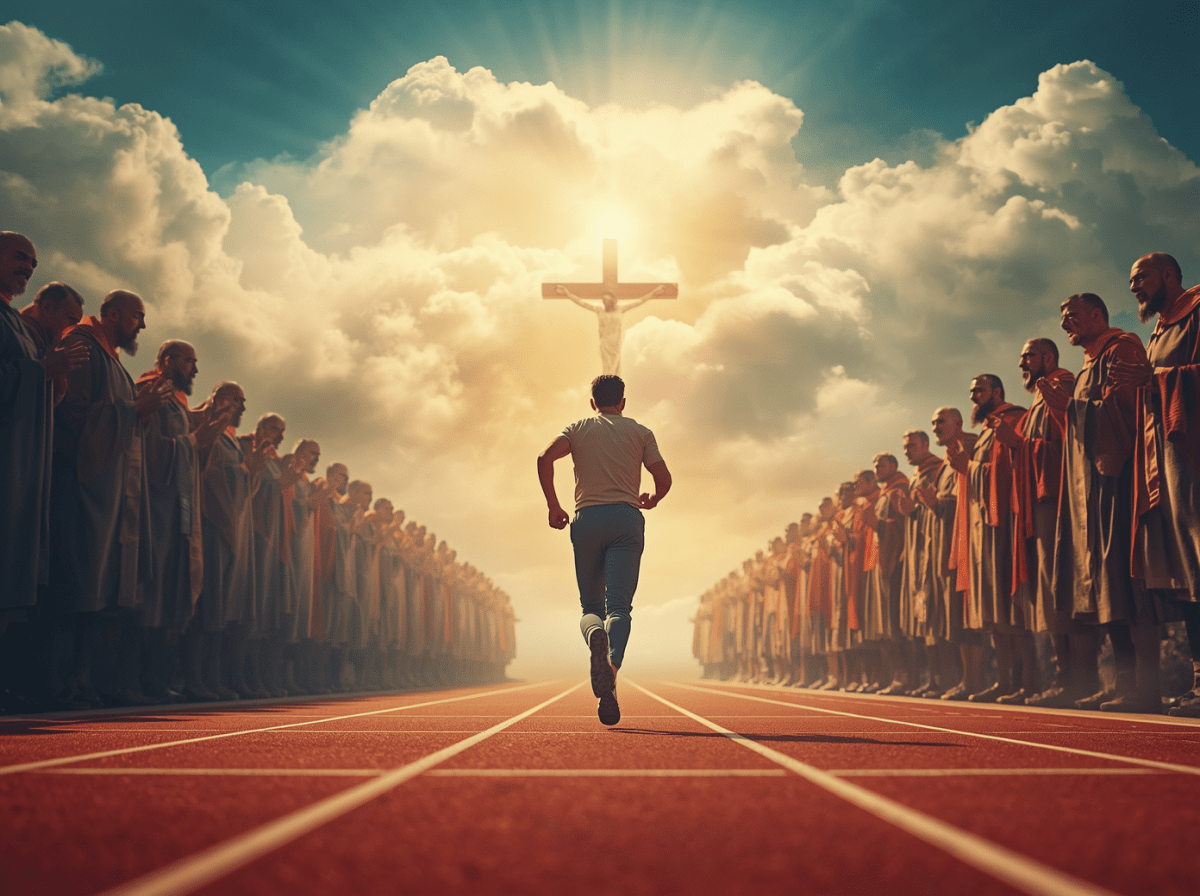
Now, to our text: Hebrews 12:1-2, “(1) Wherefore seeing we also are compassed about with so great a cloud of witnesses, let us lay aside every weight, and the sin which doth so easily beset us, and let us run with patience the race that is set before us, (2) Looking unto Jesus the author and finisher of our faith; who for the joy that was set before him endured the cross, despising the shame, and is set down at the right hand of the throne of God.”

The cloud of witnesses – our heroes of Hebrews, our elders, your Bishop and First Lady are looking towards you today.

They surround you, they compass you, watching to see if you can lay aside that which has hindered you.

Can you receive the baton of determination, faith, and endurance?

Will you run with patience the race set before you?

Are you Determined to Meet the Challenge?

Look to Jesus: “And it came to pass, when the time was come that he should be received up, he stedfastly set his face to go to Jerusalem” (Luke 9:51).

Jesus demonstrated determination by deliberately marching toward Jerusalem. He knew that betrayal, torture, and crucifixion were waiting for Him.

He was determined to face the agony of the cross and to bear your sins on it.

He refused fear, even when facing intense physical and spiritual pain. Jesus looked past the temporal and focused on the ultimate eternal victory.

He disregarded the humiliation and pushed through the suffering for the sake of the final goal:

“…who for the joy that was set before him endured the cross, despising the shame, and is set down at the right hand of the throne of God.”[14]

That joy was you.

Conclusion:

We are surrounded by a massive cloud of witnesses—from the heroes of Hebrews to 43 years of pastoral grit.

Jesus did not stop at Gethsemane,

Akhwari did not stop on the marathon track,

Bishop Moore and Lady Moore have not stopped through 43 years of challenges.

Lay aside the weights that hold you down and turn away from your sins.

Stop beating yourself up over past falls and failures.

Jesus is here binding your wounds today.

Stand up, square your shoulders, and be

Determined to Meet the Challenge.


[1] Good News Bible.

[2] Philippians 4:13

[3] Romans 8:28

[4] Source: https://www.olympics.com/en/news/marathon-man-akhwari-demonstrates-superhuman-spirit

[5] 2 Timothy 4:1-8 

[6] https://marbaniang.wordpress.com/2017/09/07/origin-of-the-poem-when-god-wants-to-drill-a-man/

[7] Believed to be an anonymously “Christianized” form of her 1918 poem When Nature Wants a Man.

[8] Ps. 30:5

[9] 2 Corinthians 4:17-18

[10] Hebrews 11:1

[11] Hebrews 11:6

[12] Ezekiel 34:11-12, 16

[13] Proverbs 24:16

[14] Hebrews 12:2
Categories
Bible Teaching

Dynamic Duo

Stephen Kuntzman | July 27, 2025 | 10:00 AM

Text: James 2:14

What doth it profit, my brethren, though a man say he hath faith, and have not works? can faith save him?

The Dynamic Duo[1]

Ancillary Text: Genesis 22:1–14

(1) And it came to pass after these things, that God did tempt Abraham, and said unto him, Abraham: and he said, Behold, here I am. [availability]  (2)  And he said, Take now thy son, thine only son Isaac, whom thou lovest, and get thee into the land of Moriah; and offer him there for a burnt offering upon one of the mountains which I will tell thee of.  (3)  And Abraham rose up early in the morning, and saddled his ass, and took two of his young men with him, and Isaac his son, and clave the wood for the burnt offering, and rose up, and went unto the place of which God had told him. [faith in preparation]  (4)  Then on the third day Abraham lifted up his eyes, and saw the place afar off.  [faith tested with time] (5)  And Abraham said unto his young men, Abide ye here with the ass; and I and the lad will go yonder and worship, and come again to you.  [hope] (6)  And Abraham took the wood of the burnt offering, and laid it upon Isaac his son; and he took the fire in his hand, and a knife; and they went both of them together.  [faith in action] (7)  And Isaac spake unto Abraham his father, and said, My father: and he said, Here am I, my son. And he said, Behold the fire and the wood: but where is the lamb for a burnt offering? [Isaac is no mere boy, but a man of 37]  (8)  And Abraham said, My son, God will provide himself a lamb for a burnt offering: so they went both of them together. [a messianic prophecy, but also a rhema word for that moment] (9)  And they came to the place which God had told him of; and Abraham built an altar there, and laid the wood in order, and bound Isaac his son, and laid him on the altar upon the wood.  [faith and works] (10)  And Abraham stretched forth his hand, and took the knife to slay his son. [dynamic duo of Abraham and Isaac – trust in God and trust in the man of God]  (11)  And the angel of the LORD called unto him out of heaven, and said, Abraham, Abraham: and he said, Here am I.  (12)  And he said, Lay not thine hand upon the lad, neither do thou any thing unto him: for now I know that thou fearest God, seeing thou hast not withheld thy son, thine only son from me.  [God saw his faith and rewarded it] (13)  And Abraham lifted up his eyes, and looked, and behold behind him a ram caught in a thicket by his horns: and Abraham went and took the ram, and offered him up for a burnt offering in the stead of his son.  (14)  And Abraham called the name of that place Jehovahjireh: as it is said to this day, In the mount of the LORD it shall be seen. [God will see – or – God sees and provides]

Lesson Text: James 2:14–26

(14) What doth it profit, my brethren, though a man say he hath faith, and have not works? can faith save him?  (15)  If a brother or sister be naked, and destitute of daily food,  (16)  And one of you say unto them, Depart in peace, be ye warmed and filled; notwithstanding ye give them not those things which are needful to the body; what doth it profit?  (17)  Even so faith, if it hath not works, is dead, being alone.  (18)  Yea, a man may say, Thou hast faith, and I have works: shew me thy faith without thy works, and I will shew thee my faith by my works.  (19)  Thou believest that there is one God; thou doest well: the devils also believe, and tremble.  (20)  But wilt thou know, O vain man, that faith without works is dead?  (21)  Was not Abraham our father justified by works, when he had offered Isaac his son upon the altar?  (22)  Seest thou how faith wrought with his works, and by works was faith made perfect?  (23)  And the scripture was fulfilled which saith, Abraham believed God, and it was imputed unto him for righteousness: and he was called the Friend of God.  (24)  Ye see then how that by works a man is justified, and not by faith only.  (25)  Likewise also was not Rahab the harlot justified by works, when she had received the messengers, and had sent them out another way?  (26)  For as the body without the spirit is dead, so faith without works is dead also.

God calls us to put our faith into action, and so we demonstrate our faith through our works.

INTRODUCTION

Topeka, Kansas, is well known in American history for multiple reasons. In Topeka the events that led to the famous Brown v. Board of Education case occurred, which resulted in the desegregation of American schools.

Topeka was also the location of the Bible school where Charles Fox Parham and his students believed and taught that speaking in tongues was the initial sign of Holy Ghost baptism, helping to spark the modern Pentecostal movement.

Also, the city where Pastor Charles Sheldon, in 1896, decided to try something different during the Sunday night services.

Instead of a traditional sermon, he began reading a novel he was writing by presenting one chapter each week to the congregation. The story became so popular that soon the church was full of people wanting to find out about what would happen next.

Eventually the book would be published with the title In His Steps, and it remains a popular book to this day.

The story is set in fictional Raymond, a railroad town in the Eastern United States. It opens with the main character, Reverend Henry Maxwell, pastor of First Church of Raymond, sitting in his home on Friday afternoon preparing his Sunday sermon. When his efforts to concentrate are interrupted by a panhandler, the pastor brushes him aside and gets back to what he considers a more important activity.

On Sunday morning the same man shows up to service and addresses the congregation. He then immediately collapses and dies a few days later.

Reverend Maxwell is affected deeply by these events and begins to question his selfish behavior.

He challenges his congregation with a question that causes a revival in the lives of virtually everyone in the town: what would Jesus do?

Inspired by this simple, yet profound question, the members of Central Congregational Church begin to look for ways to use their position in the community to bring about changes that will form Raymond into a place God desires it to be.

What would Jesus do?

We would still do well to consider that provoking question because one of the essential components of true biblical theology should focus on what we believe and what we do.

Living for God is much more than simply listening to the preached Word of God on Sunday mornings; we must respond and follow what the Word of God calls us to do.

When God’s Word calls us to repent, we must repent.

When God’s Word calls us to love our neighbor and forgive those who hurt us, we must hear and heed.

We would do well to enter every service asking ourselves two questions:

  1. What does God want me to know?
  2. What does God want me to do?

THE DYNAMIC DUO OF FAITH AND WORKS

The Danger of Faith without Works

Peanut butter and jelly. Coffee and donuts. Rest and relaxation. Batman and Robin. Some things seem destined to always go together.

The same should be true of faith and works.

Bernard of Clairvaux wrote, “Hell is full of good wishes or desires.” Today, we say, “The road to Hell is paved with good intentions.”

Neither of these quotes are from the Word of God because they are not exactly accurate.

Being cast into outer darkness and eternally separated from God is not simply the end result of good intentions – it is the direct result of sin.

Likewise, we understand that good works alone cannot earn us entrance into heaven.

You will never be good enough to purchase your own salvation because, even on your best day, the Bible declares all your righteousness as nothing more than “filthy rags” (Isaiah 64:6).

It is impossible to do enough good deeds to erase the stain of one single sin.

You must apply the gospel to your life through the new-birth experience because neither good works nor good intentions are enough to save you.

This simple fact is demonstrated throughout the Word of God:

If Noah had the faith to believe it was going to rain but refused to build the ark, he would have drowned.

If Peter had answered the question, “Men and brethren, what shall we do?” by explaining that simply changing their mind about Jesus was enough for salvation, the people may have gone home with a repentance experience, but they would not have been born again. (See Acts 2:36–39.)

The Power of Faith with Works

When faith is combined with works the power of God is released.

Faith and works are both involved in all elements of obeying the gospel of Jesus Christ:

  • 2 Thessalonians 1:8, “In flaming fire taking vengeance on them that know not God, and that obey not the gospel of our Lord Jesus Christ”
  • 1 Peter 4:17, “For the time is come that judgment must begin at the house of God: and if it first begin at us, what shall the end be of them that obey not the gospel of God?” 

You must do more than have a change of mind about your sinful state; you must repent of your sins by turning from your old life. It is not enough to feel sorry for past mistakes; you must quit sinning.

For those who gathered to be baptized by John the Baptist, he demanded they “bring forth therefore fruits worthy of repentance” (Luke 3:8).

Jesus taught the same doctrine when He instructed the woman caught in adultery to “go, and sin no more” (John 8:11).

Repentance is how you obey the death of Jesus. You must have faith to believe that His death on the cross of Calvary was sufficient to pay your debt to sin, and then you must do the work of turning from sin.

After you repent of your sin, you respond to Jesus’ burial by being baptized in the name of Jesus Christ:

“Therefore we are buried with him by baptism into death: that like as Christ was raised up from the dead by the glory of the Father, even so we also should walk in newness of life.”[2]

When the first Gentiles were brought into the New Testament church in Acts 10, Peter did not just suggest they be baptized; rather, he “commanded them to be baptized in the name of the Lord” (Acts 10:48).

Your new birth is not complete without Spirit baptism. In His supreme wisdom, God provided you an undeniable sign that you have been filled with His Spirit.

Multiple experiences in life can make the hair stand up on your neck or give you moments of joy or a sense of peace.

However, only the baptism of the Holy Ghost allows you to worship God in a language you have never learned as you declare “the wonderful works of God” (Acts 2:11).

That experience involves a level of faith in the Word of God combined with surrendering your whole self to Him.

Faith without works is dead, but the combination of faith and works produces the new birth.

I Will Demonstrate My Faith through My Works

Just as faith apart from obedience will not result in salvation, your walk with God after the new birth is equally dependent upon the marriage of faith and works.

If Jesus had only declared His identity with words, the statements He made would have been true, but the opportunity to prove their accuracy may have been lost. The Bible declares: “Jesus . . . went about doing good” (Acts 10:38).

When John the Baptist sent messengers asking whether Jesus really was the Messiah, Jesus offered the works He had done as evidence:

“Go your way, and tell John what things ye have seen and heard; how that the blind see, the lame walk, the lepers are cleansed, the deaf hear, the dead are raised, to the poor the gospel is preached” (Luke 7:22).

Why do you think the majority of Jewish society rejected Jesus even after witnessing so many marvelous miracles?

The Book of James contains the most notable commentary on this subject. James asked these rhetorical questions: “What doth it profit, my brethren, though a man say he hath faith, and have not works? can faith save him?” (James 2:14).

James then gave a very practical example to illustrate his point. If we encounter a brother or sister needing clothing and food and say, “Depart in peace, be ye warmed and filled” without offering practical help, it is of no use (James 2:16).

“Even so faith, if it hath not works, is dead, being alone” (James 2:17).

THE FAITHFULNESS OF ABRAHAM

God Challenged Abraham’s Faith

To see faith in real life, let us look at the “father of the faithful” based on Paul’s description of Abraham as “the father of all them that believe” (Romans 4:11).

The first eleven chapters of the Book of Genesis chronicle approximately two thousand years. In those chapters we read about Adam and Eve, the story of Noah and the Flood, and how God confused the languages because of humanity’s disobedience in building the Tower of Babel.

We see some detail, but the Bible paints in rather broad brushstrokes until we reach chapter twelve where we are introduced to a man named Abram and his wife Sarai. The next fourteen chapters are devoted exclusively to that one man and his family. If we add in the portion of the Bible dedicated to Abraham’s son, grandson, and great-grandson, we see a total of thirty-nine chapters devoted to this one extended family.

Abraham is celebrated in God’s Hall of Faith in Hebrews 11: “By faith Abraham, when he was called to go out into a place which he should after receive for an inheritance, obeyed; and he went out, not knowing whither he went” (Hebrews 11:8).

Abraham was called, and then he obeyed.

Abraham combined faith with works.

If he had sat around his entire life bragging about God speaking to him and explaining how much he believed God’s promise without ever leaving his hometown, his spoken faith would have been dead words.

But to be proven faithful required more than one action. Abraham left his hometown, separated from his entire family (including his nephew Lot), and received the promised son named Isaac. Then the Lord challenged Abraham’s faith yet again with a call that must have been incredibly difficult to hear:

“Take now thy son, thine only son Isaac, whom thou lovest, and get thee into the land of Moriah; and offer him there for a burnt offering upon one of the mountains which I will tell thee of” (Genesis 22:2).

Abraham Proved to Be Faithful

No one can truly understand the anguish he felt to offer up his own son to God as a sacrifice. Abraham must have thought, God, this did not make sense. Is this really Your plan? Your nature? Yet Abraham’s response may be one of the most impressive examples of faith in God we read in the entire Bible.

Consider the test of Abraham’s faith. He had waited approximately twenty-five years for his promised son to be miraculously born. He had received the promise from God that through Isaac all nations of the earth shall be blessed. Then God said to sacrifice his promised son, Isaac.

Do not underestimate what this means: Abraham would have to lay his 37-year-old son on an altar and kill him as a sacrifice to God.

Can you think of any reason it would make sense for God to call Abraham to offer Isaac?

How could Abraham do something so barbaric? Offering Isaac directly conflicted with the promises God had given him. But there are two reasons for those concerns:

  • First, Abraham loved Isaac, but he loved God more. One of the main issues for Abraham was whether he loved the promise (Isaac) more than the promise keeper (God). Abraham passed the test by his willingness to sacrifice his son unto the one who gave him his son.
  • Secondly, Abraham had enough faith and trust that if he followed what God told him to do, the Lord was able to prove Himself faithful. Again we discover insight in the Book of Hebrews that helps explain Abraham’s thought process. The Bible explains Abraham reasoned that if God had promised all the nations of the earth would be blessed through Isaac, then when he followed God’s instructions and sacrificed his son, “God was able to raise him up, even from the dead” (Hebrews 11:19).

That is certainly faith with works.

But that resurrection miracle was unnecessary because as Abraham lifted the knife to sacrifice Isaac, the Lord stopped him and provided a ram as a sacrifice in place of Isaac, a beautiful Old Testament foreshadowing of our Savior, the Lord Jesus Christ.

I Will Seek to Be Found Faithful When Tested

Today we are faced with the same choice as every saint of God who has come before us. Unlike Noah, we will probably not be asked to build a large boat out of gopher wood, and we certainly should not expect God to call us to sacrifice our children. However, we must be mindful that living for God always has and always will require some level of sacrifice.

Only by a combination of faith with works is it possible to please God. The Book of James is often called the New Testament companion to the Old Testament Book of Proverbs. We are encouraged to be “doers of the word, and not hearers only.” If we only hear the word without taking proper action, we are guilty of deceiving our own selves (James 1:22).

This same principle can be applied to believing without taking action—faith without works.

You must daily decide to allow the Word of God to be the mirror through which you evaluate your actions and motives to ensure you are not guilty of Jesus’ warning in Luke 9:62, “No man, having put his hand to the plough, and looking back, is fit for the kingdom of God.”

A proper combination of faith and works will ensure we endure to the end and obtain salvation.

CONCLUSION

The year 1955 was significant. America had endured the Great Depression, experienced the thrill of victory in World War II, and found itself one decade into the Cold War with what was then known as the Soviet Union. President Eisenhower sent the first military advisors to Vietnam, and in that same year, a woman named Rosa Parks refused to give up her seat on a bus in Montgomery, Alabama, an event that sparked the Civil Rights Movement and inspired Martin Luther King, Jr.

Also in 1955 a recently retired man sat on his front porch and watched as his Social Security check was delivered to his mailbox. His life had been difficult. When Harland was only six years old, his father had died, causing young Harland to take the lead in caring for his younger brothers and sisters when their mother entered the workforce. He had dropped out of school in the sixth grade and held a wide variety of jobs since then: a railroad worker, a tire salesman, an unsuccessful politician, and others.

At the age of sixty-five, all he seemed to have to show for his efforts was the promise of another Social Security check being delivered. He went to the mailbox, retrieved his check, and thought to himself, Is this all my life is going to be, just sitting on the front porch waiting for my next check to arrive?

The thought was discouraging. Harland decided to pause and write down all the blessings in his life, listing everything, even the small things. You could say he was counting his blessings, naming them one by one. He wrote that he was the only person in the world who knew his mother’s recipe for fried chicken, which included eleven different herbs and spices. That day he decided to become a doer. He visited a local restaurant and asked if he could get a job cooking chicken. Soon his chicken became the most popular item on the menu.

Later Harland opened his own restaurant, which soon became a string of restaurants we now know as Kentucky Fried Chicken. He sold to a national organization for millions of dollars and served as their public representative until his death in 1980 at the age of ninety. All this became possible when “Colonel Sanders” refused to simply sit on the porch waiting to receive; he decided to do something with what he already had.

If Colonel Sanders realized his recipe and his fried chicken were gifts, and if his decision to do something with that knowledge allowed him to achieve fame in our society, what can the church of the living God do if we will become doers of the Word instead of hearers only?

Let’s Pray:

  • For God to help us become doers of the Word and not hearers only.
  • For God to give us the confidence to stand when life challenges our faith.
  • What types of sacrifice has God required from you in your walk with Him?

[1] SOURCE: God’s Word for Life Adult Lesson Guide Summer 2025. Pentecostal Publishing House. Lesson 2.4 – A Dynamic Duo.

[2] Romans 6:4

Categories
Bible Teaching

More Than Expected

Apostolic Life Cathedral | 1/5/2025 | 10:00 AM

Categories
Bible Teaching

How are People Saved? -Harold Hoffman

“The value of truth is never diminished because of repetition.” -Harold Hoffman

Categories
Bible Teaching

The Last First Meal

Apostolic Life Cathedral | May 5, 2024 | 10:00 AM

Categories
Bible Teaching

Faith’s Report

Text: Hebrews 10:35-11:2

“(35) Cast not away therefore your confidence, which hath great recompence of reward.  (36)  For ye have need of patience, that, after ye have done the will of God, ye might receive the promise.  (37)  For yet a little while, and he that shall come will come, and will not tarry.  (38)  Now the just shall live by faith: but if any man draw back, my soul shall have no pleasure in him.  (39)  But we are not of them who draw back unto perdition; but of them that believe to the saving of the soul. (11:1) Now faith is the substance of things hoped for, the evidence of things not seen.  (2)  For by it the elders obtained a good report.” 

 There is a repayment of the faith invested in the things of God.

 Patience is faith waiting in the hallway of the hospital to hear the good report that the promised child has been born.

 A great amount of faith is tested in the waiting room of life. A promise is given and now we watch and pray, but that is sometimes a mistake.  

 You see, while we wait for the promise to come, we are also preparing our home and ourselves for the due date.

 This is why Home Depot, Lowe’s, Walmart, Target, and Amazon sell so much baby items. 

 People are not just waiting around twiddling their thumbs: 

• They are painting the nursery room either blue or pink – male or female

• They are shopping for rockers, baby beds, basinets, diaper bags, bottles, car seats, etc.

• They are deciding if they should breast feed the promise, or feed it a bottle

• They are worrying about cost and hoping two nickels can somehow make 50 cents.

• But, most importantly, they are preparing for the day when the promise arrives.

 It time to make a plan for arrival time

Faith’s Report is that everyone who lives by faith will receive a good report.

 Good Report = “to be a witness, that is, testify (literally or figuratively): – charge, give [evidence], bear record, have (obtain, of) good (honest) report, be well reported of, testify, give (have) testimony, (be, bear, give, obtain) witness.”

 The just who live by faith overcome the accuser by: 

Revelation 12:10-11, “(10) And I heard a loud voice saying in heaven, Now is come salvation, and strength, and the kingdom of our God, and the power of his Christ: for the accuser of our brethren is cast down, which accused them before our God day and night.  (11)  And they overcame him by the blood of the Lamb, and by the word of their testimony; and they loved not their lives unto the death.”

There is much power in faith. In fact, faith is involved in our justification:

Romans 5:1-2, “(1) Therefore being justified by faith, we have peace with God through our Lord Jesus Christ:  (2)  By whom also we have access by faith into this grace wherein we stand, and rejoice in hope of the glory of God.”

Peace with God starts with faith in God.

Jeff Arnold said, “Faith is focus on God, fear is focus on your problems.”

Faith’s Report is the the obtaining of a good report through trust in God’s promise that propels an action on our part…an active faith. If observed from that point-of-view, trust can be seen as a step beyond faith.

 Hebrews 11:39-12:2, “(39) And these all, having obtained a good report through faith, received not the promise:  (40)  God having provided some better thing for us, that they without us should not be made perfect. (12:1) Wherefore seeing we also are compassed about with so great a cloud of witnesses, let us lay aside every weight, and the sin which doth so easily beset us, and let us run with patience the race that is set before us,  (2)  Looking unto Jesus the author and finisher of our faith; who for the joy that was set before him endured the cross, despising the shame, and is set down at the right hand of the throne of God.”

Categories
Bible Teaching

Delighting In the Glory of God

Apostolic Life Cathedral | 7/11/2023 | 10:00 AM

Opening Text: Exodus 33:18-19

(18) And he said, I beseech thee, shew me thy glory.

(19)  And he said, I will make all my goodness pass before thee, and I will proclaim the name of the LORD before thee; and will be gracious to whom I will be gracious, and will shew mercy on whom I will shew mercy.

Glory = “glory, honour, glorious, abundance, riches, spendour, dignity, reputation.”[1]  “Properly weight.”[2]

“For our light affliction, which is but for a moment, worketh for us a far more exceeding and eternal weight of glory; While we look not at the things which are seen, but at the things which are not seen: for the things which are seen are temporal; but the things which are not seen are eternal” (2 Corinthians 4:17-18).

Ancillary Text: 1 Corinthians 1:26-31

(26)  For ye see your calling, brethren, how that not many wise men after the flesh, not many mighty, not many noble, are called:

(27)  But God hath chosen the foolish things of the world to confound the wise; and God hath chosen the weak things of the world to confound the things which are mighty;

(28)  And base things of the world, and things which are despised, hath God chosen, yea, and things which are not, to bring to nought things that are:

(29)  That no flesh should glory in his presence.

(30)  But of him are ye in Christ Jesus, who of God is made unto us wisdom, and righteousness, and sanctification, and redemption:

(31)  That, according as it is written, He that glorieth, let him glory in the Lord.

Delight in God’s Glory[3] = Glory in the Lord

Main Text: Jeremiah 9:23-24

(23)  Thus saith the LORD, Let not the wise man glory in his wisdom, neither let the mighty man glory in his might, let not the rich man glory in his riches:

(24)  But let him that glorieth glory in this, that he understandeth and knoweth me, that I am the LORD which exercise lovingkindness, judgment, and righteousness, in the earth: for in these things I delight, saith the LORD.

  1. Lovingkindness: God is always ready to grant both mercy and grace.
  2. Judgment: Because of His loving-kindness, God judged sin and placed on Christ the sin of all humanity at Calvary – “For even hereunto were ye called: because Christ also suffered for us, leaving us an example, that ye should follow his steps: Who did no sin, neither was guile found in his mouth: Who, when he was reviled, reviled not again; when he suffered, he threatened not; but committed himself to him that judgeth righteously: Who his own self bare our sins in his own body on the tree, that we, being dead to sins, should live unto righteousness: by whose stripes ye were healed. For ye were as sheep going astray; but are now returned unto the Shepherd and Bishop of your souls” (1 Peter 2:21-25).
  3. Righteousness: Without a faith in the righteousness of God – believing that He is always dealing with you rightly and justly – you will never truly learn to love, trust and reverence Him – never knowing what it means to truly delight, glory, in the Lord. Hebrews 11:6, “But without faith it is impossible to please him: for he that cometh to God must believe that he is, and that he is a rewarder of them that diligently seek him.”
  4. “…for in these things I delight, saith the Lord…” – John Gill wrote: “…in showing mercy, grace, and favour, to miserable and undeserving men…” Jesus became “an offering for sin…”[4]

The best way to enjoy God forever is by glorifying Him now.

We have begun to delight in God when we determine to use every part of us – “…heart, soul, mind and strength…”[5] – to serve and follow Him.

Jonathan Edwards[6]To delight in God’s Glory is enjoy a relationship with Him that is so complete that we have a:

  1. Hatred for sin.
  2. Fear of displeasing God.
  3. Hope in the promises of God.
  4. Contentment in the fellowship of God.
  5. Desire for more revelation of Jesus Christ.
  6. Exultation (rejoicing, celebration, joy) in the redemption He gives.
  7. Grief and contrition (godly sorrow) for failures of love. <Sin is a failure to show love properly.>
  8. Gratitude for undeserved benefits.
  9. Zeal (passion, enthusiasm) for God’s purpose.
  10. Hunger for righteousness.

Faith arises from the Principle of Divine Love:

[Love]…Beareth all things, believeth all things, hopeth all things, endureth all things (1 Corinthians 13:7).

The Principle of Divine Love contains the Power of Perseverance[7]

It bears through all things, believes through all things, hopes through all things, endures through all things.

Not just “IN” all things, but “THROUGH” all things.

When you truly delight in God your loving relationship with Him is so exact and trusting that you know without a shadow of a doubt will get through whatever life brings your way.

Your relationship with God demands a faith – a persevering faith

The initial act of believing faith was a seed.

The continual act of faith is perseverance – letting the seed grow and mature in and through all things.

“…He that glorieth, let him glory in the Lord.”

Our faith and delight in the glory of God is realized completely when we no longer glory in ourselves, but entirely on the Lord Jesus Christ.

Then we will delight in what He delights in:

  • Lovingkindness = mercy, “goodness, kindness, faithfulness.”[8]
  • Judgment = “justice, right, rectitude [integrity, goodness, morality].”[9]
  • Righteousness = “justice, truthfulness, rightness, moderately [judiciously].”[10]

[1] H3519. Kâbôd. Brown-Driver-Briggs.

[2] H3519. Kâbôd. Strong’s.

[3] John Piper. (2015). The Supremacy of God in Preaching. Grand Rapids: Baker.

[4] Jeremiah 9:24. John Gill’s Exposition of the Bible.

[5] Mark 12:30

[6] Notes from the writings of Jonathan Edwards.

[7] John Piper. (2015). The Supremacy of God in Preaching. Grand Rapids: Baker. ISBN: 978-0801017087.

[8] H2617. Chesed. Brown-Driver-Briggs.

[9] H4941. Mishpâṭ. Brown-Driver-Briggs.

[10] H666. Tsedâqâh. Brown-Driver-Briggs & Strong’s

Categories
Bible Teaching

Anchored In Hope

Apostolic Life Cathedral | 1/22/2023 10:00 AM

Text: Hebrews 6:13-20

(13)  For when God made promise to Abraham, because he could swear by no greater, he sware by himself,

(14)  Saying, Surely blessing I will bless thee, and multiplying I will multiply thee.

(15)  And so, after he had patiently endured, he obtained the promise.

(16)  For men verily swear by the greater: and an oath for confirmation is to them an end of all strife.

(17)  Wherein God, willing more abundantly to shew unto the heirs of promise the immutability of his counsel, confirmed it by an oath:

(18)  That by two immutable things, in which it was impossible for God to lie, we might have a strong consolation, who have fled for refuge to lay hold upon the hope set before us:

(19)  Which hope we have as an anchor of the soul, both sure and stedfast, and which entereth into that within the veil;

(20)  Whither the forerunner is for us entered, even Jesus, made an high priest for ever after the order of Melchisedec.

Hope, in the New Testament, is generally defined as “anticipation, expectation, confidence, faith.”[1]

However, in this passage it is best defined as that which we “have, hold, own, or possess.”[2]

Another way to view hope in our text today is “to hold one’s self to a thing, to lay hold of a thing, to adhere or cling to.”[3]

George Beverly Shea wrote “In Times Like These,” and it contains these words:

In times like these you need a Savior

In times like these you need an anchor

Be very sure, be very sure

Your anchor holds and grips the Solid Rock!

This Rock is Jesus, Yes He’s the One

This Rock is Jesus, the only One

Be very sure, be very sure

Your anchor holds and grips the Solid Rock!

With all the uncertainty of our day, it is abundantly clear that we need something, or someone to hold on to.

Something, or someone, to cling to.

That Rock is Jesus, He is the one we anchor our hope upon.

My hope is built on nothing less

Than Jesus’ blood and righteousness

I dare not trust the sweetest frame

But wholly lean on Jesus’ name

On Christ the solid rock I stand

All other ground is sinking sand

All other ground is sinking sand

At some point everyone will have a testing of their faith.

When those tribulations come, you need to be anchored in Jesus.

You need to anchor into Jesus from several points.

Six anchor points are suggested when you moor a boat.[4]

We need multiple mooring/anchor points in our lives.

Approach truth from every angle.

You have scripture and an experience to match the Word of God.

Anchor points that help you to hold on to your faith.

Truth comes by revelation from the Word of God.

Reason is not the final authority, but God is the final authority.

Postmodernism = the idea that there is no absolute truth and what works for me “in the moment” is my truth, but it’s relative and may change at any time.

When you don’t have a personal experience with the Lord Jesus Christ all you have is theology.

Always choose the side of truth, righteousness, & holiness.

How we choose to obey and follow Jesus in our relationship with Him is key to a life of holiness.

When we don’t have a long term goal we often fall short ofour potential.

Live with an awareness of eternity.

What if Jesus were coming today.

Live for today and live for that Day when He comes for us.

Six Anchor Points

Hebrews 6:1-3, “(1) Therefore leaving the principles of the doctrine of Christ, let us go on unto perfection; not laying again the foundation of repentance from dead works, and of faith toward God,  (2)  Of the doctrine of baptisms, and of laying on of hands, and of resurrection of the dead, and of eternal judgment.  (3)  And this will we do, if God permit.”

Six Anchor Points:

  1. We must believe there is a God.
    • Hebrews 11:6, “But without faith it is impossible to please him: for he that cometh to God must believe that he is, and that he is a rewarder of them that diligently seek him.”
    • Jesus is the one true God manifest in the flesh to be our Savior.
  2. The Bible is the Word of God.
    • 2 Timothy 3:16-17, “(16) All scripture is given by inspiration of God, and is profitable for doctrine, for reproof, for correction, for instruction in righteousness:  (17)  That the man of God may be perfect, throughly furnished unto all good works.”
  3. We must believe, obey, and experience the New Birth.
    • Faith, Repentance, Water Baptism in the Name of Jesus Christ, and the Infilling of the Holy Ghost Speaking in Tongues.John 3:5-8, “(5) Jesus answered, Verily, verily, I say unto thee, Except a man be born of water and of the Spirit, he cannot enter into the kingdom of God.  (6)  That which is born of the flesh is flesh; and that which is born of the Spirit is spirit.  (7)  Marvel not that I said unto thee, Ye must be born again.  (8)  The wind bloweth where it listeth, and thou hearest the sound thereof, but canst not tell whence it cometh, and whither it goeth: so is every one that is born of the Spirit.”
    • Acts 2:38, “Then Peter said unto them, Repent, and be baptized every one of you in the name of Jesus Christ for the remission of sins, and ye shall receive the gift of the Holy Ghost.”
  4. Life in the Spirit.
    • Laying on of Hands = Operation of the Spirit and its Fruit and Gifts.
    • Romans 8:12-15, “(12) Therefore, brethren, we are debtors, not to the flesh, to live after the flesh.  (13)  For if ye live after the flesh, ye shall die: but if ye through the Spirit do mortify the deeds of the body, ye shall live.  (14)  For as many as are led by the Spirit of God, they are the sons of God.  (15)  For ye have not received the spirit of bondage again to fear; but ye have received the Spirit of adoption, whereby we cry, Abba, Father.”
  5. Life of Holiness.
    • Acts 2:40, “And with many other words did he testify and exhort, saying, Save yourselves from this untoward generation.”
    • How? Living a life of holiness.
    • 1 Peter 1:13-16, “(13) Wherefore gird up the loins of your mind, be sober, and hope to the end for the grace that is to be brought unto you at the revelation of Jesus Christ;  (14)  As obedient children, not fashioning yourselves according to the former lusts in your ignorance:  (15)  But as he which hath called you is holy, so be ye holy in all manner of conversation;  (16)  Because it is written, Be ye holy; for I am holy.
  6. The Life to Come.
    • Jesus is coming.
    • 1 Thessalonians 4:13-18, “(13) But I would not have you to be ignorant, brethren, concerning them which are asleep, that ye sorrow not, even as others which have no hope.  (14)  For if we believe that Jesus died and rose again, even so them also which sleep in Jesus will God bring with him.  (15)  For this we say unto you by the word of the Lord, that we which are alive and remain unto the coming of the Lord shall not prevent them which are asleep.  (16)  For the Lord himself shall descend from heaven with a shout, with the voice of the archangel, and with the trump of God: and the dead in Christ shall rise first:  (17)  Then we which are alive and remain shall be caught up together with them in the clouds, to meet the Lord in the air: and so shall we ever be with the Lord.  (18)  Wherefore comfort one another with these words.”

If you feel adrift today then you need to go back and secure the lines of your hope and reattach your anchor on the Lord Jesus Christ, the Rock.

When you have made sure these six anchor points are secure, then you can weather any storm.


[1] Strong’s.

[2] Thayer’s

[3] Ibid.

[4] David K. Bernard, “Anchor Points (In Our Lives),” May 14, 2015

Categories
Consider this...

Be a Risk Taker & Trust the Riskbreaker

Psalm 20:7-8, “Some trust in chariots, and some in horses: but we will remember the name of the LORD our God. They are brought down and fallen: but we are risen, and stand upright.”

There are some who have traded their trust in God for that which they’ve made with their own hands. They trust in chariots and are more confident in human talent, philosophy, and ability than in the provision and strength of the Lord.

They trust in human sufficiency and abort God’s will by their doubt and forgetfulness. They trust in their own ideas and manufacture scenarios thinking their finite understanding is better than the infinite wisdom of the LORD.

They use the policies of the world to obtain that which can only come by the proven principles of the Word of God. They invent strategies without prayer and forget (or ignore) to call upon God. They’ve forgotten His name, fame, and reputation. What He’s done and what He wants takes a backseat to what these purveyors of self foist onto the good and trusting flock of God.

Lack of trust is evident by their preoccupation with what they can form, cultivate, or influence. Afraid to show faith in something outside of themselves they resist what they don’t understand and grasp onto that which is temporal, known, and comfortable.

Isaiah 31:1, “Woe to them that go down to Egypt for help; and stay on horses, and trust in chariots, because they are many; and in horsemen, because they are very strong; but they look not unto the Holy One of Israel, neither seek the LORD!”

Some have forgotten the freedom and liberty that comes with trust in God and have traded that assurance for the illusion of control. They’ve trusted in horses. They trust in what they think they can direct. Their attempt at control and manipulation is a mirage. The only control they have is the choice to trust in God, or to trust in their own frail human ways.

I was with Pastor Edwin S. Harper for a few days this week. He asked me this question (once asked of him), “How do you spell faith?” My first thought was the predictable one, “F-A-I-T-H,” but he said, “Faith is spelled R-I-S-K.”

RISK! You get nowhere in life without taking a risk. The four bearers of the Ark of the Covenant took a risk by stepping out into the Jordan, but their risk was rewarded with the miraculous parting of the waters, and, as I heard Buddy Buie say recently, “When they stepped into the Jordan their feet kicked up the dust in the dry riverbed.” God doesn’t just answer prayer, He goes the extra mile in displaying His majesty as He works on your behalf.

It is easy to sometimes be paralyzed by the need to know for sure what a decision will bring to pass before we do something, but this is not faith. Faith is taking God at His Word and risking everything of comfort for uncertainty.

The wonderful thing about taking a risk on God is that it’s not really a risk. Remember and trust in His reputation, fame, and power. Recall the authority resident in His name, the name of Jesus.

Next time you are thinking of taking a risk remember the true Riskbreaker and personalize these words: “Be strong and of a good courage, fear not, nor be afraid of them: for the LORD thy God, he it is that doth go with thee; he will not fail thee, nor forsake thee” (Deut. 31:6).

Vagrant Story

Shout out to my good friend, Stewart A. Bertram: Happy Birthday!

Originally posted on 24 May 2009 on https://thepillarandgroundoftruth.blogspot.com/2009/04/be-risk-taker-trust-riskbreaker.html

Categories
Bible Teaching

Rahab’s Faith

Faith is a conviction or belief that one holds.  To be convicted of something is to be convinced, and to have a belief is the “mental act, condition, or habit of placing trust or confidence in another.”[1] 

Rahab showed her complete faith in the God of the Hebrews by her statement, “The LORD your God, he is God in heaven above, and in earth beneath.”[2]  This is why she could hide the two spies and then put out the red cord. 

She did it in faith and because of this the scripture states, “And Joshua saved Rahab the harlot alive, and her father’s household, and all that she had; and she dwelleth in Israel even unto this day; because she hid the messengers, which Joshua sent to spy out Jericho.”[3] 

The action on Rahab’s part was a response to the fact that she was convinced of the omnipresence and complete deity of God because she believed that He was the only God of heaven and earth.  This is why James wrote, “Likewise also was not Rahab the harlot justified by works, when she had received the messengers, and had sent them out another way?”[4] 

When we have faith, we will also have a response to that faith.  Rahab’s response to her complete faith in Jehovah was in helping the spies.  Thus, “…faith without works is dead.”[5]


[1] Dictionary.com. http://dictionary.reference.com/search?q=belief.

[2] Joshua 2:9-11

[3] Joshua 6:25

[4] James 2:25

[5] James 2:20