Categories
Bible Preaching

True Cross

Stephen Kuntzman | 12/12/2022 | 6:30 PM

Luke 9:23-24

(23)  And he said to them all, If any man will come after me, let him deny himself, and take up his cross daily, and follow me.

(24)  For whosoever will save his life shall lose it: but whosoever will lose his life for my sake, the same shall save it.

Hebrews 12:1-2

(1)  Wherefore seeing we also are compassed about with so great a cloud of witnesses, let us lay aside every weight, and the sin which doth so easily beset us, and let us run with patience the race that is set before us,

(2)  Looking unto Jesus the author and finisher of our faith; who for the joy that was set before him endured the cross, despising the shame, and is set down at the right hand of the throne of God.

In Luke 15 we have the account of three men – a father and two brothers.

Prodigal son was met by his father, and the older son was met by his father.

The father met both because he loved them both equally.

However, the prodigal son had a son mentality, but was willing to be a servant – Luke 15:17-20, “(17) And when he came to himself, he said, How many hired servants of my father’s have bread enough and to spare, and I perish with hunger!  (18)  I will arise and go to my father, and will say unto him, Father, I have sinned against heaven, and before thee,  (19)  And am no more worthy to be called thy son: make me as one of thy hired servants.  (20)  And he arose, and came to his father. But when he was yet a great way off, his father saw him, and had compassion, and ran, and fell on his neck, and kissed him” (KJV).

The elder brother had a slave mentality longing to be a son – “All these years I’ve worked like a slave for you” (ISV).

We need a revelation of the Father’s love.

“Jesus, give me a revelation of Your love for me.”

Without a revelation of the Father’s love we will try to somehow earn our place in His family,

Children don’t earn a place in the family –  they are born into the family, and we are born into the family of God.

The new birth puts you in the family of God.

What does it mean to be a bastard and not a son?

What does it mean to be illegitimate in the eyes of God?

The church is a family.

When Jesus says I go to prepare a place for you, He is preparing a place for His Bride, His Church, His family.

Why?

So that where He is there we will be also.

Relationship

Relationship demands proximity, it demands closeness.

It’s that “where I am there you may be also” intimacy found in healthy relationships.

The devil’s tool for destruction is isolation.

To put a gap between you and God.

Sin will surely do that, but so will your inability to see yourself as a son.

You need to be confident in your identity = I AM A CHILD OF GOD.

To be unaware of your true identity and all that comes with it — the benefits of sonship is – detrimental to you.

Know the benefits of carrying His name

Ephesians 3:14-21

(14)  For this cause I bow my knees unto the Father of our Lord Jesus Christ,

(15)  Of whom the whole family in heaven and earth is named,

(16)  That he would grant you, according to the riches of his glory, to be strengthened with might by his Spirit in the inner man;

(17)  That Christ may dwell in your hearts by faith; that ye, being rooted and grounded in love,

(18)  May be able to comprehend [to understand] with all saints what is the breadth, and length, and depth, and height;

(19)  And to know the love of Christ, which passeth knowledge, that ye might be filled with all the fulness of God.

(20)  Now unto him that is able to do exceeding abundantly above all that we ask or think, according to the power that worketh in us,

(21)  Unto him be glory in the church by Christ Jesus throughout all ages, world without end. Amen.

Verse 18-19

  • You are the temple of the Holy Ghost
  • The Church of God is a building: a heavenly house, a habitation for God to dwell in through the Holy Spirit
  • The Love of God for His Church is wide and long and deep and tall.
    • Length = Love is eternal.
    • Breadth = All people have access to His Love in every place, age or nation.
    • Depth = His love will find people at their lowest point.
    • Height = His love will take people to the highest state of glory in Christ.

I remember laying in the top bunk at the age of 11 or 12 with my Walkman cassette player on listening to the Imperials and crying as I told God

I’d do whatever He wanted me to do,

go wherever He wanted me to go,

and be whomever He called me to be.

I can still feel the wetness of the tears as they pooled in my ears.

I don’t remember the exact song, but I remember the moment of calling, response, and commitment I made on that top bunk with my pillow wet with salty tears.

It was there I took up my cross to follow Jesus.

After that night, the devil worked to destroy my young heart, innocence and pure desire.

You may think that devil ain’t worried about a child’s commitment, future, destiny, or ordination. 

You would be wrong

The Antichrist Spirit in Herod tried to kill the Christ, and did indeed kill many children in the process.

Abortion is a satanic tool to destroy the hope and future of our next generation.

All the OT youth: David (lion, bear, giant), young Joseph betrayed, Josiah barely escaping Athaliah’s treachery.

Moses in the bulrush escaping death.

New Converts – young babes in Christ – fighting for their spiritual lives against an enemy who seeks to kill, steal and destroy.

The devil will sift because he wants to destroy, but what he sees as victory is actually God blowing away the chaff that hinders you from fulfilling your purpose.

“The 3D Strategy of Satan: Detour, Distract, Delay.”

-Ken Gurley ?

The devil will try to put a false cross on you if you let him.

This weight might be a legitimate concern that the devil inflates into an illegitimate cross.

The burden he wants to saddle you with doe not lead to victory and resurrection power,

But it leads to hopelessness and despair.

He seeks to get you isolated in order to plague you and burden you down the inner struggles and secret parts of your life,[1]

There – Alone – feelings of depression, desolation and inadequacy overwhelm us.

We then keep the struggle of this False Cross to ourselves and tell ourselves the lie, “This is just my cross to bear.”

That’s a lie.

You have a cross to bare, but this ain’t it.

If you carry this illegitimate cross you’ll be worn away.

Your true cross will lead to full and complete deliverance, power and victory.

The true cross will lead to death, yes, but also to true resurrection:

Philippians 3:10, “That I may know him, and the power of his resurrection, and the fellowship of his sufferings…”

Take up your cross and follow Jesus.

Stop carrying the false cross of weights and sins.

Quit listening to the voice of the serpent whispering in your ear.

The devil is a LIAR, and the father of all lies.

Because of this, whatever he tells you is a lie and an attempt to get you to believe what he knows is untrue.

So, anytime the devil tells you something just ask yourself, “what is the exact opposite?”

When you find out what that opposite is, it’s a good indication of where the Lord is likely taking you.

Also, if the devil tells you he’s going to kill, destroy, ruin, harm, rob, etc.

You can be certain that he will not do that because he doesn’t have the permission to do it.

If he did then he would have already done it and wouldn’t warn you.

When he speaks it is a play to intimidate and a sign that you are safely in the protection of God.

Praise the Lord[2] -The Imperials

When you’re up against a struggle that shatters all your dreams

And your hopes have been cruelly crushed by Satan’s manifested schemes

And you feel the urge within you to submit to earthly fears

Don’t let the faith you’re standing in seem to disappear

Praise the Lord, He can work through those who praise Him

Praise the Lord, for our God inhabits praise

Praise the Lord, for the chains that seems to bind you

Serve only to remind you that they drop powerless behind you

When you praise Him

Now Satan is a liar and he wants to make us think

That we are paupers when he knows himself we’re children of the King

So lift up the mighty shield of faith for the battle must be won

We know that Jesus Christ has risen so the work’s already done

2 Corinthians 2:11

Four Attacks of Satan

“Lest Satan should get an advantage of us: for we are not ignorant of his devices.”

John 10:10

“The thief cometh not, but for to steal, and to kill, and to destroy: I am come that they might have life, and that they might have it more abundantly.”

  • Obsession
    • Compulsive preoccupation with a fixed idea or an unwanted feeling or emotion, often accompanied by symptoms of anxiety.
    • A compulsive, often unreasonable idea or emotion.[3]
  • Oppression
    • The act of oppressing; arbitrary and cruel exercise of power:
      • “There can be no really pervasive system of oppression… without the consent of the oppressed.” -Florynce R. Kennedy
    • The state of being oppressed.
    • Something that oppresses.
    • A feeling of being heavily weighed down in mind or body.[4]
  • Depression
    • A mental state characterized by a pessimistic sense of inadequacy and a despondent lack of activity.
    • Sad feelings of gloom and inadequacy.
    • A state of depression and anhedonia (the absence of pleasure or the ability to experience it) so severe as to require clinical intervention.[5]
  • Possession
    • The state of being dominated by or as if by evil spirits or by an obsession.[6]

Seven Weapons Against Satan’s Attack[7]

Isaiah 59:19b

“When the enemy shall come in like a flood, the Spirit of the LORD shall lift up a standard against him.”

  1. The Blood of Jesus Christ.
    • Revelation 12:11, “And they overcame him by the blood of the Lamb, and by the word of their testimony; and they loved not their lives unto the death.”
    • Exodus 12:13, “And the blood shall be to you for a token upon the houses where ye are: and when I see the blood, I will pass over you, and the plague shall not be upon you to destroy you, when I smite the land of Egypt.”
  2. Our Testimony.
    • Revelation 12:11, “And they overcame him by the blood of the Lamb, and by the word of their testimony; and they loved not their lives unto the death.”
  3. The Name of Jesus.
    • Mark 16:17-18, “And these signs shall follow them that believe; In my name shall they cast out devils; they shall speak with new tongues; They shall take up serpents; and if they drink any deadly thing, it shall not hurt them; they shall lay hands on the sick, and they shall recover.”
    • Colossians 3:17, “And whatsoever ye do in word or deed, do all in the name of the Lord Jesus, giving thanks to God and the Father by him.”
  4. The Written Word of God.
    • Matthew 4:1-10, “1Then was Jesus led up of the Spirit into the wilderness to be tempted of the devil. 2And when he had fasted forty days and forty nights, he was afterward an hungered. 3And when the tempter came to him, he said, If thou be the Son of God, command that these stones be made bread. 4But he answered and said, It is written, Man shall not live by bread alone, but by every word that proceedeth out of the mouth of God. 5Then the devil taketh him up into the holy city, and setteth him on a pinnacle of the temple, 6And saith unto him, If thou be the Son of God, cast thyself down: for it is written, He shall give his angels charge concerning thee: and in their hands they shall bear thee up, lest at any time thou dash thy foot against a stone. 7Jesus said unto him, It is written again, Thou shalt not tempt the Lord thy God. 8Again, the devil taketh him up into an exceeding high mountain, and showeth him all the kingdoms of the world, and the glory of them; 9And saith unto him, All these things will I give thee, if thou wilt fall down and worship me. 10Then saith Jesus unto him, Get thee hence, Satan: for it is written, Thou shalt worship the Lord thy God, and him only shalt thou serve. 11Then the devil leaveth him, and, behold, angels came and ministered unto him.”
  5. Prayer and Praise.
    • Philippians 4:6, “Be careful for nothing; but in every thing by prayer and supplication with thanksgiving let your requests be made known unto God.”
    • I Thessalonians 5:18, “In every thing give thanks: for this is the will of God in Christ Jesus concerning you.”
  6. Angels of the LORD.
    • Hebrews 1:13-14, “But to which of the angels said he at any time, Sit on my right hand, until I make thine enemies thy footstool? Are they not all ministering spirits, sent forth to minister for them who shall be heirs of salvation?”
    • Psalm 103:20, “Bless the LORD, ye his angels, that excel in strength, that do his commandments, hearkening unto the voice of his word.”
  7. The Holy Ghost.
    • John 14:18, “I will not leave you comfortless: I will come to you.”
    • Acts 1:8, “But ye shall receive power, after that the Holy Ghost is come upon you: and ye shall be witnesses unto me both in Jerusalem, and in all Judaea, and in Samaria, and unto the uttermost part of the earth.”
    • Galatians 5:16, “This I say then, Walk in the Spirit, and ye shall not fulfil the lust of the flesh.”

[1] Kenneth V. Reeves. The Angels, Demons & People (Vol. 1). p. 20

[2] https://www.lyrics.com/lyric/6616995/The+Imperials/Praise+The+Lord

[3] The American Heritage® Dictionary of the English Language, Fourth Edition Copyright © 2000 by Houghton Mifflin Company. Published by Houghton Mifflin Company. All rights reserved. 4-20-2005.

http://dictionary.reference.com/search?q=obsession

[4] Ibid. http://dictionary.reference.com/search?q=oppression

[5] Ibid. http://dictionary.reference.com/search?q=depression

[6] Ibid. http://dictionary.reference.com/search?q=possession

[7]Kenneth V. Reeves. The Angels, Demons & People (Vol. 1). p. 33-47.
Categories
Bible Preaching

How To Receive the Holy Ghost – Billy Cole

Categories
church history

Pamphlets from Oneness Pentecostal Writers (Part 3)

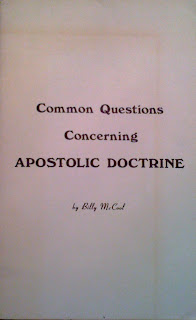
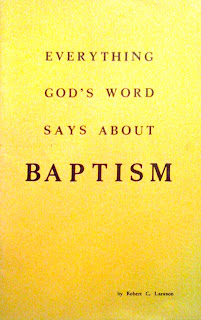
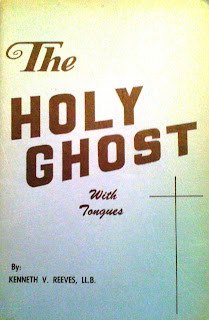
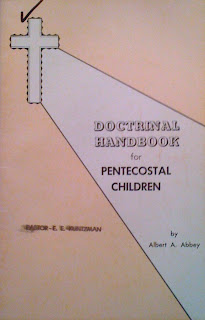
Here are some more pictures of pamphlets written by Oneness Pentecostal / Apostolic writers, which I took at my Grandmother’s home in South Bend, IN several years ago.


I read recently that if you want to change your generation you need to preach, but if you want to change future generations then write.  I’m thankful these authors wrote these pamphlets.


Originally posted on https://thepillarandgroundoftruth.blogspot.com/2012/12/more-pamphlets-from-apostolic-writers.html

Categories
Consider this...

The Gift

“A gift, to be a gift, has to be accepted. Otherwise it lies like a burden between people.”
–Robert Fisher, The Knight In Rusty Armor

I think that we are too casual in explaining the present of the Holy Ghost. Since it is in fact the Spirit of Christ in us, it is no wonder that He would be grieved by those who would not want Him in them. I think of those in the nominal church world who have the same access to the Holy Ghost as all of us in this age of grace and Holy Ghost outpouring, but who merely put it on a shelf and never unwrap it. The gift then lies unwrapped, unaccepted, and a burden.

My first date occurred at a banquet on February 14th, when I was twelve years old. I gave the young lady a present that night, which she accepted. However, later that evening, as she was preparing to go home, I misunderstood something she said. She wanted to go get her present, but I thought that she was saying something else. Consequently, she thought that I was refusing to let her keep the gift. To this day I think she still has little time for me and that event is a burden between two individuals.

LOL!! What a catastrophe!?!?

God is not like that. He not only gives a gift, but He never takes it back and He always knows exactly what we communicate – even when we don’t know how or what to say.

My grandfather began his journey towards God in the late 1940s. He had such an experience in repentance that he received the joy that the Samaritans had in Acts 8, but he had not received the Holy Ghost. His wife then met some Pentecostals and received the Holy Spirit. Grandpa would get upset with her at night because she spoke in tongues before going to bed at night and insisted that he needed more than what he had. It lay as a burden between them. Finally, Grandpa prayed to God and said that he knew he had all that God had for him, but to make his wife happy, would God let him speak in tongues. Instantly, the presence of God that he’d felt since his repentance left him. This was when he knew that God had more for him – it lay as a burden between him and God. He then cried out in repentance for His pride and God filled him with the Holy Ghost speaking in tongues.

Salvation is a gift that unless received in totality will be forfeit no matter who we are. Paul wrote about receiving the abundance of grace and the gift of righteousness, which is only accessible through Jesus Christ, who is our portion and free gift through grace (Ro. 5:21). Refusal of this gift, in this particular text, results in the refusal of eternal life.

Paul also wrote of the gift he was given charge of by the churches of Macedonia, who gave it to bless the Corinthian church (2 Cor. 8). I imagine that if this gift had been refused that there would have been ought among these two groups.

Unrequited love is often mentioned in literature and even God Himself is mentioned by some as a jilted lover covering His eyes in grief as His Jewish bride rejects Him and He then turns to the Gentiles for succor. I only know that He wept at their obtuseness and they became a people who had eyes but did not see. This rejection of Jesus still lies as a burden between God and the nation of Israel as a whole, but, praise God, Israel did not stumble to fall. I believe that the burden will be lifted when they look on Him whom they pierced and acknowledge Him as Messiah.

We call it the gift of the Holy Ghost and it is, by one man’s estimation, being received by 35,000 people a day throughout the world. Why wouldn’t people want to receive this phenomenon that Christ has paid for with His blood and made available to all people?


Originally posted on 20 March 2008 on https://thepillarandgroundoftruth.blogspot.com/2008/03/gift.html

Categories
church history

Pre-1900 Examples of Apostolic Doctrine in North America

The following is derived from a symposium paper co-authored by Stewart A. Bertram and myself in the Spring of 2005 and presented to Parkersburg Bible College (Parkersburg, WV) during their annual colloquium.

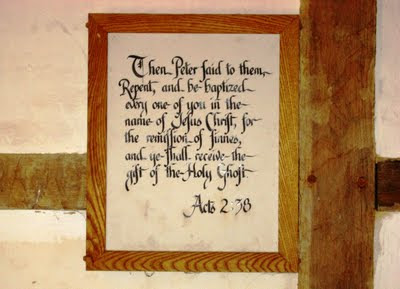
The oldest permanent English settlement in America was established on April 26, 1607, in Jamestown, Virginia. This plaque was posted on the wall of the lobby of the first church built there – Acts 2:38.

History undeniably records various elements of distinctly Orthodox Apostolic doctrine in North America as early as 1677, which was only 70 years after the first permanent settlement was established in Jamestown.[1]  What we will attempt to show is a chronological outline of these various apostolic doctrines and practices as they appear in the index of North American history.  While many will view this as a restoration of Apostolic Pentecostal experience we maintain that it actually proves the continued existence and growth of the orthodox teaching of the book of Acts.  We further assert that there have always been pockets of true believers in every century following and obeying the true message of the New Birth.  Some examples record partial alignment with the Apostles’ doctrine, the following is a list of some of those instances:

  • Society of Friends (Quakers) – “…our tongues loosed and our mouths opened, and we spake with new tongues as the Lord gave utterance, and as His Spirit led us.”[2]
  • John Wesley (1703-1791) – “What so impressed and encouraged John Wesley and his followers, what so shocked, startled, and bewildered his contemporaries, is no mystery to the modern psychologist, to whom it is known as glossolalia…”[3]
  • Charles G. Finney (1783-1875) – “I received a mighty baptism in the Holy Ghost…No words can express the wonderful love that was shed abroad in my heart.  I wept aloud with joy and love; and I do not know but I should say, I literally bellowed out the unutterable gushings of my heart.”[4]
  • John Miller – a Presbyterian minister wrote Is God a Trinity in 1876 and “believed that the doctrine of the trinity was not biblical and that it greatly hindered the Church….He emphatically declared the full deity of Jesus Christ.”[5]
  • D. L. Moody (1837-1899) – According to R. A. Torrey, Moody’s friend and associate, he once witnessed Moody walk to the pulpit to preach but instead of addressing the crowd in English he began to speak in another language.  This occurred one more time before he was able to gain control and preach to the audience, but “only after much prayer and praise.”[6]
  • Lowell, Ohio (1835) – a group of Camisards and/or French Huguenots establish an Orthodox Apostolic Acts 2:38 believing Church, but article IX of the church constitution changes the baptismal formula from Jesus’ name to the trinitarian formula in 1847.  In 1980 Dr. Nelson preaches the Apostolic message to the congregation and they convert back to the orthodox message of Acts 2:38.[7]
  • Dan Huntington (1850) – baptized people in Boston, Massachusetts in Jesus’ name.[8]
  • Canada (1854) – “There was an organization of Acts 2:38 clergymen in Canada.”[9]
  • America (1865) – More than 160,000 Americans spoke in tongues.[10] [11]
  • Alvin E. Velie (1884-1904) – all pre-1900:[12]

1)      Wrote the book Safety First Acts 2:38.

2)      Baptized over 1,500 people in Jesus’ name in Wisconsin.

3)       Preached in various locations along the Mississippi River.

4)      Preached a considerable amount of the time in the Salvation Army.

  • Charles Fox Parham – “the first leader in the twentieth century Pentecostal movement, began to administer water baptism in Jesus’ name, although he apparently did not link this practice with an explicit denial of trinitarianism.”[13]  Parham also “formulated the basic Pentecostal doctrine of ‘initial evidence’ after a student in his Bethel Bible School, Agnes Ozman, experienced glossolalia in January, 1901.”[14] 

[1] Weisser, Thomas. After the Way Called Heresy. 1981.

[2] Bresson, Bernard L. Studies in Ecstasy. New York: Vintage Press. 1966. p. 48-52.

[3] Bowen, Marjorie. Wrestling Jacob: a study of the life of John Wesley. London: Watts & Co. 1948.

[4] Finney, Charles G. Memoirs of Charles G. Finney, being an Autobiography. New York.
1876.

[5] Bernard, David K. The Oneness of God. Hazelwood: Pentecostal Publishing House. 1993. 31 May 2005.

[6] Darbee, Lennard. Tongues: the Dyanmite of God.

[7] Nelson, Joseph. Church History. Parkersburg Bible College. Lecture given and Church Constitution shown to class on 18 November 2002.

[8] Synan, V. Aspects of Pentecostal-Charismatic Origins, NJ: Logos. 1975.

[9] Arnold, Marvin M.  Apostolic History Outline. Arno Publications, Inc. 1985.

[10]Ibid.

[11] Blunt, John H. Dictionary Of Sects, Heresies, Ecclesiastical Parties, And Schools Of Religious Thought. Ann Arbor: Gryphon Books. 1971.

[12] Nelson, Joseph. Church History. Parkersburg Bible College. Lecture on 18 November 2002.

[13] Bernard, David K. The Oneness of God. Hazelwood: Pentecostal Publishing House. 1993. 31 May 2005.

[14] Synan, V. Pentecostalism. 16 April 2005. http://mb-soft.com/believe/txc/pentecos.htm.

[Originally posted on 17 August 2011 on https://thepillarandgroundoftruth.blogspot.com/2011/08/pre-1900-examples-of-apostolic-doctrine.html]

Categories
Bible Teaching

The Recovery of Purity

Romans 5:12-21
12  Wherefore, as by one man sin entered into the world, and death by sin; and so death passed upon all men, for that all have sinned:
13 (For until the law sin was in the world: but sin is not imputed when there is no law.
14 Nevertheless death reigned from Adam to Moses, even over them that had not sinned after the similitude of Adam’s transgression, who is the figure of him that was to come.
15 But not as the offence, so also is the free gift. For if through the offence of one many be dead, much more the grace of God, and the gift by grace, which is by one man, Jesus Christ, hath abounded unto many.
16 And not as it was by one that sinned, so is the gift: for the judgment was by one to condemnation, but the free gift is of many offences unto justification.
17 For if by one man’s offence death reigned by one; much more they which receive abundance of grace and of the gift of righteousness shall reign in life by one, Jesus Christ.)
18 Therefore as by the offence of one judgment came upon all men to condemnation; even so by the righteousness of one the free gift came upon all men unto justification of life.
19 For as by one man’s disobedience many were made sinners, so by the obedience of one shall many be made righteous.
20 Moreover the law entered, that the offence might abound. But where sin abounded, grace did much more abound:
21 That as sin hath reigned unto death, even so might grace reign through righteousness unto eternal life by Jesus Christ our Lord.

In the beginning God made Man perfect and complete in His image and after His likeness (Gen. 1:26).

Man (Adam & Eve) was absolute in his spirit, soul, & body.

ABSOLUTE = “Perfect in quality or nature; complete. Not mixed; pure. Something regarded as the ultimate basis of all thought and being.” [1]

Synonyms include “unadulterated, undiluted, uncontaminated, total, unconditional, unquestionable finality, unequivocal, definite, sure.”[2]

There are absolutes of truth, which are held by all true orthodox Christians (Christians who follow the teachings of Jesus, first century Apostles, and the prophets), and these truths include:

  1. The eternality of the Word of God: “For Ever, O LORD, thy word is settled in heaven” (Ps. 119:89).
  2. One God
  3. The Bible standard of salvation: “…Repent, and be baptized every one of you in the name of Jesus Christ for the remission of sins, and ye shall receive the gift of the Holy Ghost” (Acts 2:38).
  4. The necessity of the “born again” experience: “Jesus answered…Except a man be born again, he cannot see the kingdom of God” (Jn. 3:3).

With the existence of these (and other) absolutes, there is also another truth. The devil wishes to pervert the beauty of Man’s original design and separate him completely from his Maker.

The spirit of perversion is at work today and began with Lucifer and his rebellion against God, moved to the Garden of Eden and the serpent’s tactic of questioning and corrupting the relationship between Man and God.

PERVERSION in 1388 was defined as “action of turning aside from truth, corruption, distortion (originally of religious beliefs).”[3]

This is the devil’s tactic; to subvert, corrupt, bend, misshape, and distort what God calls “good” into something perverse. Perversion is not, of necessity sexual in connotation, but it is the turning of something pure into a wrong use.

The Fall of Man resulted in the perversion of our original state into a nature – – the Adamic nature. Because Man has fallen so far from his original state we find examples in the bible of many types of perverseness (one such illustration is the Jezebel spirit found in 1 Kings 16:31-21:252 Kings 9:7-37; & Rev. 2:20-23). Trinitarianism, cessationism, & the Jezebel spirit are all perversions, but Jesus has given the Church the power and authority to help bring those stuck in error back to completeness in God and in truth.

Sin is the state of perversion from the original design and purpose of Man. The account of the Good Samaritan can be viewed as Jesus’ attempt to warn the Apostles and Church of the dangers of perversion.

Jesus came to return what was once perverted back to its original state, by His love: “For when we were yet without strength, in due time Christ died for the ungodly. For scarcely for a righteous man will one die: yet peradventure for a good man some would even dare to die. But God commendeth his love toward us, in that, while we were yet sinners, Christ died for us” (Ro. 5:6-8).

Because of Jesus Christ we now have the opportunity to walk in right relationship with Him. You’ve never met a man like Jesus. He never withdrew Himself from the lost sinners of the world (as many in the church do once they are “saves”). Instead, He went to the perverted (in spirit, soul, and body) who were looking for a change and a return to purity. He did not condemn the world, but He saved it through the work of redemption and reconciliation. He did not revile the perverse, but He removed the crookedness in them and returned them to a state of completeness. He, as the Potter, took the misshapen clay and created vessels of honor. Jesus heals, delivers, sets the captive free, restores broken homes, and places His love into right relationships.

Although tempted in all things, Jesus is our perfect example of a sinless life, and His obedience is what has reconciled Man to God. This ministry of reconciliation is the recovery of purity in our relationship with God.

“Therefore if any man be in Christ, he is a new creature: old things are passed away; behold, all things are become new. And all things are of God, who hath reconciled us to himself by Jesus Christ, and hath given to us the ministry of reconciliation; To wit, that God was in Christ, reconciling the world unto himself, not imputing their trespasses unto them; and hath committed unto us the word of reconciliation. Now then we are ambassadors for Christ, as though God did beseech you by us: we pray you in Christ’s stead, be ye reconciled to God. For he hath made him to be sin for us, who knew no sin; that we might be made the righteousness of God in him” (2 Cor. 5:17-21).

[Originally Posted on 27 October 2007. http://thepillarandgroundoftruth.blogspot.com/2007/10/recovery-of-purity.html]
____________
SOURCES:
[1] Absolute. (n.d.). The American Heritage® Dictionary of the English Language, Fourth Edition. Retrieved October 26, 2007, from Dictionary.com website: http://dictionary.reference.com/browse/absolute
[2] Absolute. (n.d.). Dictionary.com Unabridged (v 1.1). Retrieved October 26, 2007, from Dictionary.com website: http://dictionary.reference.com/browse/absolute
[3] Perversion. (n.d.). Online Etymology Dictionary. Retrieved October 26, 2007, from Dictionary.com website: http://dictionary.reference.com/browse/perversion

Categories
Bible Teaching

The Promise

Text: John 14:15-26, “(15) If ye love me, keep my commandments.  (16)  And I will pray the Father, and he shall give you another Comforter, that he may abide with you for ever;  (17)  Even the Spirit of truth; whom the world cannot receive, because it seeth him not, neither knoweth him: but ye know him; for he dwelleth with you, and shall be in you.  (18)  I will not leave you comfortless: I will come to you.  (19)  Yet a little while, and the world seeth me no more; but ye see me: because I live, ye shall live also.  (20)  At that day ye shall know that I am in my Father, and ye in me, and I in you.  (21)  He that hath my commandments, and keepeth them, he it is that loveth me: and he that loveth me shall be loved of my Father, and I will love him, and will manifest myself to him.  (22)  Judas saith unto him, not Iscariot, Lord, how is it that thou wilt manifest thyself unto us, and not unto the world?  (23)  Jesus answered and said unto him, If a man love me, he will keep my words: and my Father will love him, and we will come unto him, and make our abode with him.  (24)  He that loveth me not keepeth not my sayings: and the word which ye hear is not mine, but the Father’s which sent me.  (25)  These things have I spoken unto you, being yet present with you.  (26)  But the Comforter, which is the Holy Ghost, whom the Father will send in my name, he shall teach you all things, and bring all things to your remembrance, whatsoever I have said unto you.”

Isaiah 55:10-11, “For as the rain cometh down, and the snow from heaven, and returneth not thither, but watereth the earth, and maketh it bring forth and bud, that it may give seed to the sower, and bread to the eater: So shall my word be that goeth forth out of my mouth: it shall not return unto me void, but it shall accomplish that which I please, and it shall prosper in the thing whereto I sent it.”

            God’s Word is forever settled in Heaven and will accomplish its goal.  God generally offers two types of promise in the Bible:

  1. Unconditional – The promises to Abraham, Isaac, and Jacob did not depend on any future action on their part because they were unconditional and would come to pass regardless of anything that these men did or didn’t do:
    • Joel 2:28-29, “And it shall come to pass afterward, that I will pour out my spirit upon all flesh; and your sons and your daughters shall prophesy, your old men shall dream dreams, your young men shall see visions: And also upon the servants and upon the handmaids in those days will I pour out my spirit.”
    • Isaiah 28:11-12, “For with stammering lips and another tongue will he speak to this people.  To whom he said, This is the rest wherewith ye may cause the weary to rest; and this is the refreshing: yet they would not hear.”
  2. Conditional – The Bible contains “ifthen” statements.  These are requirements that you must meet to receive the promise.  They represent future acts that must be obeyed to receive the full promise:
    • 2 Chronicles 7:14, “If my people, which are called by my name, shall humble themselves, and pray, and seek my face, and turn from their wicked ways; then will I hear from heaven, and will forgive their sin, and will heal their land.
    • Acts 2:37-39, “Now when they heard this, they were pricked in their heart, and said unto Peter and to the rest of the apostles, Men and brethren, what shall we do? Then Peter said unto them, Repent, and be baptized every one of you in the name of Jesus Christ for the remission of sins, and ye shall receive the gift of the Holy Ghost. For the promise is unto you, and to your children, and to all that are afar off, even as many as the Lord our God shall call.”

Often the question is asked, “Why Tongues?”[1]

  1. God is not accountable to us for what He chooses to so.  He is Sovereign, Creator, Sustainer, Redeemer, Savior…
  2. Tongues is an initial external sign that must be followed by the fruit of the Spirit.
    1. Gal. 5:22-23, “…the fruit of the Spirit is love, joy, peace, longsuffering, gentleness, goodness, faith, Meekness, temperance…”
    1. John 3:8, “The wind bloweth where it listeth, and thou hearest the sound thereof, but canst not tell whence it cometh, and whither it goeth: so is every one that is born of the Spirit.”
  3. It is the consistent pattern of evidence established by God as essential in the New Birth:
    1. 1 Corinthians 12:13, “For by one Spirit are we all baptized into one body, whether we be Jews or Gentiles, whether we be bond or free; and have been all made to drink into one Spirit.”
  4. The tongue is the most unruly member of the body and when you receive the Holy Ghost speaking in tongues you are allowing God to control the most expressive part of your personality.  Man’s expression of emotion, intelligence, and communication is articulated through the tongue.

It’s just for the Apostles and Early Church:

            Irenaeus (died 202) ~ “In like manner we do also hear many brethren in the Church, who possess prophetic gifts, and who through the Spirit speak all kinds of languages, and bring to light for the general benefit the hidden things of men, and declare the mysteries of God.”[2]

            Hildegard of Bingen (1098-1179) ~ “sang in unknown words with such facility and winsomeness that her utterances were known as ‘concerts in the Spirit’.”[3]

            The Waldenses (c. 1217) ~ these followers of Peter Waldo believed in visions and prophecies.[4] Both healing and speaking in tongues were manifested among these heavily persecuted Christians.[5]

            Early Quakers ~ “We received often the pouring down of the Spirit upon us, and our hearts were made glad and our tongues loosed and our mouths opened, and we spake with new tongues as the Lord gave utterance, and as His Spirit led us.”[6]

            John Wesley ~ People in Wesley’s meetings would be filled with the Holy Ghost while he preached.[7]

                    Thomas Walsh (one of Wesley’s foremost preachers) made this entry in his diary; “This morning the Lord gave me a language that I knew not of, raising my soul to Him in a wonderful manner.”[8]

                    In England (1830) there was a revival under Edward Irving where gifts of the Spirit were manifested. One member of the congregations writes: “The moment I am visited with the Spirit, and carried out to God in a tongue which I know not… I am more conscious than ever of the presence of God. He and He alone is in my soul. I am filled with some form of the mind of God, be it joy or grief, desire, love, pity, compassion, or indignation; and I am made to utter it in words which are full of power over my spirit, but not being accessible to my understanding, my devotion is not interrupted by association of suggestions from the visible or intellectual world: I feel myself, as it were, shut in with God in His pavilion, and hidden close from the invasions of the world, the devil, and the flesh.”[9]

                    Charles G. Finney ~  “I received a mighty baptism in the Holy Ghost…No words can express the wonderful love that was shed abroad in my heart. I wept aloud with joy and love; and I do not know but I should say, I literally bellowed out the unutterable gushings of my heart.”[10]

                    D. L. Moody ~ “One the following Sunday night, when I got to the rooms of the Y.M.C.A. I found the meetings on fire. The young men were speaking in tongues and prophesying. What on earth did it all mean? Only that Moody had been addressing them that afternoon.”[11] At a meeting in Los Angeles, Dr. R.A. Torrey told of a service in London where Moody took the pulpit to preach and instead broke into another language. He tried again, with similar results. The third time, after prayer and praise, he was able to preach his message.[12]

                    Charles H. Spurgeon ~ a British preacher told how Spurgeon once asked his audience to forgive him that when he got especially happy in the Lord, “I break forth into a kind of gibberish which I do not myself understand.”[13]

How Do I Receive this Phenomenon of the Holy Ghost?[14]

  1. Prepare your heart by obeying Acts 2:38 (Repent).
  2. Understand that God wants you to receive His gift as much as you want it…just ask Him for the Holy Ghost: “If ye then, being evil, know how to give good gifts unto your children: how much more shall your heavenly Father give the Holy Spirit to them that ask him?” (Luke 11:13)
  3. You must be hungry to receive His Spirit.
    1. Matthew 5:6, “Blessed are they which do hunger and thirst after righteousness: for they shall be filled.”
    1. James 4:8, “Draw nigh to God, and he will draw nigh to you. Cleanse your hands, ye sinners; and purify your hearts, ye double minded.”
  4. Expect to receive: “And when Paul had laid his hands upon them, the Holy Ghost came on them; and they spake with tongues, and prophesied” (Acts 19:6).
  5. Believe to receive: John 7:38-39, “He that believeth on me, as the scripture hath said, out of his belly shall flow rivers of living water.  (But this spake he of the Spirit, which they that believe on him should receive: for the Holy Ghost was not yet given; because that Jesus was not yet glorified.)”
  6. Relax!!

Promise of Christ’s Return:

            1 Corinthians 15:51-56, “51 Behold, I shew you a mystery; We shall not all sleep, but we shall all be changed, 52 In a moment, in the twinkling of an eye, at the last trump: for the trumpet shall sound, and the dead shall be raised incorruptible, and we shall be changed. 53 For this corruptible must put on incorruption, and this mortal must put on immortality. 54 So when this corruptible shall have put on incorruption, and this mortal shall have put on immortality, then shall be brought to pass the saying that is written, Death is swallowed up in victory. 55 O death, where is thy sting? O grave, where is thy victory? 56 The sting of death is sin; and the strength of sin is the law. 57 But thanks be to God, which giveth us the victory through our Lord Jesus Christ.”


[1] “Speaking In Tongues.” Various Authors. Retrieved 5-15-2005 from http://altupc.com/articles/tongues1.htm.

[2] Against Heresies, V,6,1, Ibid., vol 1, p. 531

[3] George H. Williams and Edith Waldvogel, “A History of Speaking in Tongues and Related Gifts,” in The Charismatic Movement, ed. by Michael P. Hamilton, p. 70

[4] R. Kissack, “Waldenses,” The New International Dictionary of the Christian Church, ed. by J.D. Douglas, revised edition, p. 1026

[5] Gordon F. Atter, The Third Force, p. 13

[6] Bresson, Studies in Ecstacy, pp. 48-52

[7] http://www.holyspiritinfo.net/ch_hist.htm

[8] Entry of March 8, 1750, quoted by Frodsham, With Signs following, p. 232

[9] A.L. Drummond, Edward Irving and His Circle, pp. 161-162

[10] Charles G. Finney, Autobiography, p. 20

[11] Boyd, Robert, The Lives and Labours of Moody and Sankey, p. 47

[12] Lennard Darbee, Tongues: The Dynamite of God, p. 24.

[13] Ibid. p.24

[14] Principles of Doctrine: Lesson 11. “Holy Spirit Baptism.” Parkersburg Bible College.

The Promise | 15 May 2005

Categories
Bible Teaching

Water Baptism in the Name of Jesus -James Anderson

“Water Baptism in the Name of Jesus”
Guest Author: James Anderson

This topic is often discussed, but I have been conversing with someone with an opposing view and here are some of my notes.

I would not say that there was a codified baptismal formula in the primitive church. Myself and most Oneness teachers should indicate it was developed, in some sense. However, I do believe that scripture and history indicate to us that the name of Jesus was invoked or implied, in literary devices, by or over the baptized. I think most scholars realize this but disallow it by marginalizing it to, now, include the Matthean titles (28:19; Father, Son, and Holy Spirit) and thus giving a sense of credibility to the Trinitarian method. If we study history accurately we should understand that no biblical or primitive NT believer was baptized using the titles. Biblical and historical evidence explicitly indicates that the name “Jesus” was actually used in baptism and not a recitation of the actual instruction of Christ in the Matthean passage, instead actual obedience to His instruction, e.g. “baptizing them…in the name…” (c.f. Matthew 28:19, NKJV).

In connection with this it is interesting to note the Lukan Great Commission as well. Luke records: “and that repentance and remission of sins should be preached in his name among all nations, beginning at Jerusalem.” (Luke 24:47, KJV) Both the Lukan and Matthean passages indicate that a single, known name was used in Christian baptism. As the below sources will show, this is the only form used by the Disciples and early believers.

The Anchor Bible Dictionary is a landmark work of scholarly thought. It clearly states:

“It is relatively certain that in the early Church one commonly referred to baptism as being done “into the name of the Lord Jesus”or “something similar.” (1)

The Bible knows of no Christian in the New Testament who had not been baptized, either by John or in the name of Jesus. Consequently, as modern New Testament believers we should feel compelled to follow that same Biblical method. Christian baptism was from the first administered “in the name of Jesus”. The trinitarian formula of merely repeating, not obeying or properly interpreting, Matthew 28:19 is not found in the scriptures. Anyone baptizing in titles or any other method that does not include the name of Jesus is without scriptural support, there is simply no text that demonstrates or gives license for such aberrations. Baptism identifies us with Jesus Christ and brings us into the Body of Christ, therefore it is logical to conclude that we should have the name of Jesus invoked over us in baptism.

The reason that we are baptized in Jesus’ name is that we are being baptized into Jesus. We are taking on his name, similar to the way a woman takes on her husband’s name at marriage. We are saying that we belong to Jesus and we are identifying with Him in His death and burial. Paul said, “Is Christ divided? Was Paul crucified for you? Or were you baptized in the name of Paul?” (1 Corinthians 1:13) Paul’s thinking here is to exalt the name of Jesus Christ. If we follow his logic it becomes obvious that he is telling the Corinthians that Christ was the one crucified for them and so they, too, were baptized in the name of Christ. The believers at Corinth as well as those in Rome were baptized in Jesus’ name.

We may contest that there was no EXACT formula for baptism in the New Testament, but such a statement is only partially true. As mentioned prior, in all occasions of baptism the name Jesus is used, in the name of the Lord or in the name of the Lord Jesus, etc. Whether “Christ” or “Lord” is used all the references refer directly to the only saving name—Jesus (Acts 4:12). How can we expect baptism to be efficacious for one if the name of Jesus is not invoked then? It seems then that anything else would be…unbiblical.

In Acts 22:16 we read, “And now why tarriest thou? arise, and be baptized, and wash away thy sins, calling on the name of the Lord.” (Acts 22:16, KJV) There is other debates concerning this passage, but none as relevant as the one we are discussing now. The Greek word for “calling” here is epikaleomai. This word is defined “idiomatically, denoting that one person belongs to another whose name is attached to him…literally have someone’s name called on someone, i.e. belong to,”(2) Therefore, the name of Christ is important in every sense of salvation and not just in professing Him as Lord. This name should be “called on” as we are baptized into Christ; we arise with His name attached to us and are His people.

Epikaleomai is used to mean a literal invoking in several New Testament passages. In Acts 9 we see the story of Paul after being blinded on the road to Damascus, “And here he has authority from the chief priests to bind all who call on Your name. (15) But the Lord said to him, Go, for he is a chosen vessel of Mine to bear My name before Gentiles, kings, and the children of Israel. (16) For I will show him how many things he must suffer for My name’s sake.” Acts 9:14-16 NKJV

The early Christians were preaching and baptizing in the name of Jesus. They literally uttered the words, there was no non-verbal reflection upon the name—it was a literal calling on the name of Jesus. Paul (formerly Saul) was commissioned by the Priests to persecute those who were calling on the name of Jesus. After being blinded Paul is taken to Ananias. Ananias is told by the Lord that Paul is a “chosen vessel” to “bear” the name of Jesus to the Gentiles. Paul also was to suffer for this name. The name of Jesus is so intrinsically involved in the process of salvation and our subsequent lives, how can we, then, abandon this name at our baptism?

Some assume that the trinitarian formula for baptism, which invokes the titles—Father, Son, and Holy Spirit–are indeed the biblical method. This may cause one to ask, “Was the trinitarian formula used in New Testament times?” The International Standard Bible Encyclopedia answers this for us:

No record of such use can be discovered in the Acts or the epistles of the apostles. The baptisms recorded in the New Testament after the Day of Pentecost are administered “in the name of Jesus Christ” (Acts 2:38), “into the name of the Lord Jesus” (Acts 8:16), “into Christ” (Rom 6:3; Gal 3:27).” (3)

James Hastings indicates:

“The original form of words was ‘into the name of Jesus Christ’ or ‘the Lord Jesus.’ Baptism into the name of the Trinity was a later development.”(4)

Self-admittedly then trinitarians confess that the form of words used in an oral invocation in the rite of baptism was done by, the very least, using the name of Jesus, in some sense. Signifying that the Apostles as well as those following their death used the saving Name—Jesus.

Often the words, “in” or “into” are used with being baptized in or into the name of Jesus. Both terms are prepositions which are used to connect nouns or pronouns in an adjectival or adverbial sense. Example: the babe lying in a manger, the sun sets in the west. They denote being in or into something, such as baptized into or in the name of Jesus. When used in an adjectival or descriptive sense it is describing the method or the how of what is being said. How were the early Christians baptized? Answer: in the name of Jesus. Therefore, we enter into or in the power or person of Jesus by using His name.

In the New Testament, specifically in the historical book of Acts we see baptisms that involve an actual verbal invocation using wholly, partly, or by implications (Lord) the name of Jesus. Otto Heick a church historian wrote in his book, “A History of Christian Thought” (1,53), that “At first baptism was administered in the name of Jesus, but gradually in the name of the Triune God: Father, Son, and Holy Spirit.” Today, as modern New Testament believers, it is imperative that we hold the teachings of scripture paramount, rather than relying too heavily upon extra-biblical sources or church councils, creeds, dogmas and catechisms. When we stand before God in the Day of Judgment, we will be accountable to His Word.

In Acts 4:12 Peter uses the word “must” which is the Greek preposition dei. In this passage it literally means “it is necessary.”(5) “Must” here is an emphatic word indicating compelling necessity and it is joined with “name” which is part of the “must.” Not only is there only one way to get salvation, e.g. through Jesus Christ, but there is only one saving name in baptism—Jesus Christ.

Many New Testament passages speak of healing done in Jesus’ name (Acts 3:6, 16; 4:9–10), signs and wonders through His name (4:30). Some preached in His name (8:12) or spoke boldly in His name (9:27–28). This being so, it seems that historical and theological bias exist in order to assert that baptism is not to be done by invoking the name of Jesus. Baptism in the name of Jesus was and still is the correct name to administer over one who is to be baptized or by the baptized. Historically and biblically, all competent accounts point us directly to Jesus name.

Here is a syllogism to conclude:

  1. Biblical and historical sources indicate that baptism was done by orally invoking, in some sense, the name “Jesus”. Further, the historical evidence confirms that extra-biblical change was made to include titles.
  2. The Bible also places soteriological emphasis on the name of Jesus that it “must” be a part of a believers experience.
  3. Therefore, it is logical to conclude, from evidence, that baptism in the name of “Jesus” is both valid and necessary.

NOTES:

1. Freedman, David Noel. The Anchor Bible Dictionary. New York: Doubleday, 1996, c1992.2. Friberg, T., Friberg, B., & Miller, N. F. (2000). Vol. 4: Analytical lexicon of the Greek New Testament. Baker’s Greek New Testament library (Page 164). Grand Rapids, Mich.: Baker Books.
3. “Baptism” International Standard Bible Encyclopedia, Electronic Database Copyright (c)1996 by Biblesoft
4. “Baptism” IV (a.) A Dictionary of the Bible, Edited by James Hastings, M.A., D.D., Vol. 1, Hendrickson Publishers, Inc.
5. Exegetical Dictionary of the New Testament © 1990 by William B. Eerdmans Publishing Company. All rights reserved

[Originally posted on 9 May 2007 at http://thepillarandgroundoftruth.blogspot.com/2007/05/water-baptism-in-name-of-jesus.html]

Categories
Bible Preaching

Receiving the Promise

Apostolic Life Cathedral | 1/9/2022, 10:00 AM
Categories
Bible Preaching

When Two Worlds Collide

Apostolic Life Cathedral | 3/23/2022, 7:00 PM