1 Timothy 3:15, "...that thou mayest know how thou oughtest to behave thyself in the house of God, which is the church of the living God, the pillar and ground of the truth."
None of the twelve did what they knew needed to be done.
Why?
Because there had arisen among them a contention, a strife, an argument, about which of them should be considered the greatest (Luke 22:24).
They had begun to compare themselves with one another, and Scripture reminds us that this is never wise.
They were jockeying for position. Their egos had risen to the surface, revealing something deeper within them: pride, self-importance, and assumptions of superiority. They were so concerned with who was greatest that they overlooked the opportunity to serve one another.
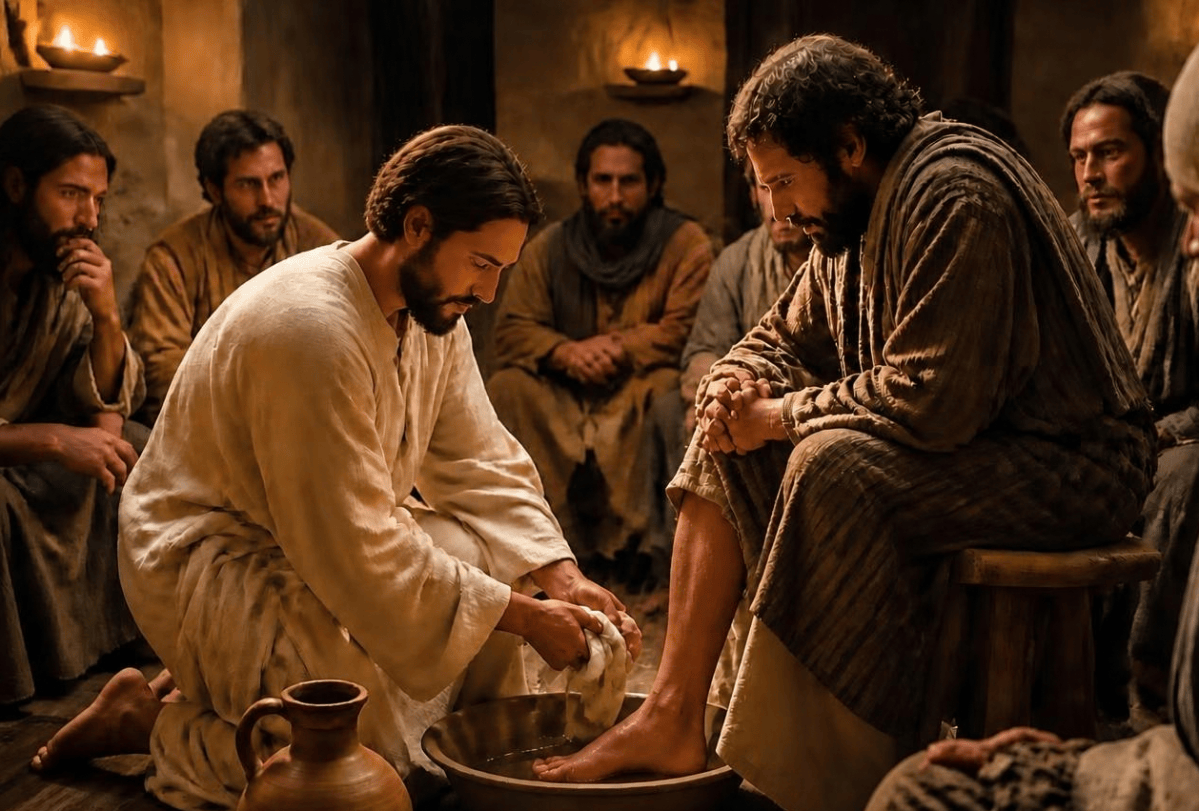
The towel was there. The basin was there. The pitcher was there. But no one picked them up. None of the twelve knelt.
So Jesus did.
Jesus, God in the flesh, took the towel, the basin, and the pitcher, and He knelt before them as a servant and washed their feet.
Jesus wasn’t trying to put His humility on display. He was demonstrating what true love looks like.
Love serves. Love stoops. Love takes the position nobody else wants. Love doesn’t need recognition. Love simply does what needs to be done.
Not long before this, a woman had washed Jesus’ feet with her tears and anointed them with costly perfume. Her love had been expressed through extravagant, devoted service. Now Jesus would take that same posture of love and demonstrate it to His disciples.
The Master knew His hour had come. He knew the cross was waiting. He knew betrayal was coming. He knew suffering was coming.
And yet, knowing all of this, Jesus turned His attention toward the twelve He loved. And He loved them all (yes, even Judas).
Secure in His own identity, Jesus was not threatened by taking the position of a servant. There is power in knowing who you are, and you don’t have to prove yourself by the position you occupy.
You can serve. You can stoop. You can pick up the towel. You can carry the basin. You can pour the water. You can kneel. You can wash feet.
Because your identity isn’t diminished by serving someone else.
In fact, when you truly understand who you are, you realize that no assignment is beneath you.
The disciples were arguing about who would be greatest.
Jesus answered their argument without an argument. He picked up a towel.
They were thinking about thrones. Jesus was thinking about feet.
They were concerned about position. Jesus demonstrated servanthood.
They wanted to be recognized. Jesus chose to kneel.
And in one final lesson before the cross, Jesus taught them, and He teaches us, that before you ever sit on a throne to judge, you must first learn how to kneel with a towel, a basin, a pitcher and serve.
Because greatness in the Kingdom of God is not measured by how many people serve you, but by how willing you are to serve others.
Before there is a throne, there is a towel. Before there is a crown, there is a cross. And before you learn how to lead from a position of authority, you must learn how to kneel in the posture of love.
There’s much to consider when we discuss what makes a good preacher.
My Uncle Mark talked about the importance of wrestling for the mind of the people when we stand behind the sacred desk and preach a message.
It is that space between the lips of the preacher and the ears of the listeners where the struggle intensifies and the anointing grapples with thoughts of sincere men and women.
Unfortunately, preachers sometimes are guilty of being out-of-touch with their generation, or as Carey Nieuwhof wrote: “Too many church leaders are perfectly equipped to reach a world that no longer exists.”
In his seminal work, J. T. Pugh addressed this issue by writing: “One of the secrets of David’s greatness was that he ‘served his generation.’ How sad and futile it is when a preacher persists in presenting the gospel in a format peculiar to another day. How useless it is to answer questions that a present, living generation is not asking. The key to deathly stagnation in any local assembly is a fervent Spirit-filled, God-called pastor, alert to the needs and hurts of this present age to, without compromise, present the healing word in communication that modern pagans can relate to.”
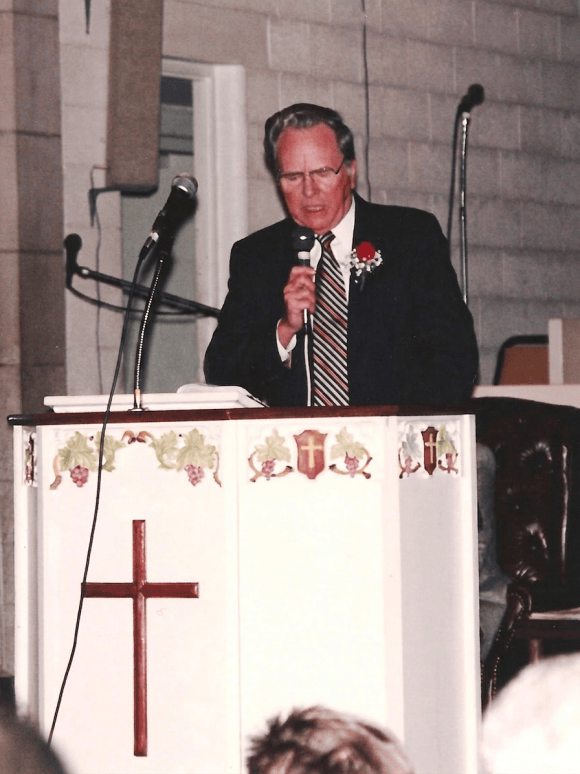
J T Pugh at Zion Tabernacle (Kokomo, IN) in 1993
The following collection of notable quotes offer key insight for the preacher who is wrestling for the mind of the people and striving to serve their generation well.
Bishop James E. Tyson taught the “3 B’s of Preaching: 1. Be Anointed. – 2. Be Brief. – 3. Be Seated.”
J. T. Pugh: “Sermons that are not revealed to the preacher cannot be revealed to the people.”
J. T. Pugh: “You may learn how to preach sermons but you will never be a minister without suffering.”
I like this definition offered by Raymond Woodward: “Preaching is the anointed declaration of Truth. Teaching is the anointed explanation of Truth.”
Richard Baxter wrote, “I preached as never sure to preach again, and as a dying man to dying men.”
James Lumpkin, Sr. said, “A prayerless preacher builds a powerless pulpit and a troublesome pew.”
Vance Havner had a few things to say about the preacher and preaching:
“A preacher should have the mind of a scholar, the heart of a child, and the hide of a rhinoceros. His problem is how to toughen his hide without hardening his heart.”
“If we preach the whole counsel of God, we shall be accused of extremism, not only by the world but also by a professing church that cannot endure sound doctrine.”
“We have suffered from the preaching of cheap grace. Grace is free, but it is not cheap. People will take anything that is free, but they are not interested in discipleship. They will take Christ as Savior but not as Lord.”
Leonard Ravenhill: “Prophets may have miracles, but they must have a message.”
T.F. Tenney left these two poignant thoughts:
“No man with wet eyes will ever preach a dry sermon.”
“Preach every sermon like your son was sitting on the back seat giving church one last chance.”
I heard Rex Johnson once time say that there are three things every minister needs to do: 1. Stay clean – 2. Love people – 3. Preach when necessary
There there is the inimitable Charles H. Spurgeon:
“Preach Christ, and Christ, and Christ, and Christ, and nothing else but Christ.”
“No Christ in your sermon, sir Then go home, and never preach again until you have something worth preaching.”
Alistair Begg: “Unfortunately, preachers who distort God’s Word are all too common today. Sometimes this springs from a sincere desire to soften hard hearts, but hearts aren’t changed by compromise.”
Alistair Begg: “The truth is that we are not good people who make mistakes; we are sinful people in need of mercy. Because it requires humility to accept what our hearts are truly like, those same hearts will tend to prefer to be deceived by preachers of self-esteem and self-confidence rather than listen to prophets such as Jeremiah.”
The beloved Lee Stoneking connects anointing to preaching: “Inspiration does not break the yoke of bondage. Only the anointing breaks the yoke of bondage.”
G. T. Haywood wrote the following in “Do All In Jesus’ Name” (1923):
“Preach in Jesus name, teach in Jesus name,
Heal the sick in His name and always proclaim
It was Jesus’ Name in which the power came;
Baptize in His Name, enduring the shame,
For there is vict’ry in Jesus’ name.”
Johnny James: “When preaching is done like it is supposed to be done, the sinner is evangelized, the saint is edified and the Lord is glorified.”
in Romans 10:13-15, the Apostle Paul emphasized the beauty of a true preacher of God’s Word:
“For whosoever shall call upon the name of the Lord shall be saved. How then shall they call on him in whom they have not believed? and how shall they believe in him of whom they have not heard? and how shall they hear without a preacher? And how shall they preach, except they be sent? as it is written, How beautiful are the feet of them that preach the gospel of peace, and bring glad tidings of good things!”
For me, a good preacher is one who follows what James Lumpkin, Sr. called the Prophet’s Creed (Micah 6:8): “He hath shewed thee, O man, what is good; and what doth the LORD require of thee, but to do justly, and to love mercy, and to walk humbly with thy God?”
Paul wanted Timothy to witness the eternal significance of good preaching: “(1) I charge thee therefore before God, and the Lord Jesus Christ, who shall judge the quick and the dead at his appearing and his kingdom; (2) Preach the word; be instant in season, out of season; reprove, rebuke, exhort with all longsuffering and doctrine. (3) For the time will come when they will not endure sound doctrine; but after their own lusts shall they heap to themselves teachers, having itching ears; (4) And they shall turn away their ears from the truth, and shall be turned unto fables”(2 Timothy 4:1-4).
Our Lord Jesus Christ is our example (Luke 4:14-31):
“(14) And Jesus returned in the power of the Spirit into Galilee: and there went out a fame of him through all the region round about. (15) And he taught in their synagogues, being glorified of all. (16) And he came to Nazareth, where he had been brought up: and, as his custom was, he went into the synagogue on the sabbath day, and stood up for to read. (17) And there was delivered unto him the book of the prophet Esaias. And when he had opened the book, he found the place where it was written, (18) The Spirit of the Lord is upon me, because he hath anointed me to preach the gospel to the poor; he hath sent me to heal the brokenhearted, to preach deliverance to the captives, and recovering of sight to the blind, to set at liberty them that are bruised, (19) To preach the acceptable year of the Lord. (20) And he closed the book, and he gave it again to the minister, and sat down. And the eyes of all them that were in the synagogue were fastened on him. (21) And he began to say unto them, This day is this scripture fulfilled in your ears. (22) And all bare him witness, and wondered at the gracious words which proceeded out of his mouth. And they said, Is not this Joseph’s son? (23) And he said unto them, Ye will surely say unto me this proverb, Physician, heal thyself: whatsoever we have heard done in Capernaum, do also here in thy country. (24) And he said, Verily I say unto you, No prophet is accepted in his own country. (25) But I tell you of a truth, many widows were in Israel in the days of Elias, when the heaven was shut up three years and six months, when great famine was throughout all the land; (26) But unto none of them was Elias sent, save unto Sarepta, a city of Sidon, unto a woman that was a widow. (27) And many lepers were in Israel in the time of Eliseus the prophet; and none of them was cleansed, saving Naaman the Syrian. (28) And all they in the synagogue, when they heard these things, were filled with wrath, (29) And rose up, and thrust him out of the city, and led him unto the brow of the hill whereon their city was built, that they might cast him down headlong. (30) But he passing through the midst of them went his way, (31) And came down to Capernaum, a city of Galilee, and taught them on the sabbath days.”
I believe Allan Oggs said that the greatest preacher in the world was not Peter, James, or John. The greatest preacher isn’t some world-famous pulpiteer whose name is known around the globe.
The greatest preacher in the world is a little short man who takes the pulpit of your mind and begins to preach to you like nobody else can.
That preacher is your conscience.
Your conscience can wrestle with your mind like no other preacher can. It knows your thoughts, motives, failures, compromises, and your spiritual condition.
He preaches a message of conviction calling you to renewal, crying for you to consecrate you heart and mind. He sees exactly where you are and his sermon somehow reaches when no one else’s can, because your conscience can reach you exactly where you are, and that is what is important in the making of a good preacher.
A good preacher is not merely someone who can get your attention to hear a sermon; a good preacher is someone who can get your conscience to hear from God and then make the changes necessary to come and submit your life to Jesus Christ.
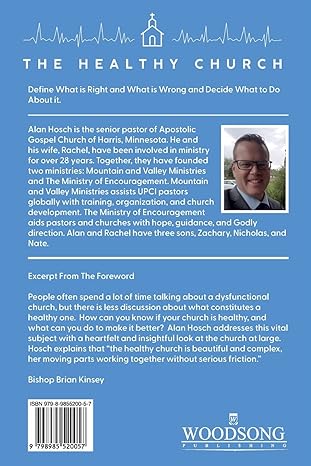
We were recently blessed, in West Virginia, by the ministry of Pastor Alan Hosch, and his wife, Rachel. He has been a senior pastor for 18 years and has served the last 14 years as senior pastor of Apostolic Gospel Church of Harris, Minnesota. The Hosch’s also have three sons and two daughters-in-law.
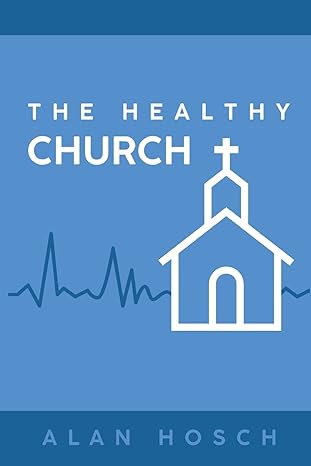
Alan & Rachel have a beautiful ministry of encouragement, especially for those in pastoral ministry. He is also a missionary to South Asia, a podcaster, a bi-vocational pastor and has recently written a book entitled The Healthy Church.
If you serve in any area of ministry The Healthy Church will be a blessing to you. I appreciate Pastor Hosch for having the burden and vision to write such a book because he is addressing issues that need addressed right now in the the Body of Christ.
As presbyter of section 4 in the West Virginia / Wester Maryland District of the United Pentecostal Church International (UPCI), it was my honor to host our section’s annual ministers and spouses Christmas banquet. Pastor Hosch and I were reacquainted at General Conference of the UPCI and after we spoke the Holy Spirit prompted me to ask him to be our guest speaker at the event. I am so glad he was able to oblige us because what he shared with over 60 the pastors, ministers and spouses richly blessed and encouraged them as he spoke on the necessity of refusing to allow the enemy to bind them and their ministries with thoughts of inadequacy and condemnation. If you need similar encouragement, read his book!
Pastor Hosch also has a podcast entitled: The Healthy Church Podcast, which contains over 20 episodes where he has interviewed many ministers from a wide variety of ministries and experiences. If you recognize these names then you will want to give the podcast a listen: Raymond Woodward, Aaron Soto, Jerry Dean, Brian Kinsey and others.
I was pleasantly surprised and honored when Pastor Hosch asked to interview me for the episode linked at the top of this page (and below). Normally, I would not be so bold as to post a podcast I’m in and ask everyone to listen to it, but I believe that Alan Hosch has been situated at a strategic time by God to ask questions, open topics and engage in dialogue that needs to be discussed in our movement.
Some questions in the interview:
What is the greatest challenge to the practical side and/or administration of the local church?
What is the greatest challenge to the spiritual side of local church ministry?
How does one use the Gifts of Wisdom and Knowledge to understandthe hidden struggles in the church?
Varying definitions of “inerrancy” exist today. However, an orthodox interpretation should include the idea that the Bible, when correctly interpreted, is completely truthful and accurate in all and every respect and that its original autographs are free from error. This paper is not exhaustive on the subject of “inerrancy” because there are so many paradigms to consider; however, one particular view that this paper considers is the “argument from animation.”
All Scripture is given by inspiration of God, and is profitable for doctrine, for reproof, for correction, for instruction in righteousness,2 Timothy 3:16 NKJV.
This paper presupposes that its readers understand and affirm the “divine inspiration” of Holy Scriptures. However, the phrase “given by inspiration of God” in 2 Timothy 3:16 is one Greek word, theopneustos. It literally means “God-breathed.”[1] If the book is God-breathed, then it is God’s Book and not just man’s book. In the Genesis 2 God formed man (Adam) from the dust of the ground, and breathed into his nostrils the breath of life, and man became a living soul. The body was present, created by God, but it was dead. It had no animation—no life. The difference here is between life and death.
We should not understand the Holy Scriptures as written merely by people but as breathed into by God (as in the case of the Adam). The words of the Bible came from God but were written by men. The apostle Peter affirmed this when he said that “prophecy never came by the will of man, but holy men of God spoke as they were moved by the Holy Spirit.” (2 Peter 1:21 NKJV). These men were literally “moved” (Grk. phero) to write or go into the destination that the Holy Spirit desired. It is as if the Holy Spirit picked them up in one place and carried them or bore them to another. They did not write by their own will, but were moved by the Spirit. These writings are living, not inanimate, and have the ability to encourage and convict the hearts of people.
It has been a common thing for non-believers to argue against the inerrancy of Scripture. In recent times, however, many Christian scholars have come to disallow in part or in whole the scriptural doctrine of inerrancy (Jack Rogers of Fuller Theological Seminary affirms limited inerrancy).[2] In view of this attack against the reliability, inspiration, and veracity of Scripture from those within and without the ranks of Christianity, it is important that Christians be able to defend and articulate the proper position on the inerrancy of Scripture against all attacks. Here is my personal statement on inerrancy; it is basically a modification of Article XII of the Chicago Statement on Biblical Inerrancy:
“When all facts are known, the Scriptures–the original autographs–properly interpreted will be shown to be wholly true in everything that they affirm whether that has to do with doctrine or morality or with the social, physical, or life sciences. We affirm that Scripture in its entirety is inerrant, being free from all falsehood, fraud, or deceit. This inerrancy is not limited to spiritual, religious, or redemptive themes, exclusive of assertions in the fields of history and science. Past, present, or future scientific hypotheses about earth history will not overturn the teaching of Scripture on creation and the flood.”
Without understanding or perhaps realizing their position many preachers or lay persons have made statements like this, “Well, the bible does not claim to be a science book so it may have some errors about biology or creation.” Such a statement is on par with “limited inerrancy” and should be avoided. If the bible is God’s book, and God is omniscient, it is only counterproductive to use such reasoning. Usually the faux pas is the fault of the exegete. Typically the texts are not interpreted properly or the translations make an error—not the original texts. In any case, all supposed biblical errors in English translations have a plausible explanation.
Another common argument against the true inerrancy of the Scripture is that man wrote the bible, man is errant, thus there must be mistakes in the bible. This is a circular argument. None of us would question the fact that George Washington was the first American president. Yet, we can only know this fact by reading the historical writings of men. Another attempt to undermine inerrancy is the change in certain terminology. Some scholars prefer the term “inerrancy” over “infallibility.” “Infallibility” is the “idea that Scripture is not able to lead us astray…”[3] This switch of terms, most likely, has to do with the insistence of some that one could have an infallible message while also having an errant biblical text.[4] Here, we should wonder if the critics really understand or affirm divine inspiration.
As Christ made no room in His claims to simply be a “good man” or a “good prophet”, so the Holy Scriptures affirm that all of Scripture is profitable for us (2 Timothy 3:16) and that all of it is “God-breathed.” Thus it is completely pure (Psalms 12:6), perfect (Psalms 119:96), and true (Proverbs 30:5). The Bible itself does not make any exclusions or special restrictions on the class of subjects to which it speaks truthfully or un-truthfully. As Jesus told us that He is “the way”, so the scriptures tell us that they are breathed by God Himself—they have life and animation by Him.
A denial of inerrancy presents us with the snowball effect. It begins like this, since the scriptures are indeed inspired of God, yet is not inerrant then it is possible that God has inspired lies. If God is a liar, and we are being made into God’s image should we expect to lie? This would lead us to wonder if we can really believe anything God says. Thus, by discounting certain passages as errant we are making the claim that we have a higher level of understanding and truth than God’s Word. Essentially we end up in a humanistic paradigm, where human reasoning has exalted itself above God. Therefore, we end up with Pandora’s Box and all of biblical doctrine subject to error and easily dismissed.
The Bible lets us know about its human authorship, but it also makes us aware of its divine authorship as well—dual authorship (2 Timothy 3:16, 2 Peter 1:21). The argument for Spirit animation, in my opinion, is a very strong argument—albeit significant others do exist. Dr. Elmer Towns, of Liberty University, says, “Since the process of inspiration is “in-breathing” God did more than breathe accurate content into the Bible, He breathed His Spirit into it.”[5] God is not a stranger to the supernatural. The Incarnation is accompanied by a virgin birth—a supernatural infusion of divinity and humanity. The Word of God should be seen as no less supernatural—an infusion of a divine author and human authors. Thus, we have a supernatural book. This supernatural book has the ability to transform lives. It is a supernatural book that has the power to convict, convince, and convert.
[1] Friberg, T., Friberg, B., & Miller, N. F. (2000). Vol. 4: Analytical lexicon of the Greek New Testament. Baker’s Greek New Testament library (Page 196). Grand Rapids, Mich.: Baker Books.
[2] Belief that the Bible is free of error only in its theological content, and not in its historical or scientific statements.
“…and the hypocrite’s hope shall perish” (Job 8:3b)
If you do a cursory google search for the phrase “I can’t stand hypocrites” you’ll find all kinds of results, from the shocking to the mundane. In fact, I use to say, quite emphatically, “I can’t stand a hypocrite!”
However, I’ve come to appreciate the necessity of those poor souls, and I can now stand hypocrites because of what they reveal.
Andrae Crouch wrote a line in the song “Through It All” that reminds me of the necessity of hypocrites:
So I thank God for the mountains And I thank Him for the valleys And I thank Him for the storms He’s brought me through For if I’d never had a problem I’d never know God could solve them I’d never know what faith in His word could do
Albert Barnes’ note on this passage: “That there were hypocrites even in that early age of the world. They are confined to no period, or country, or religious denomination, or profession. There are hypocrites in religion – and so there are in politics, and in business, and in friendship, and in morals. There are pretended friends, and pretended patriots, and pretended lovers of virtue, whose hearts are false and hollow, just as there are pretended friends of religion. Wherever there is genuine coin, it will be likely to be counterfeited; and the fact of a counterfeit is always a tribute to the intrinsic worth of the coin – for who would be at the pains to counterfeit that which is worthless? The fact that there are hypocrites in the church, is an involuntary tribute to the excellency of religion.”
Hypocrisy is actually a compliment to the authenticity of the Christian life. So, in a sense, we should thank God for the hypocrite. They remind us of the value of the true and the faithful.
So, I thank God for the hypocrites, for if I’d never met one then I’d never truly know the value of the authentic in comparison to the fake.
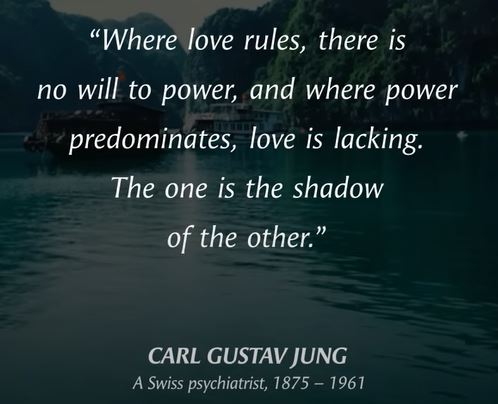
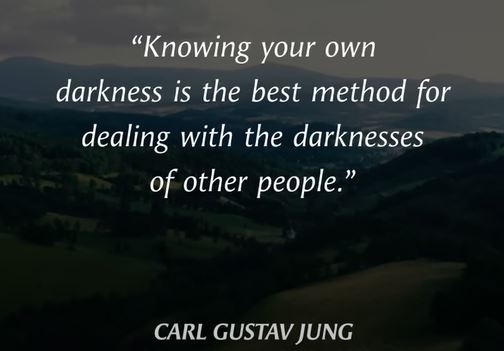
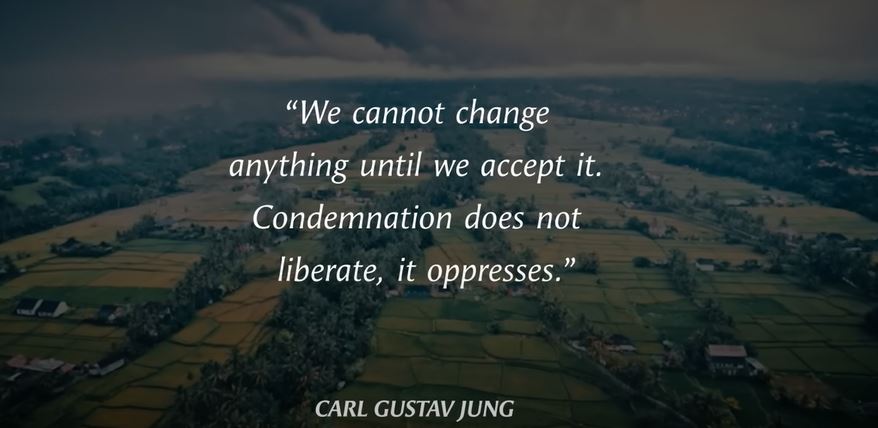
I’ve taken the liberty to capture some screenshots of the various quotes attributed to Carl Gustav Jung and collected in the video above, which was made by Quotes.
My interest in Rollo May began when I read that he received training in divinity as well as psychoanalysis. At that time I began to think that he might have something to say that I’d be interested in. The more I read about May the more I was intrigued by his views. He makes sense on a number of issues that face our modern society. Although his book, Love and Will, was published in 1969, it is clear that most of the concepts remain accurate and can be applied to the twenty-first century. I found his ideas to be hopeful and focused on a bright future. While May spent many pages dealing with the anxiety, alienation, and the vacuous expression of society today, he ends his book on a positive note when he writes about how “we may embrace the future” (May, 1969). His book left me with the understanding that with a combination of love and will one can wrap their arms around the future without anxiety or loneliness haunting their days. With that in mind, the purpose of this paper is to give a brief history of Rollo May’s life, to recount the various concepts in existential and humanistic psychology that May is credited with defining, to briefly explain May’s views on love and will, and to discuss what I think is a key element missing in May’s aspect of love.
According to Paul Minnillo (n.d.), of the University of Georgia, “Rollo May introduced European existential thought into American psychology.” Minnillo (n.d.) explains the difference between humanism and existentialism by writing, “Humanists see people as basically good; existentialists see human nature as neutral. Whether the person becomes good or evil is a matter of personal choice. One can decide to be good or evil.”
While it is nice to know that May played such an influential part in the development of existential psychology in the US, it is needful that we take a closer look at May’s background before falling headlong into a discussion of contributions and definitions.
In a brief biographical sketch, Dr. C. George Boeree (1998), a professor of psychology at Shippensburg University, writes:
“Rollo May was born April 21, 1909, in Ada, Ohio. His childhood was not particularly pleasant: His parents didn’t get along and eventually divorced, and his sister had a psychotic breakdown. After a brief stint at Michigan State (he was asked to leave because of his involvement with a radical student magazine), he attended Oberlin College in Ohio, where he received his bachelors degree. After graduation, he went to Greece, where he taught English at Anatolia College for three years. During this period, he also spent time as an itinerant artist and even studied briefly with Alfred Adler.
When he returned to the US, he entered Union Theological Seminary and became friends with one of his teachers, Paul Tillich, the existentialist theologian, who would have a profound effect on his thinking. May received his BD in 1938.
May suffered from tuberculosis, and had to spend three years in a sanatorium. This was probably the turning point of his life. While he faced the possibility of death, he also filled his empty hours with reading. Among the literature he read were the writings of Soren Kierkegaard, the Danish religious writer who inspired much of the existential movement, and provided the inspiration for May’s theory. He went on to study psychoanalysis at White Institute, where he met people such as Harry Stack Sullivan and Erich Fromm.
And finally, he went to Columbia University in New York, where in 1949 he received the first PhD in clinical psychology that institution ever awarded. After receiving his PhD, he went on to teach at a variety of top schools. In 1958, he edited, with Ernest Angel and Henri Ellenberger, the book Existence, which introduced existential psychology to the US. He spent the last years of his life in Tiburon, California, until he died in October of 1994.”
While this seems to be quite a long excerpt it is necessary to point out the various influences combined in the mind of May that would eventually become part of his theory. When reading Love and Will (1969), it is easy to become overwhelmed by the vast amount of knowledge that May presents. He writes, quite capably, about a wide range of subjects, which include (but are not limited to) Greek mythology, Judaism, Sigmund Freud, Alfred Adler, Carl Jung, Gestalt, William Shakespeare, Goethe, Dante, Hugh Hefner, Cezanne, Epicurus, Henrik Ibsen, and Soren Kierkegaard. This eclectic taste appeals to the philosophical nature, and yet he uses that knowledge to support a significant amount of his arguments. This would not have been the case if he had not had those years of travel, study, or sickness. At any rate, by the time May published Love and Will (1969) he was 60 years old and had gathered 6 decades of knowledge, experience, and wisdom.
Like many psychologists before him, May developed an assortment of key concepts to define his aspect of Existential psychology. It is important to note that while some of these are mentioned in Love and Will others are not. It is also important that we recognize that many of May’s ideas build upon those of earlier psychologists while taking on a definite Existential tone. The following are those concepts and definitions as briefly defined as possible.
Dr. Boeree (1998) points out the four nontraditional stages that May used in his Existential model:
Innocence — the pre-egoic, pre-self-conscious stage of the infant. The innocent is premoral, i.e. is neither bad nor good. Like a wild animal who kills to eat, the innocent is only doing what he or she must do. But an innocent does have a degree of will in the sense of a drive to fulfill their needs!
Rebellion — the childhood and adolescent stage of developing one’s ego or self-consciousness by means of contrast with adults, from the “no” of the two year old to the “no way” of the teenager. The rebellious person wants freedom, but has as yet no full understanding of the responsibility that goes with it. The teenager may want to spend their allowance in any way they choose — yet they still expect the parent to provide the money, and will complain about unfairness if they don’t get it!
Ordinary — the normal adult ego, conventional and a little boring, perhaps. They have learned responsibility, but find it too demanding, and so seek refuge in conformity and traditional values.
Creative — the authentic adult, the existential stage, beyond ego and self-actualizing. This is the person who, accepting destiny, faces anxiety with courage!
While May did use these stages to explain his philosophical view of Existential psychology, we need to be careful not to think of these stages as following a specific path like Sigmund Freud’s Psychosexual Stages or Erik Erikson’s Stage Theory.
According to Paul Minnillo (n.d.), “The following terms and concepts relate to May’s specific applications of existential philosophy to psychology:”
Human Dilemma: the fact that humans can view themselves as both the subject and the object at the same time. Humans can see themselves as an object to which things happen; we are continually influenced by stimuli presented to us (Skinner’s theory); whether we respond or not to the stimuli depends on our rationality (Rogers’ theory); our ability to self-relate is what distinguishes us from the rest of nature; “man’s ability to stand outside himself”; we can view ourselves viewing, a metacognitive skill.
Intentionality: the means by which the dichotomy between subject and object is partially overcome; all emotional and mental experiences must relate to (intend) object or events outside the person; the human capacity to perceive selectively and to assign meaning to objects and events in the world; the relationship between the thinking person and the outside world. Both the individual’s will (movement in a certain direction to fulfill specific goals) and wish (the imaginative playing with the possibility of future courses of action) are related to his/her intentionality. Intentionality, will, and wish are three of the most important concepts in May’s theory. Through these three cognitive constructs the person experiences his identity, exercises his freedom and senses his being.
Normal and Neurotic Anxiety: anxiety and freedom always go together. Anxiety is defined as the resulting response to anything that threatens our freedom. May’s definition of normal anxiety: “the apprehension cued off by a threat to some value which the individual holds essential to his existence as a self.” Anxiety is necessary for growth and expansion of self; moving forward into the unknown is anxiety producing, an unfortunate companion of freedom of choice. Healthy anxiety should be recognized and accepted as inevitable. Neurotic anxiety is the feeling that comes when one decides to conform, accept conditions of worth of others, and give up possible personal growth, all in the name of safety and security. Neurotic anxiety, leading to psychological stagnation and intense feelings of guilt, is the subject of therapy.
Normal and Neurotic Guilt: normal guilt comes when one doesn’t live up to his/her potential as a human being; it is part of the human condition, like anxiety; normal guilt can be used constructively when it is recognized and consciously reduced by appropriate action; neurotic guilt is the result of giving up and taking no risks for growth and expansion of self.
Values: what we deem important and meaningful. In infancy: love, care, nourishment; in childhood and adolescence: approval, success, status among peers and autonomy from parents; in adulthood: those which transcend the immediate situation in time and encompass past and future, extending outward toward the good of the community and the larger world; holding mature values is more important than satisfying those values, i.e. search for beauty and truth is more important that actually finding it. Without functional values, we are alienated from the world and lose our sense of identity, worth, and significance; there is a sense of helplessness and aimlessness….mature values allow a person to deal effectively with reality, to empathize with others, and to form meaningful interpersonal relationships, and to be future-oriented; without an adequate system of values, people depend on things outside themselves to indicate worth and significance—status, income, possessions, prestige.
Daimonic: from Greek, meaning both divine and diabolic; any natural function that has the power to take over the whole person—sex, eros, anger, rage, craving for power or achievement; may be either creative and healthy or destructive, or usually both. The desire to achieve is a kind of affirmation of self, but if it becomes an obsession, it takes over the whole person without regard for the person’s well-being or the well-being of others; all of life is a constant search for the optimal level of each of our personality traits.
Psychotherapy: the goal is to convert neurotic anxiety and guilt to normal anxiety and guilt; to help the client actualize his/her potentialities. What is the client trying to express by the presenting problems? To help the client find meaning in circumstances s/he would otherwise find meaningless or hopeless. Therapy should be an encounter between two selves coming together and sharing their existence; empathy for the client is a key ingredient.
Importance of Myth: May agreed with Jung that myths give expression to the universal truths of human nature, and guide human existence; these are narratives that make sense in a senseless world; myths provide universal themes to the individual regarding birth, death, love, marriage, good (Christ), evil (Satan), freedom, independence’ memory and myth are inseparable; our earliest memories become our personal myths, that influence our perceptions about the world, others and self.
Perhaps the greatest contribution that Rollo May gives us is his position on the five types of love. May begins chapter two of Love and Will (1969) with this paragraph:
“There are four kinds of love in Western tradition. One is sex, or what we call lust, libido. The second is eros, the drive of love to procreate or create – the urge, as the Greeks put it, toward higher forms of being and relationship. A third is philia, or friendship, brotherly love. The fourth is agape or caritas as the Latins called it, the love which is devoted to the welfare of the other, the prototype of which is the love of God for man. Every human experience of authentic love is a blending, in varying proportions, of these four” (p. 37-8).
After this paragraph May spends the next 139 pages dealing exclusively with sex and eros. He only mentions philia and agape two more times. However, May (1969) makes the argument that each type of love is progressive in nature. Thus, sex needs eros, eros needs philia, and “philia, in turn, needs agape” (p. 319).
The striking thing about this progression to me is the claim that each aspect of love is necessary for one to be fulfilled, and a person needs aspects of all four to reach that state of authenticity mentioned earlier in May’s creative stage.
For example, sex is purely lustful and completely about gratifying the body. There is nothing wrong or evil about sex (within marriage), but when the daimonic of sex overwhelms a person they begin to think only about their performance and this brings about alienation or anxiety, and could end in violence or some type of destructive behavior if left unchecked.
On page 40 May (1969) even mentions that in our own supposedly enlightened age there is “so much sex and so little meaning or even fun in it!” The reason for this is that people are more interested in the mechanics of sex than in the devotion of eros. May puts it better by writing, “We fly to the sensation of sex in order to avoid the passion of eros” (p. 65).
Why this flight from eros? May responds, “Sex can be defined fairly adequately in physiological terms as consisting of the building up of bodily tensions and their release. Eros, in contrast, is the experiencing of the personal intentions and meaning of the act. Whereas sex is a rhythm of stimulus and response, eros is a state of being” (p. 73). This ontological concept – “the science of being” – is what causes the escape from eros (p. 112). It is at this point of sharing our being with another where we learn what love is while experiencing love in its most vulnerable and unprotected state. May wrote that “love means to open ourselves to the negative as well as the positive – to grief, sorrow, and disappointment as well as to joy, fulfillment, and an intensity of consciousness we did not know was possible before” (p. 100). Therefore, it may be this lack of courage (authenticity) which causes so many to run away from eros.
May reminds us that the act of love is unique because “man is the only creature who makes love face to face…looking at his/her partner” (p. 311). However, as “sex is saved from self-destruction by eros,” so eros is made bearable by philia (May, 1969, p. 317). According to May (1969), philia is being able to relax with someone else. It is the ability to be and to appreciate the being of that significant other. There is no requirement for action on the part of philia because it is simply accepting the companionship of someone you love to be with (p. 317).
Agape is needed by philia because it is that love which requires nothing in return. May (1969) declares that agape contains “within it the element of selfless giving” (p. 319). It is a spiritual love transcending the physical.
Since people need to be loved physically and spiritually, and not just one or the other, May pronounces, “In normal human relations, each kind of love has an element of the other three, no matter how obscured it may be” (p. 320). This means that in order for love to truly be authentic it needs will. According to Howard Friedman and Miriam Schustack (1999, 2003), May’s concept of will is effort and volition (p. 502). Thus, authentic love is a decision – a choice – to determine to love courageously and to cast aside those anxieties that hold us back.
The strength of May’s theory lies in its ability for each individual to experience their struggles with courage and to celebrate the uniqueness of their existence. As mentioned earlier, May’s form of psychotherapy gives the client the opportunity to express their problems to an empathetic therapist. This meeting then allows the client to face those daunting situations with the aid of another and to find meaning out of situations that seem to be bleak or pointless.
The weakness of May’s theory, in my opinion, is that he fails to adequately explain the role of the family in the types of love. There is another Greek word for love that he never mentions in his book. This word, storge, is defined by C.S. Lewis (1994) as that affection one finds among family members and is part of the “maternal instinct.” At any rate, Lewis (1970, 1994) calls storge the “humblest of loves” simply because it is there by virtue of one’s birth, or adoption, into a family. In my opinion, by ignoring the love that is found between family members, May misses a key ingredient in his theory of love. If I were to incorporate May’s theory into my own theory I’d add this final element of storge.
This question put a smile on my face when I read it because it reminded me of Paul Rudd’s final reply to Zach Galifianakis after he had asked him a series of uncomfortable questions on the comedy sketch/movie Between Two Ferns: The Movie:
ZG: “What advice would you give to a young actor who wants to hide his Jewishness as well as you have?”
PR: “I’ve never really tried to hide my Jewishness.”
ZG: “Jesus was Jewish and he didn’t hide it.”
PR: “No, he put it out there for everybody to see. He’s one of our best.”
ZG: “Are you practicing?”
PR: “No, I’m not a practicing Jew…”
Paul Rudd then says with a wry smile, “I perfected it.”
Makes me smile every time I watch that clip.
Unfortunately, perfection and religion are not always congruent terms. In fact, of the five times “religion” is used in the KJV it is only used positively one time and it is qualified with the adjective “pure.”
While we are working and practicing the command to “be perfect,” which is found eight times in the KJV, let’s also endeavor to perfect the “pure religion” James wrote about.
“If any man among you seem to be religious, and bridleth not his tongue, but deceiveth his own heart, this man’s religion is vain. Pure religion and undefiled before God and the Father is this, To visit the fatherless and widows in their affliction, and to keep himself unspotted from the world” (James 1:26-27, KJV).
“If anyone thinks he is religious and does not bridle his tongue but deceives his heart, this person’s religion is worthless. Religion that is pure and undefiled before God the Father is this: to visit orphans and widows in their affliction, and to keep oneself unstained from the world” (James 1:26-27, ESV).
“If you claim to be religious but don’t control your tongue, you are fooling yourself, and your religion is worthless. Pure and genuine religion in the sight of God the Father means caring for orphans and widows in their distress and refusing to let the world corrupt you” (James 1:26-27, NLT).
“Anyone who sets himself up as “religious” by talking a good game is self-deceived. This kind of religion is hot air and only hot air. Real religion, the kind that passes muster before God the Father, is this: Reach out to the homeless and loveless in their plight, and guard against corruption from the godless world” (James 1:26-27, MSG).