Categories
Tag: Jesus Christ
Categories
The Potter’s Work of Grace

Text: Isaiah 64:8, “But now, O LORD, thou art our father; we are the clay, and thou our potter; and we all are the work of thy hand.”
The Potter’s Work of Grace
Jeremiah 18:1-6
(1) The word which came to Jeremiah from the LORD, saying,
(2) Arise, and go down to the potter’s house, and there I will cause thee to hear my words.
(3) Then I went down to the potter’s house, and, behold, he wrought a work on the wheels.
(4) And the vessel that he made of clay was marred in the hand of the potter: so he made it again another vessel, as seemed good to the potter to make it.
(5) Then the word of the LORD came to me, saying,
(6) O house of Israel, cannot I do with you as this potter? saith the LORD. Behold, as the clay is in the potter’s hand, so are ye in mine hand, O house of Israel.
GRACE is more than just a prayer we say before we eating a meal.
The Grace of God has been understood simply as “unmerited favour,” but such a definition robs the grace of God of its true meaning, purpose, and intent.
Some say that since we live in this “age of grace,” or the “church age,” and that God is not going to judge a believer as strictly as He did in other periods of time, but this flies in the face of many passages in the New Testament that defy such a wrongheaded view.
In our time, Grace, and the “age of grace,” has been relegated to some kind of “get out of jail free” card where the individual can act, do, live and be whatever they’re able get by with as long as they say, “I’m sorry,” somewhere along the way between their birth and their death.
This is not the case.
The notion that God’s grace never comes with judgment is incorrect.
Grace is a teacher, and as all students know, sometimes the best lessons learned came from encounters with discipline, and grace is the discipline God uses to instruct His people.
How many remember the “rod of correction,” the “board of education,” or the dreaded words “go to the principal’s office?”
These, sometimes drastic measures came about, usually, because a student/child would not listen, follow instructions, or behave properly.
So, in order to find a quicker way to get a student to be more, shall we say, “cooperative with the learning process,” various forms of discipline were applied.
Some might say that I am forgetting that God loves us and would not punish us, but that in itself is erroneous.
Let’s take a look at the Word of God:
- 156 times in the New Testament the word GRACE (charis) is used, it means “the divine influence upon the heart, and its reflection in the life; including gratitude.”[1]
- When a child of God is properly educated by grace, the heart of the student has been changed and molded by the Holy Ghost (our counselor, guide, and help) inside of us, and the proof of that divine influence is reflected in how we live our lives. We live a life of grace.
- When we say that we live a life of grace we are saying, “We live disciplined lives,” because grace is discipline.
- And just to be sure: DISCIPLINE can also be called “chastisement, reproof, a warning, restraint, correction, doctrine, instruction, or rebuke.”
- The person that has allowed grace to teach them, influence their heart, and manifest itself their life is going to naturally be filled with gratitude.
- Titus 2:11-14, “(11) For the grace of God that bringeth salvation hath appeared to all men, (12) Teaching us that, denying ungodliness and worldly lusts, we should live soberly, righteously, and godly, in this present world; (13) Looking for that blessed hope, and the glorious appearing of the great God and our Saviour Jesus Christ; (14) Who gave himself for us, that he might redeem us from all iniquity, and purify unto himself a peculiar people, zealous of good works.”
- I want you to catch that tonight. God’s primary method of instruction for the believer in the New Testament is Grace.
- Grace is the great teacher of self-denial, and as we submit ourselves to God’s influence we learn how to deny “ungodliness [wickedness] and worldly lusts [desire],” and how to “live soberly” (moderately [balanced] with a sound mind), “righteously, and godly, in this present world.”
- Why? Because Jesus is coming for us.
- Lift your arm and with your opposite hand pinch that pink stuff we call skin. If your neighbor won’t give them a gentle pinch tonight and tell them, “You’re fleshy.” Now, tell someone else, “You’re carnal.”
- There’s nothing wrong with admitting that. In fact, Paul wrote to the church in Rome and said, “I am carnal, sold under sin” (Ro. 7:14).
- So, being human, we are predisposed to rebellion and sin because of this flesh, even the believer, even the saint of God, sometimes has to be instructed by God through grace in some way other than a pleasant reminder to BE GOOD.
- In some way other than just a feel good, goosebump, run the aisle, dance all over the church.
- Your praise
- There are some who revel in a cheap sort of grace that reveals their selfish desire to receive the benefits of serving God without changing their lifestyle of sin.
- Then there are others who are simply ignorant of the disciplines that come from grace. So, God, in His love, disciplines the erring member to bring about a positive change in their life.
- Hebrews 12:5-11, “(5) And ye have forgotten the exhortation which speaketh unto you as unto children, My son, despise not thou the chastening of the Lord, nor faint when thou art rebuked of him: (6) For whom the Lord loveth he chasteneth, and scourgeth every son whom he receiveth. (7) If ye endure chastening, God dealeth with you as with sons; for what son is he whom the father chasteneth not? (8) But if ye be without chastisement, whereof all are partakers, then are ye bastards, and not sons. (9) Furthermore we have had fathers of our flesh which corrected us, and we gave them reverence: shall we not much rather be in subjection unto the Father of spirits, and live? (10) For they verily for a few days chastened us after their own pleasure; but he for our profit, that we might be partakers of his holiness. (11) Now no chastening for the present seemeth to be joyous, but grievous: nevertheless afterward it yieldeth the peaceable fruit of righteousness unto them which are exercised thereby.”
- If you have felt the chastisement of God, you should rejoice. He loves you. He wants you to live holy, and be ready for His coming.
- Grace is the discipline of love God uses to teach you.
The Sign of Being Born Again
The Evidence of Being Born Again
Taking on the Divine Nature – the Grace of God: 2 Peter 1:1-11
(1) Simon Peter, a servant and an apostle of Jesus Christ, to them that have obtained like precious faith with us through the righteousness of God and our Saviour Jesus Christ:
(2) Grace and peace be multiplied unto you through the knowledge of God, and of Jesus our Lord,
(3) According as his divine power hath given unto us all things that pertain unto life and godliness, through the knowledge of him that hath called us to glory and virtue:
(4) Whereby are given unto us exceeding great and precious promises: that by these ye might be partakers of the divine nature, having escaped the corruption that is in the world through lust.
(5) And beside this, giving all diligence, add to your faith virtue; and to virtue knowledge;
(6) And to knowledge temperance; and to temperance patience; and to patience godliness;
(7) And to godliness brotherly kindness; and to brotherly kindness charity.
(8) For if these things be in you, and abound, they make you that ye shall neither be barren nor unfruitful in the knowledge of our Lord Jesus Christ.
(9) But he that lacketh these things is blind, and cannot see afar off, and hath forgotten that he was purged from his old sins.
(10) Wherefore the rather, brethren, give diligence to make your calling and election sure: for if ye do these things, ye shall never fall:
(11) For so an entrance shall be ministered unto you abundantly into the everlasting kingdom of our Lord and Saviour Jesus Christ.
No wonder the definition includes the idea of GRATITUDE.
GRACE (charis) is “the divine influence upon the heart, and its reflection in the life; including gratitude.”[2]
[1] Strong’s Exhaustive Concordance. G5485
[2] Ibid.
Exodus 6:1-9
1 Then the LORD said unto Moses, Now shalt thou see what I will do to Pharaoh: for with a strong hand shall he let them go, and with a strong hand shall he drive them out of his land.
2 And God spake unto Moses, and said unto him, I am the LORD:
3 And I appeared unto Abraham, unto Isaac, and unto Jacob, by the name of God Almighty, but by my name JEHOVAH was I not known to them.
4 And I have also established my covenant with them, to give them the land of Canaan, the land of their pilgrimage, wherein they were strangers.
5 And I have also heard the groaning of the children of Israel, whom the Egyptians keep in bondage; and I have remembered my covenant.
6 Wherefore say unto the children of Israel, I am the LORD, and I will bring you out from under the burdens of the Egyptians, and I will rid you out of their bondage, and I will redeem you with a stretched out arm, and with great judgments:
7 And I will take you to me for a people, and I will be to you a God: and ye shall know that I am the LORD your God, which bringeth you out from under the burdens of the Egyptians.
8 And I will bring you in unto the land, concerning the which I did swear to give it to Abraham, to Isaac, and to Jacob; and I will give it you for an heritage: I am the LORD.
John 1:1-14
“In the beginning was the Word, and the Word was with God, and the Word was God. The same was in the beginning with God. All things were made by him; and without him was not any thing made that was made. In him was life; and the life was the light of men. And the light shineth in darkness; and the darkness comprehended it not. There was a man sent from God, whose name was John. The same came for a witness, to bear witness of the Light, that all men through him might believe. He was not that Light, but was sent to bear witness of that Light. That was the true Light, which lighteth every man that cometh into the world. He was in the world, and the world was made by him, and the world knew him not. He came unto his own, and his own received him not. But as many as received him, to them gave he power to become the sons of God, even to them that believe on his name: Which were born, not of blood, nor of the will of the flesh, nor of the will of man, but of God. And the Word was made flesh, and dwelt among us, (and we beheld his glory, the glory as of the only begotten of the Father,) full of grace and truth.”
The national sin of slavery existed within the boundaries of the present USA for over 200 years.
It has been nearly 157 years since the slaves were set free in our nation in 1865.
It is nearly impossible for men and women who were born in this modern era in these United States to know what it really means to be a slave.
To Be A Slave
To be a slave…
- There must be a slave master
- An individual is forced, against their will, to serve another/others.
- Force will be used, fear, and punishment
- Deception will be incorporated to gain slaves
- A price will be agreed upon to possess a slave
- Lies told to cloud the reality of the horror of slavery
- A slave master will use the way of the whip (to drive the enslaved), the threat of the auction block (to place more fear of loss), and murder (life isn’t precious only the commodity)
- The slave’s mind is brainwashed to destroy his ability to think for himself…
- The loss of the sense of self
- Slaves in the USA had no family names of their own, but they were known by their master’s name.[1]
To Be A Slave
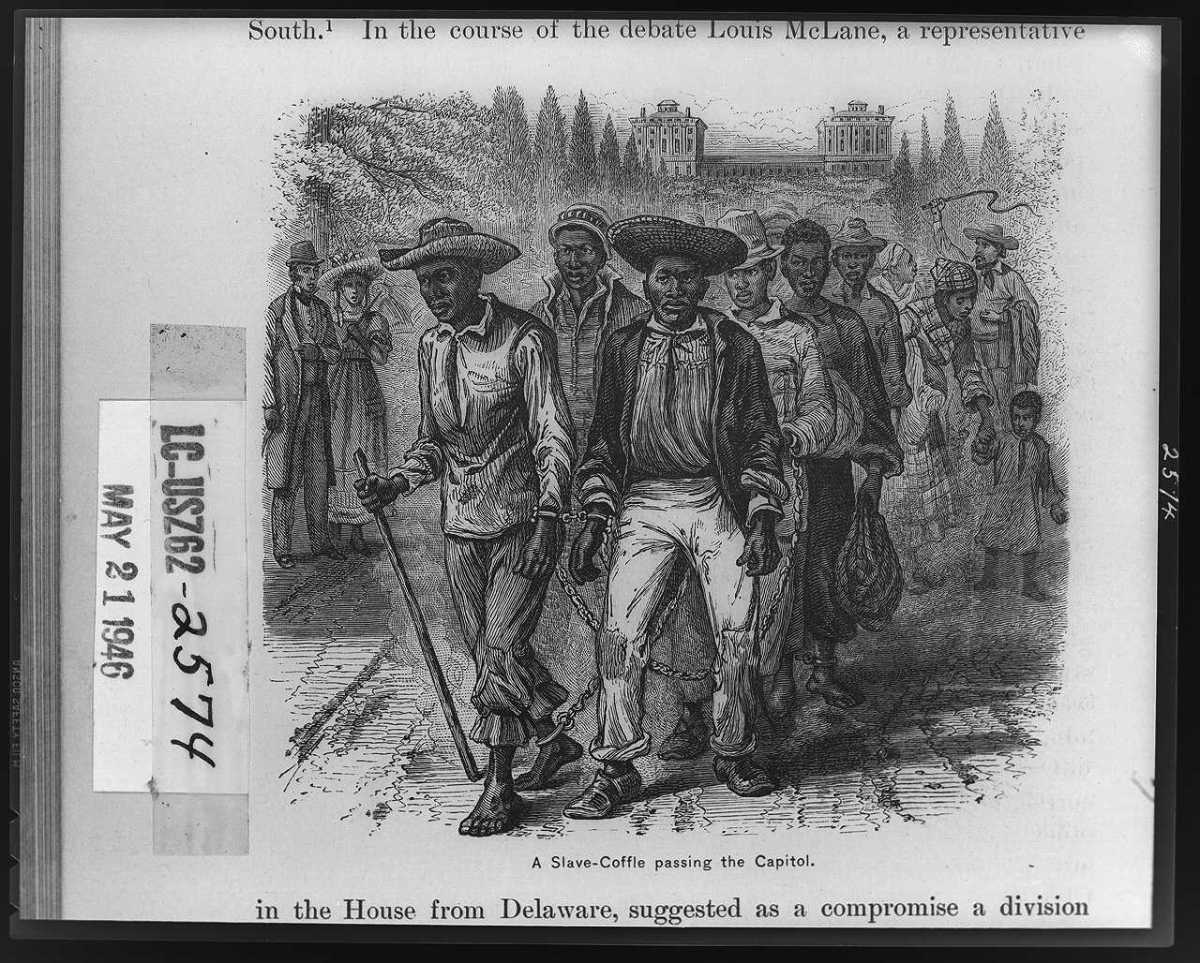
They called it a “slave coffle.” This was a line of slaves chained together and then marched by the slave trader to some town where these enslaved humans would be auctioned off to the highest bidder.
Treated as merchandise – – as a thing, a unit of economic power – – men and women suffered at the hands of other humans because their skin color, their helplessness and their place of birth.
The children of Israel were enslaved by Pharaoh in Egypt. The Egyptians kept these children of promise in bondage, and their cry, groans, & sorrows were heard by the Lord.
God sees your state.
He’s aware of what it is that enslaves you.
He knows where you are right now.
He has heard your cries, seen your tears and is touched by your condition
Job said, “…He knoweth the way that I take…” (Job 23:10).
Hebrews 4:14-16
(14) Seeing then that we have a great high priest, that is passed into the heavens, Jesus the Son of God, let us hold fast our profession.
(15) For we have not an high priest which cannot be touched with the feeling of our infirmities; but was in all points tempted like as we are, yet without sin.
(16) Let us therefore come boldly unto the throne of grace, that we may obtain mercy, and find grace to help in time of need.
He knows what it’s like to be tempted by the false allure of sin.
Many in this room have face a harsh taskmaster…
They have felt the whip of the driver…
But…those same people are here today as witnesses to the freedom that Jesus gives.
People who were once enslaved by:
| Jealousy | Envy | Hatred |
| Drugs | Alcohol | Gambling |
| Pornography | Illicit Relationships | Cigarettes |
| Gossiping | Back-biting | Strife |
| Digging up the past | Tale-bearing | Lying |
| Playing the busybody | Arrogance | Pride |
| Lust | Self-righteousness | Looking down on others |
| Spiritual superiority | Bad attitudes | Anger |
| Bitterness | Sickness | Disease |
There are saints here right now who know what Jesus meant when He said, “If the Son therefore shall make you free, ye shall be free indeed” (John 8:36).
Are you free?
Do you really want to be freed from sin?
What do you want to be free from? Hell?
Lust? Pride? Arrogance? Ditch Digging?
These chains of unrighteousness are indicators that you still need to be set free from sin’s enslavement.
Signs that while you may be free in some areas, you are still in need of deliverance in others.
Gal. 5:1, “Stand fast therefore in the liberty wherewith Christ hath made us free, and be not entangled again with the yoke of bondage.”
Do you groan out to God for freedom from the slavery of sin and satan?
Do you want the bonds of sin to be broken from your life?
Do you cry out in your bed of oppression at night?
Does the oppression and overwhelming habit of sinful activities, habits, and behavior leave your mind with no peace?
The psalmist wrote (Ps. 6:6-7), “I am weary with my groaning; all the night make I my bed to swim; I water my couch with my tears. Mine eye is consumed because of grief; it waxeth old because of all mine enemies.”
The beautiful hope we have tonight is that Jesus has redeemed us out of the slave market of sin.
He has bought us, freed us, and declared us His people, not His slaves, but His adopted children.
And because we are His children we have access to the benefits of redemption.
When the Lord brought the Hebrews out of Egyptian slaver He declared Four Expressions of Redemption (Ex. 6:6-7):
- I will bring you out from under the burdens of the Egyptians
- Jehovah brought the Israelites out of Egypt and took the burden of slavery from off their shoulders.
- Jesus will bring you out of the world of sin and lift the burden of guilt that sin has set on your shoulders.
- You no longer need to suffer when Jesus frees you from sin.
- I will rid you out of their bondage
- The LORD delivered the Israelites from the chains of slavery.
- Jesus will deliver you from those addictions and behaviors that seem to hang on you like chains.
- Romans 8:2, “For the law of the Spirit of life in Christ Jesus hath made me free from the law of sin and death.”
- I will redeem you with a stretched out arm, and with great judgments
- God showed Himself strong for the Israelites, revealed Himself to them by His redeeming name (Jehovah/LORD), and brought judgment on Pharaoh in Egypt and at the Red Sea.
- Jesus wants to show you His love and compassion by freeing you from the penalty of sin, by revealing His true nature to you, and by bringing judgment on those things that have enslaved you for so long.
- Isaiah 53:1-5, “Who hath believed our report? And to whom is the arm of the LORD revealed? For he shall grow up before him as a tender plant, and as a root out of a dry ground: he hath no form nor comeliness; and when we shall see him, there is no beauty that we should desire him. He is despised and rejected of men; a man of sorrows, and acquainted with grief: and we hid as it were our faces from him; he was despised, and we esteemed him not. Surely he hath borne our griefs, and carried our sorrows: yet we did esteem him stricken, smitten of God, and afflicted. But he was wounded for our transgressions, he was bruised for our iniquities: the chastisement of our peace was upon him; and with his stripes we are healed.”
- I will take you to me for a people, and I will be to you a God: and ye shall know that I am the LORD your God, which bringeth you out from under the burdens of the Egyptians
- The children of Israel are known as God’s people – – the children of promise.
- Because of Jesus, we are “a chosen generation, a royal priesthood, an holy nation, a peculiar people; that ye should shew forth the praises of him who hath called you out of darkness into his marvelous light: Which in time past were not a people, but are now the people of God: which had not obtained mercy, but now have obtained mercy” (1 Peter 2:9-10).
When Jesus redeemed you, He paid the purchase price for your release. Your freedom was purchased by another and it includes:
- Healing (Physical, Spiritual, & Emotional)
- Victory over sin
- Salvation
- Eternal Life
- Deliverance
Jesus frees completely and wholly, not partially or half-way.
Jesus wants you to be free in your spirit, soul and body: “And the very God of peace sanctify you wholly; and I pray God your whole spirit and soul and body be preserved blameless unto the coming of our Lord Jesus Christ” (1 Thessalonians 5:23).
There’s no use trying to sidestep the issue. You’re either free, or you’re not – holy, or not – right, or not.
If you need, want, desire, long for freedom, Jesus is here to free you.
If you’re free then you need to remind yourself of who you are:
- You are the head and not the tail (Deut. 28:13)
- You are above only, and not beneath (Deut. 28:13)
- You are more than a conqueror (Ro. 8:37)
- You are a peculiar treasure (Ex. 19:5)
- You are a citizen of a holy nation (Ex. 19:6)
Lionel B. Fletcher wrote, “The thoughts that are welcomed in our minds…are a reflection of our true selves as we appear in the sight of God.”[2]
Sometimes, the slave trader, that old enemy the devil, comes to kidnap a free born citizen of the kingdom of God.
Be sober, be vigilant; because your adversary the devil, as a roaring lion, walketh about, seeking whom he may devour” (1 Peter 5:8).
Once you find freedom, don’t forget where God has brought you from.
Jesus met with some Jews one day and found that they’d forgotten their origin and who it was that delivered them from slavery.
Jesus ignored their obvious mistake and went to the heart of the matter – – their slavery to sin.
John 8:30-36,“Then said Jesus to those Jews which believed on him, If ye continue in my word, then are ye my disciples indeed; And ye shall know the truth, and the truth shall make you free. They answered him, We be Abraham’s seed, and were never in bondage to any man: how sayest thou, Ye shall be made free? Jesus answered them, Verily, verily, I say unto you, Whosoever committeth sin is the servant of sin. And the servant abideth not in the house for ever: but the Son abideth ever. If the Son therefore shall make you free, ye shall be free indeed.”
Jesus properly identified satan when he said, “The thief cometh not, but for to steal, and to kill, and to destroy: I am come that they might have life, and that they might have it more abundantly” (John 10:10).
The devil is a slave master who wants to take from you all your strength, vitality, purpose, and destiny; but Jesus is The Ultimate Expression of Redemption for you today:
- He alone is the spoken Word made flesh.
- He alone is the Savior and Redeemer
- Isaiah 49:26, “All flesh shall know that I the LORD am thy Saviour and thy Redeemer, the mighty One of Jacob.”
- Isaiah 43:11, “I, even I, am the LORD; and beside me there is no saviour.”
- The word “LORD,” refers to Jehovah. This is the redeeming name of God in the Old Testament.
- When the angel told Mary that the child in her was to be called Immanuel he was signaling that He who was to be born was “God with us.” This simply means that Jehovah of the Old Testament is Jesus Christ of the New Testament.
- He alone is the “express image” of God (Heb. 11:1-3).
- “There is one God, and one Mediator between God and men, the Man Christ Jesus, who gave himself a ransom for all, to be testified in due time” (1 Tim. 2:5-6).
- 1 Tim 3:16, “…God was manifest in the flesh, justified in the Spirit, seen of angels, preached unto the Gentiles, believed on in the world, received up into glory.”
- “Neither is there salvation in any other: for there is none other name under heaven given among men, whereby we must be saved” (Acts 4:12)
Listen to me.
You are not a slave.
You are a child of God.
Your current condition is slavery.
You were created and destined to have dominion over all the earth.
In the book To Be A Slave, Julius Lester shares this true story:
Eliza was a pretty girl. Her master was her father and her mother was a slave. When the girls in the big house had suitors come to visit them, they’d ask, “Who is that pretty gal?” So they decided to get rid of her right away. The day they sold her, at the auction block, they stripped her to be bid off and looked at. The man that bought Eliza was from New York. The slaves in the community had enough money together to buy her freedom, but they wouldn’t let that happen. There was a big Swedish man there who bid for Eliza that day as well. He always bid for the pretty slave girls and bought them for his own use. He asked the man from New York, “What you gonna do with her when you get her?” The man from New York said, “None of your business, but you ain’t got money enough to buy her.” After the man from New York paid for her, he turned, looked at Eliza and said, “Eliza, you are free from now on.”[3]
Jesus is in the freeing business (John 8:36):
- “So if the Son sets you free, you will indeed be free.” (NLT)
- “So if the Son frees you, you will really be free!” (The Complete Jewish Bible)
- “So if the Son of Man sets you free, you will really be free.” (New International Reader’s Version)
Jesus came to Nazareth one day and opened the scroll of Isaiah and read:
“The Spirit of the Lord is upon me, because he hath anointed me to preach the gospel to the poor; he hath sent me to heal the brokenhearted, to preach deliverance to the captives, and recovering of sight to the blind, to set at liberty them that are bruised, To preach the acceptable year of the Lord. And he closed the book, and he gave it again to the minister, and sat down. And the eyes of all them that were in the synagogue were fastened on him. And he began to say unto them, This day is this scripture fulfilled in your ears” (Luke 4:18-21).
The Ultimate Expression of Redemption is Jesus for He came “to give his life a ransom for many” (Matt. 20:28).
[1] Lester, Julius. (1968). To Be A Slave. Dell Publishing Co. Inc.: New York, NY.
[2] Fletcher, Lionel B. (1933). The Pathway to the Stars. Hunt, Barnard & Co., Ltd: London, England. p.25.
[3] Lester, Julius. (1968). To Be A Slave. Dell Publishing Co. Inc.: New York, NY.
Categories
The Promise
Text: John 14:15-26, “(15) If ye love me, keep my commandments. (16) And I will pray the Father, and he shall give you another Comforter, that he may abide with you for ever; (17) Even the Spirit of truth; whom the world cannot receive, because it seeth him not, neither knoweth him: but ye know him; for he dwelleth with you, and shall be in you. (18) I will not leave you comfortless: I will come to you. (19) Yet a little while, and the world seeth me no more; but ye see me: because I live, ye shall live also. (20) At that day ye shall know that I am in my Father, and ye in me, and I in you. (21) He that hath my commandments, and keepeth them, he it is that loveth me: and he that loveth me shall be loved of my Father, and I will love him, and will manifest myself to him. (22) Judas saith unto him, not Iscariot, Lord, how is it that thou wilt manifest thyself unto us, and not unto the world? (23) Jesus answered and said unto him, If a man love me, he will keep my words: and my Father will love him, and we will come unto him, and make our abode with him. (24) He that loveth me not keepeth not my sayings: and the word which ye hear is not mine, but the Father’s which sent me. (25) These things have I spoken unto you, being yet present with you. (26) But the Comforter, which is the Holy Ghost, whom the Father will send in my name, he shall teach you all things, and bring all things to your remembrance, whatsoever I have said unto you.”
Isaiah 55:10-11, “For as the rain cometh down, and the snow from heaven, and returneth not thither, but watereth the earth, and maketh it bring forth and bud, that it may give seed to the sower, and bread to the eater: So shall my word be that goeth forth out of my mouth: it shall not return unto me void, but it shall accomplish that which I please, and it shall prosper in the thing whereto I sent it.”
God’s Word is forever settled in Heaven and will accomplish its goal. God generally offers two types of promise in the Bible:
- Unconditional – The promises to Abraham, Isaac, and Jacob did not depend on any future action on their part because they were unconditional and would come to pass regardless of anything that these men did or didn’t do:
- Joel 2:28-29, “And it shall come to pass afterward, that I will pour out my spirit upon all flesh; and your sons and your daughters shall prophesy, your old men shall dream dreams, your young men shall see visions: And also upon the servants and upon the handmaids in those days will I pour out my spirit.”
- Isaiah 28:11-12, “For with stammering lips and another tongue will he speak to this people. To whom he said, This is the rest wherewith ye may cause the weary to rest; and this is the refreshing: yet they would not hear.”
- Conditional – The Bible contains “if…then” statements. These are requirements that you must meet to receive the promise. They represent future acts that must be obeyed to receive the full promise:
- 2 Chronicles 7:14, “If my people, which are called by my name, shall humble themselves, and pray, and seek my face, and turn from their wicked ways; then will I hear from heaven, and will forgive their sin, and will heal their land.
- Acts 2:37-39, “Now when they heard this, they were pricked in their heart, and said unto Peter and to the rest of the apostles, Men and brethren, what shall we do? Then Peter said unto them, Repent, and be baptized every one of you in the name of Jesus Christ for the remission of sins, and ye shall receive the gift of the Holy Ghost. For the promise is unto you, and to your children, and to all that are afar off, even as many as the Lord our God shall call.”
Often the question is asked, “Why Tongues?”[1]
- God is not accountable to us for what He chooses to so. He is Sovereign, Creator, Sustainer, Redeemer, Savior…
- Tongues is an initial external sign that must be followed by the fruit of the Spirit.
- Gal. 5:22-23, “…the fruit of the Spirit is love, joy, peace, longsuffering, gentleness, goodness, faith, Meekness, temperance…”
- John 3:8, “The wind bloweth where it listeth, and thou hearest the sound thereof, but canst not tell whence it cometh, and whither it goeth: so is every one that is born of the Spirit.”
- It is the consistent pattern of evidence established by God as essential in the New Birth:
- 1 Corinthians 12:13, “For by one Spirit are we all baptized into one body, whether we be Jews or Gentiles, whether we be bond or free; and have been all made to drink into one Spirit.”
- The tongue is the most unruly member of the body and when you receive the Holy Ghost speaking in tongues you are allowing God to control the most expressive part of your personality. Man’s expression of emotion, intelligence, and communication is articulated through the tongue.
It’s just for the Apostles and Early Church:
Irenaeus (died 202) ~ “In like manner we do also hear many brethren in the Church, who possess prophetic gifts, and who through the Spirit speak all kinds of languages, and bring to light for the general benefit the hidden things of men, and declare the mysteries of God.”[2]
Hildegard of Bingen (1098-1179) ~ “sang in unknown words with such facility and winsomeness that her utterances were known as ‘concerts in the Spirit’.”[3]
The Waldenses (c. 1217) ~ these followers of Peter Waldo believed in visions and prophecies.[4] Both healing and speaking in tongues were manifested among these heavily persecuted Christians.[5]
Early Quakers ~ “We received often the pouring down of the Spirit upon us, and our hearts were made glad and our tongues loosed and our mouths opened, and we spake with new tongues as the Lord gave utterance, and as His Spirit led us.”[6]
John Wesley ~ People in Wesley’s meetings would be filled with the Holy Ghost while he preached.[7]
Thomas Walsh (one of Wesley’s foremost preachers) made this entry in his diary; “This morning the Lord gave me a language that I knew not of, raising my soul to Him in a wonderful manner.”[8]
In England (1830) there was a revival under Edward Irving where gifts of the Spirit were manifested. One member of the congregations writes: “The moment I am visited with the Spirit, and carried out to God in a tongue which I know not… I am more conscious than ever of the presence of God. He and He alone is in my soul. I am filled with some form of the mind of God, be it joy or grief, desire, love, pity, compassion, or indignation; and I am made to utter it in words which are full of power over my spirit, but not being accessible to my understanding, my devotion is not interrupted by association of suggestions from the visible or intellectual world: I feel myself, as it were, shut in with God in His pavilion, and hidden close from the invasions of the world, the devil, and the flesh.”[9]
Charles G. Finney ~ “I received a mighty baptism in the Holy Ghost…No words can express the wonderful love that was shed abroad in my heart. I wept aloud with joy and love; and I do not know but I should say, I literally bellowed out the unutterable gushings of my heart.”[10]
D. L. Moody ~ “One the following Sunday night, when I got to the rooms of the Y.M.C.A. I found the meetings on fire. The young men were speaking in tongues and prophesying. What on earth did it all mean? Only that Moody had been addressing them that afternoon.”[11] At a meeting in Los Angeles, Dr. R.A. Torrey told of a service in London where Moody took the pulpit to preach and instead broke into another language. He tried again, with similar results. The third time, after prayer and praise, he was able to preach his message.[12]
Charles H. Spurgeon ~ a British preacher told how Spurgeon once asked his audience to forgive him that when he got especially happy in the Lord, “I break forth into a kind of gibberish which I do not myself understand.”[13]
How Do I Receive this Phenomenon of the Holy Ghost?[14]
- Prepare your heart by obeying Acts 2:38 (Repent).
- Understand that God wants you to receive His gift as much as you want it…just ask Him for the Holy Ghost: “If ye then, being evil, know how to give good gifts unto your children: how much more shall your heavenly Father give the Holy Spirit to them that ask him?” (Luke 11:13)
- You must be hungry to receive His Spirit.
- Matthew 5:6, “Blessed are they which do hunger and thirst after righteousness: for they shall be filled.”
- James 4:8, “Draw nigh to God, and he will draw nigh to you. Cleanse your hands, ye sinners; and purify your hearts, ye double minded.”
- Expect to receive: “And when Paul had laid his hands upon them, the Holy Ghost came on them; and they spake with tongues, and prophesied” (Acts 19:6).
- Believe to receive: John 7:38-39, “He that believeth on me, as the scripture hath said, out of his belly shall flow rivers of living water. (But this spake he of the Spirit, which they that believe on him should receive: for the Holy Ghost was not yet given; because that Jesus was not yet glorified.)”
- Relax!!
Promise of Christ’s Return:
1 Corinthians 15:51-56, “51 Behold, I shew you a mystery; We shall not all sleep, but we shall all be changed, 52 In a moment, in the twinkling of an eye, at the last trump: for the trumpet shall sound, and the dead shall be raised incorruptible, and we shall be changed. 53 For this corruptible must put on incorruption, and this mortal must put on immortality. 54 So when this corruptible shall have put on incorruption, and this mortal shall have put on immortality, then shall be brought to pass the saying that is written, Death is swallowed up in victory. 55 O death, where is thy sting? O grave, where is thy victory? 56 The sting of death is sin; and the strength of sin is the law. 57 But thanks be to God, which giveth us the victory through our Lord Jesus Christ.”
[1] “Speaking In Tongues.” Various Authors. Retrieved 5-15-2005 from http://altupc.com/articles/tongues1.htm.
[2] Against Heresies, V,6,1, Ibid., vol 1, p. 531
[3] George H. Williams and Edith Waldvogel, “A History of Speaking in Tongues and Related Gifts,” in The Charismatic Movement, ed. by Michael P. Hamilton, p. 70
[4] R. Kissack, “Waldenses,” The New International Dictionary of the Christian Church, ed. by J.D. Douglas, revised edition, p. 1026
[5] Gordon F. Atter, The Third Force, p. 13
[6] Bresson, Studies in Ecstacy, pp. 48-52
[7] http://www.holyspiritinfo.net/ch_hist.htm
[8] Entry of March 8, 1750, quoted by Frodsham, With Signs following, p. 232
[9] A.L. Drummond, Edward Irving and His Circle, pp. 161-162
[10] Charles G. Finney, Autobiography, p. 20
[11] Boyd, Robert, The Lives and Labours of Moody and Sankey, p. 47
[12] Lennard Darbee, Tongues: The Dynamite of God, p. 24.
[13] Ibid. p.24
[14] Principles of Doctrine: Lesson 11. “Holy Spirit Baptism.” Parkersburg Bible College.
The Promise | 15 May 2005
Categories
Paul’s Revelation of God’s Love
It seems to me that Paul caught a glimpse of God’s love in the moment that he is first introduced to us in Acts 7 because here we are told that he watched the coats of the men who stoned Stephen and the implication is that he had to have heard that man of faith as “he kneeled down, and cried with a loud voice, Lord, lay not this sin to their charge.” Much like Jesus before him, Stephen took a moment of horror and turned it into an eternal memorial of love and testimony. Stephen was so full of the Holy Ghost (Spirit of Christ) that he could only offer love in the face of hatred and violence. Perhaps this was the goad that Jesus referred to when He met Saul on the Road to Damascus. It’s possible that Saul was constantly reminded of that manifestation of God’s love and had to battle with his conscience over his part in that just man’s death.
Paul’s first experience with God’s love was that a man could, under terrible circumstances, love everyone – even his tormentors. This is only possible when one possesses that agape that Paul wrote of in 1 Corinthians 13. Agape is defined as “brotherly love, affection, good will, love, benevolence, and charity.” It is the ability to hold affection for others regardless of how they treat you and it is certainly modeled best by Christ and those who possess His Spirit.
Having been involved in the persecution of the early Church and then being forgiven and placed in a position of leadership and caretaking of those he formally threatened and slaughtered must have been a humbling and awesome experience in the life of Paul. It is no wonder that he could write, “Who shall separate us from the love [agape] of Christ? shall tribulation, or distress, or persecution, or famine, or nakedness, or peril, or sword? As it is written, For thy sake we are killed all the day long; we are accounted as sheep for the slaughter. Nay, in all these things we are more than conquerors through him that loved us. For I am persuaded, that neither death, nor life, nor angels, nor principalities, nor powers, nor things present, nor things to come, Nor height, nor depth, nor any other creature, shall be able to separate us from the love [agape]of God, which is in Christ Jesus our Lord.” Paul had experienced the unconditional love of God and he was never the same.
I’m sure that Paul went through the gamut of emotions and questions, like, “how could He love me,” or “why does He love me so much,” or “what is so different about this man Stephen?” Yet, God took this mass of boiling humanity and turned him into the Apostle to the Gentiles and along the way he not only experienced the love of God, but he practiced it as well.
Paul’s revelation of God’s love was that it could only be received by the Holy Ghost. It is no wonder that he exhorted the Ephesians to “walk in love” because he knew the awesome power of love. Stephen was full of God’s love because he was a man full of the Holy Ghost and it was that fullness that Paul encouraged when he admonished the Ephesians to be “filled with the Spirit.” This was Paul’s revelation and it remains true – especially in our day. We need more “Stephens”, who have a fullness of the Holy Ghost, and more “Pauls,” who recognize that fullness as the love of God.
*First written on May 28, 2004*
Categories
Living the Prophet’s Creed
Text: Micah 6:1-8
(1) Hear ye now what the LORD saith; Arise, contend thou before the mountains, and let the hills hear thy voice.
(2) Hear ye, O mountains, the LORD’S controversy, and ye strong foundations of the earth: for the LORD hath a controversy with his people, and he will plead with Israel.
(3) O my people, what have I done unto thee? and wherein have I wearied thee? testify against me.
(4) For I brought thee up out of the land of Egypt, and redeemed thee out of the house of servants; and I sent before thee Moses, Aaron, and Miriam.
(5) O my people, remember now what Balak king of Moab consulted, and what Balaam the son of Beor answered him from Shittim unto Gilgal; that ye may know the righteousness of the LORD.
(6) Wherewith shall I come before the LORD, and bow myself before the high God? shall I come before him with burnt offerings, with calves of a year old?
(7) Will the LORD be pleased with thousands of rams, or with ten thousands of rivers of oil? shall I give my firstborn for my transgression, the fruit of my body for the sin of my soul?
(8) He hath shewed thee, O man, what is good; and what doth the LORD require of thee, but to do justly, and to love mercy, and to walk humbly with thy God?
Creed[1]
- A brief authoritative formula of religious belief
- the Nicene Creed
- A set of fundamental beliefs
- also : a guiding principle
- “Never settle for mediocrity” is his creed. -Jill Lieber
- “God won’t bless what He can’t sanction.” –James Rowe
There are principles in God’s Word that when lived out, or violated, lead to a life blessing or cursing.
In this study, we will take a look at what the late Rev. James Lumpkin, Sr. called, “The Prophet’s Creed,” taking as a title this thought:
Living the Prophet’s Creed
A creed, a set of fundamental beliefs, a collection of guiding principles, are only as effective as your desire and determination to live them out.
It is a good practice for children to have memorized all the books of the Bible by the time they leave Sunday School and graduate to the Adult Bible Class.
In fact, many children are taught to memorize the Ten Commandments (Exodus 20:3-17):
- Thou shalt have no other gods before me.
- Thou shalt not make unto thee any graven image
- Thou shalt not take the name of the LORD thy God in vain
- Remember the sabbath day, to keep it holy
- Honour thy father and thy mother
- Thou shalt not kill
- Thou shalt not commit adultery
- Thou shalt not steal
- Thou shalt not bear false witness
- Thou shalt not covet
And, there are two passage in the Bible that every saint in an Apostolic Oneness Pentecostal should have total recall on:
- Deuteronomy 6:4-5, “(4) Hear, O Israel: The LORD our God is one LORD: (5) And thou shalt love the LORD thy God with all thine heart, and with all thy soul, and with all thy might.”
- Acts 2:38, “Then Peter said unto them, Repent, and be baptized every one of you in the name of Jesus Christ for the remission of sins, and ye shall receive the gift of the Holy Ghost.”
These Scriptures are creeds that serve to pass on to the next generation a set of Basic Bible Principles, that when lived out produce a godly and sanctified life.
Living the Prophet’s Creed consists of three principles that we all need to apply to our lives:
- To do justly
- To love mercy
- To walk humbly with thy God
In verse 2, of our text, the LORD has a controversy (dispute, quarrel), with Israel, and He is pleading with them:
“O my people, what have I done unto thee? and wherein have I wearied thee? testify against me. For I brought thee up out of the land of Egypt, and redeemed thee out of the house of servants [slaves]; and I sent before thee Moses, Aaron, and Miriam” (verses 3-4).
In an attempt to call them back to a right relationship with Him, He reminded them of Egypt – the place from which God delivered them, and redeemed them.
He sent servants, you might even identify them as prophets:
- Moses = Lawgiver, to deliver and instruct.
- Aaron = The High Priest, to atone.
- Miriam = Prophetess & Praiser, and to teach the women.
The Lord is pleading with His people to remember all that He did for them.
Reminding them the He turned Baalam’s curse into a blessing proving His faithfulness to Israel.
They were perhaps sincere in their desire to keep the commandments of the Law, but misguided seekers
The laws were there not to be followed in some type of burdensone manner, but to establish principles, which had been forgotten.
Sometimes a law can be made that is still kept but nobody remembers the purpose. <ham, Vevay>
When you live The Prophet’s Creed you will automatically live by the principles that the Law was formed to teach you.
The Prophet’s Creed:
To Do Justly
- Do right by God: “And Jesus answered him, The first of all the commandments is, Hear, O Israel; The Lord our God is one Lord: And thou shalt love the Lord thy God with all thy heart, and with all thy soul, and with all thy mind, and with all thy strength: this is the first commandment” Mark 12:29-30).
- Love God
- Heart = Are your affections solely on Jesus?
- Soul = Would you give up your life for Jesus?
- Mind = Will you lay aside what you think for what God’s Word tells you?
- Strength = Will you give all the strength and effort of your life to His will?
- Do right by your neighbor: “And the second is like, namely this, Thou shalt love thy neighbor…” (Mark 12:31).
- Prefer your fellow
- Never work to harm another
- Treat people right
- Love people
- Do right by yourself: “…as thyself. There is none other commandment greater than these” (Mark 12:31).
- Do you like yourself?
- Don’t deprive yourself of all that God has richly provided.
- We live by the justness and truth of the Word of God and we are judged by it.
To Love Mercy
It is necessary that we not only live by the justice and judgment of the Law, but to also give to mercy what it requires – LOVE MERCY.
- The Law came by Moses but grace and truth came by Jesus Christ.
- 2 Corinthians 3:5-6, “…our sufficiency is of God; Who also hath made us able ministers of the new testament; not of the letter, but of the spirit: for the letter killeth, but the spirit giveth life.”
- Psalms 85:10, “Mercy and truth are met together; righteousness and peace have kissed each other.”
- Psalms 25:10, “All the paths of the LORD are mercy and truth unto such as keep his covenant and his testimonies.”
- The mercy you show is the mercy you’ll know.
- God is not in the business of stopping people from receiving mercy: “The God of my mercy shall prevent me…” (Ps. 59:10).
- Prevent = “project oneself, precede, go before.”
- God’s mercy goes before us
To Walk Humbly with Thy God
1 Peter 5:6-7, “Humble yourselves therefore under the mighty hand of God, that he may exalt you in due time: Casting all your care upon him; for he careth for you.”
- Acknowledge God’s Sovereignty
- There is One God and you are not Him!
- Beware, Humility Required:
- Confess and forsake your sin
- Submit to the ordinance of water baptism
- Yield to the Holy Ghost.
- Accept God’s Mercy
- Walk in God’s Grace
- Is the Lord Jesus Christ truly your God?
- Walk humbly before others as well
- God isn’t the only one who hates a proud, haughty or arrogant attitude.
- Submission is the hallmark of humility.
- James 4:5-12, “(5) Do ye think that the scripture saith in vain, The spirit that dwelleth in us lusteth to envy? (6) But he giveth more grace. Wherefore he saith, God resisteth the proud, but giveth grace unto the humble. (7) Submit yourselves therefore to God. Resist the devil, and he will flee from you. (8) Draw nigh to God, and he will draw nigh to you. Cleanse your hands, ye sinners; and purify your hearts, ye double minded. (9) Be afflicted, and mourn, and weep: let your laughter be turned to mourning, and your joy to heaviness. (10) Humble yourselves in the sight of the Lord, and he shall lift you up. (11) Speak not evil one of another, brethren. He that speaketh evil of his brother, and judgeth his brother, speaketh evil of the law, and judgeth the law: but if thou judge the law, thou art not a doer of the law, but a judge. (12) There is one lawgiver, who is able to save and to destroy: who art thou that judgest another?”
- Galatians 6:1-3, “(1) Brethren, if a man be overtaken in a fault, ye which are spiritual, restore such an one in the spirit of meekness; considering thyself, lest thou also be tempted. (2) Bear ye one another’s burdens, and so fulfil the law of Christ. (3) For if a man think himself to be something, when he is nothing, he deceiveth himself.”
Each of the three people Micah records as being sent to His people were at one point violators of The Prophet’s Creed, but once they learned the necessity of Living the Prophet’s Creed they became examples for us to follow:
Moses – The great lawgiver, did justly as he operated in his role as both deliverer and the giver of the Law
- A murderer, disobeyed God in a moment of rage
Aaron – The High Priest, loved mercy and as a priest stood as a bridge between God and Man making atonement for sin.
- An idolater, intimidated by those he was suppose to lead, excused his sin
Miriam – The prophetess of praise and instructor of women, learned humility.
- Jealousy, envy, rebellion
It’s a question: “He hath shewed thee, O man, what is good; and what doth the LORD require of thee, but to do justly, and to love mercy, and to walk humbly with thy God?” (Micah 6:8).
I want everyone to come forward, and I’m going to give you some basic instructions:
- Close your eyes
- Lift your head up. Look up.
- Raise both hands. Pray. Surrender. Worship.
- Speak with your outside voice.
- Commit to Living The Prophet’s Creed: to do justly, to love mercy, to walk humbly with your God.
[1] “Creed.” Merriam-Webster.com Dictionary, Merriam-Webster, https://www.merriam-webster.com/dictionary/creed. Accessed 22 Jun. 2021.
Categories
More Than A Song
“Water Baptism in the Name of Jesus”
Guest Author: James Anderson
This topic is often discussed, but I have been conversing with someone with an opposing view and here are some of my notes.
I would not say that there was a codified baptismal formula in the primitive church. Myself and most Oneness teachers should indicate it was developed, in some sense. However, I do believe that scripture and history indicate to us that the name of Jesus was invoked or implied, in literary devices, by or over the baptized. I think most scholars realize this but disallow it by marginalizing it to, now, include the Matthean titles (28:19; Father, Son, and Holy Spirit) and thus giving a sense of credibility to the Trinitarian method. If we study history accurately we should understand that no biblical or primitive NT believer was baptized using the titles. Biblical and historical evidence explicitly indicates that the name “Jesus” was actually used in baptism and not a recitation of the actual instruction of Christ in the Matthean passage, instead actual obedience to His instruction, e.g. “baptizing them…in the name…” (c.f. Matthew 28:19, NKJV).
In connection with this it is interesting to note the Lukan Great Commission as well. Luke records: “and that repentance and remission of sins should be preached in his name among all nations, beginning at Jerusalem.” (Luke 24:47, KJV) Both the Lukan and Matthean passages indicate that a single, known name was used in Christian baptism. As the below sources will show, this is the only form used by the Disciples and early believers.
The Anchor Bible Dictionary is a landmark work of scholarly thought. It clearly states:
“It is relatively certain that in the early Church one commonly referred to baptism as being done “into the name of the Lord Jesus”or “something similar.” (1)
The Bible knows of no Christian in the New Testament who had not been baptized, either by John or in the name of Jesus. Consequently, as modern New Testament believers we should feel compelled to follow that same Biblical method. Christian baptism was from the first administered “in the name of Jesus”. The trinitarian formula of merely repeating, not obeying or properly interpreting, Matthew 28:19 is not found in the scriptures. Anyone baptizing in titles or any other method that does not include the name of Jesus is without scriptural support, there is simply no text that demonstrates or gives license for such aberrations. Baptism identifies us with Jesus Christ and brings us into the Body of Christ, therefore it is logical to conclude that we should have the name of Jesus invoked over us in baptism.
The reason that we are baptized in Jesus’ name is that we are being baptized into Jesus. We are taking on his name, similar to the way a woman takes on her husband’s name at marriage. We are saying that we belong to Jesus and we are identifying with Him in His death and burial. Paul said, “Is Christ divided? Was Paul crucified for you? Or were you baptized in the name of Paul?” (1 Corinthians 1:13) Paul’s thinking here is to exalt the name of Jesus Christ. If we follow his logic it becomes obvious that he is telling the Corinthians that Christ was the one crucified for them and so they, too, were baptized in the name of Christ. The believers at Corinth as well as those in Rome were baptized in Jesus’ name.
We may contest that there was no EXACT formula for baptism in the New Testament, but such a statement is only partially true. As mentioned prior, in all occasions of baptism the name Jesus is used, in the name of the Lord or in the name of the Lord Jesus, etc. Whether “Christ” or “Lord” is used all the references refer directly to the only saving name—Jesus (Acts 4:12). How can we expect baptism to be efficacious for one if the name of Jesus is not invoked then? It seems then that anything else would be…unbiblical.
In Acts 22:16 we read, “And now why tarriest thou? arise, and be baptized, and wash away thy sins, calling on the name of the Lord.” (Acts 22:16, KJV) There is other debates concerning this passage, but none as relevant as the one we are discussing now. The Greek word for “calling” here is epikaleomai. This word is defined “idiomatically, denoting that one person belongs to another whose name is attached to him…literally have someone’s name called on someone, i.e. belong to,”(2) Therefore, the name of Christ is important in every sense of salvation and not just in professing Him as Lord. This name should be “called on” as we are baptized into Christ; we arise with His name attached to us and are His people.
Epikaleomai is used to mean a literal invoking in several New Testament passages. In Acts 9 we see the story of Paul after being blinded on the road to Damascus, “And here he has authority from the chief priests to bind all who call on Your name. (15) But the Lord said to him, Go, for he is a chosen vessel of Mine to bear My name before Gentiles, kings, and the children of Israel. (16) For I will show him how many things he must suffer for My name’s sake.” Acts 9:14-16 NKJV
The early Christians were preaching and baptizing in the name of Jesus. They literally uttered the words, there was no non-verbal reflection upon the name—it was a literal calling on the name of Jesus. Paul (formerly Saul) was commissioned by the Priests to persecute those who were calling on the name of Jesus. After being blinded Paul is taken to Ananias. Ananias is told by the Lord that Paul is a “chosen vessel” to “bear” the name of Jesus to the Gentiles. Paul also was to suffer for this name. The name of Jesus is so intrinsically involved in the process of salvation and our subsequent lives, how can we, then, abandon this name at our baptism?
Some assume that the trinitarian formula for baptism, which invokes the titles—Father, Son, and Holy Spirit–are indeed the biblical method. This may cause one to ask, “Was the trinitarian formula used in New Testament times?” The International Standard Bible Encyclopedia answers this for us:
“No record of such use can be discovered in the Acts or the epistles of the apostles. The baptisms recorded in the New Testament after the Day of Pentecost are administered “in the name of Jesus Christ” (Acts 2:38), “into the name of the Lord Jesus” (Acts 8:16), “into Christ” (Rom 6:3; Gal 3:27).” (3)
James Hastings indicates:
“The original form of words was ‘into the name of Jesus Christ’ or ‘the Lord Jesus.’ Baptism into the name of the Trinity was a later development.”(4)
Self-admittedly then trinitarians confess that the form of words used in an oral invocation in the rite of baptism was done by, the very least, using the name of Jesus, in some sense. Signifying that the Apostles as well as those following their death used the saving Name—Jesus.
Often the words, “in” or “into” are used with being baptized in or into the name of Jesus. Both terms are prepositions which are used to connect nouns or pronouns in an adjectival or adverbial sense. Example: the babe lying in a manger, the sun sets in the west. They denote being in or into something, such as baptized into or in the name of Jesus. When used in an adjectival or descriptive sense it is describing the method or the how of what is being said. How were the early Christians baptized? Answer: in the name of Jesus. Therefore, we enter into or in the power or person of Jesus by using His name.
In the New Testament, specifically in the historical book of Acts we see baptisms that involve an actual verbal invocation using wholly, partly, or by implications (Lord) the name of Jesus. Otto Heick a church historian wrote in his book, “A History of Christian Thought” (1,53), that “At first baptism was administered in the name of Jesus, but gradually in the name of the Triune God: Father, Son, and Holy Spirit.” Today, as modern New Testament believers, it is imperative that we hold the teachings of scripture paramount, rather than relying too heavily upon extra-biblical sources or church councils, creeds, dogmas and catechisms. When we stand before God in the Day of Judgment, we will be accountable to His Word.
In Acts 4:12 Peter uses the word “must” which is the Greek preposition dei. In this passage it literally means “it is necessary.”(5) “Must” here is an emphatic word indicating compelling necessity and it is joined with “name” which is part of the “must.” Not only is there only one way to get salvation, e.g. through Jesus Christ, but there is only one saving name in baptism—Jesus Christ.
Many New Testament passages speak of healing done in Jesus’ name (Acts 3:6, 16; 4:9–10), signs and wonders through His name (4:30). Some preached in His name (8:12) or spoke boldly in His name (9:27–28). This being so, it seems that historical and theological bias exist in order to assert that baptism is not to be done by invoking the name of Jesus. Baptism in the name of Jesus was and still is the correct name to administer over one who is to be baptized or by the baptized. Historically and biblically, all competent accounts point us directly to Jesus name.
Here is a syllogism to conclude:
- Biblical and historical sources indicate that baptism was done by orally invoking, in some sense, the name “Jesus”. Further, the historical evidence confirms that extra-biblical change was made to include titles.
- The Bible also places soteriological emphasis on the name of Jesus that it “must” be a part of a believers experience.
- Therefore, it is logical to conclude, from evidence, that baptism in the name of “Jesus” is both valid and necessary.
NOTES:
1. Freedman, David Noel. The Anchor Bible Dictionary. New York: Doubleday, 1996, c1992.2. Friberg, T., Friberg, B., & Miller, N. F. (2000). Vol. 4: Analytical lexicon of the Greek New Testament. Baker’s Greek New Testament library (Page 164). Grand Rapids, Mich.: Baker Books.
3. “Baptism” International Standard Bible Encyclopedia, Electronic Database Copyright (c)1996 by Biblesoft
4. “Baptism” IV (a.) A Dictionary of the Bible, Edited by James Hastings, M.A., D.D., Vol. 1, Hendrickson Publishers, Inc.
5. Exegetical Dictionary of the New Testament © 1990 by William B. Eerdmans Publishing Company. All rights reserved
[Originally posted on 9 May 2007 at http://thepillarandgroundoftruth.blogspot.com/2007/05/water-baptism-in-name-of-jesus.html]
Categories
 The Pillar and Ground of Truth