1 Timothy 3:15, "...that thou mayest know how thou oughtest to behave thyself in the house of God, which is the church of the living God, the pillar and ground of the truth."
God has always desired to fellowship with man, but sin came into the human family and separated God from man. The purpose of Sonship was so that God could provide the best means by which He and man could regain their fellowship, and to give dominion over the earth to man again. This fellowship is the result of the sacrifice of the Savior on Calvary. He could only do this by providing complete redemption for mankind. He is the Lamb that was slain from the foundation of the world, Rev. 13:8. In short, the Sonship is about God and man engaging in a loving and healthy relationship that is void of any hindrances (sin), which would separate each from the other. For that to take place a Mediator (the Son) had to provide reconciliation between God and man. This Mediator was realized in the person of Jesus Christ.
Who Fulfilled the Sonship
Jesus Christ fulfills the Sonship. In Colossians 2:9 we are told that in Jesus dwells all the fullness of the Godhead (all the characteristics of God) bodily, and we (the Church) are complete in Him (Jesus). Paul did say that the Gospel message was a mystery, but then he went on to explain what the mystery was: “And without controversy great is the mystery of godliness: God was manifest in the flesh, justified in the Spirit, seen of angels, preached unto the Gentiles, believed on in the world, received up into glory” (I Timothy 3:16). Only Jesus Christ fulfills these six points. Thus proving the adage, “Jesus Christ of the New Testament is Jehovah of the Old Testament.”
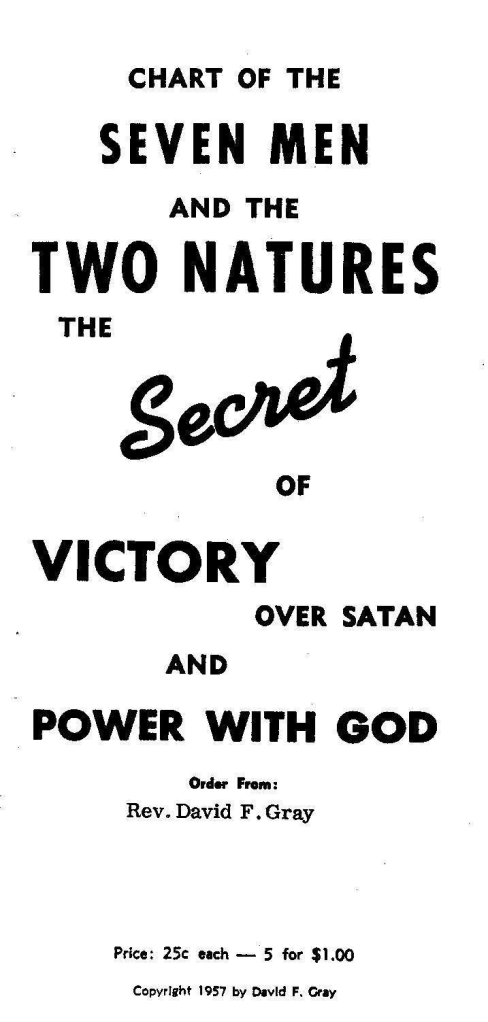
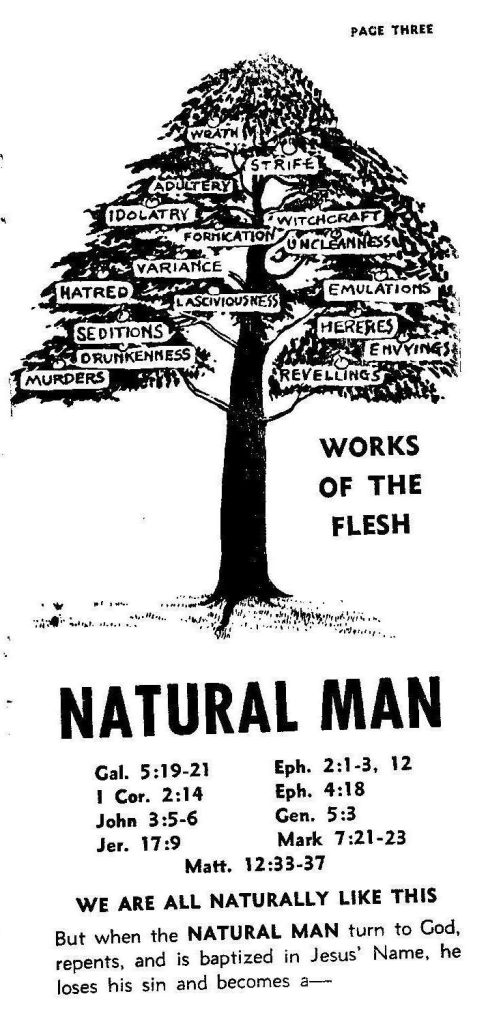
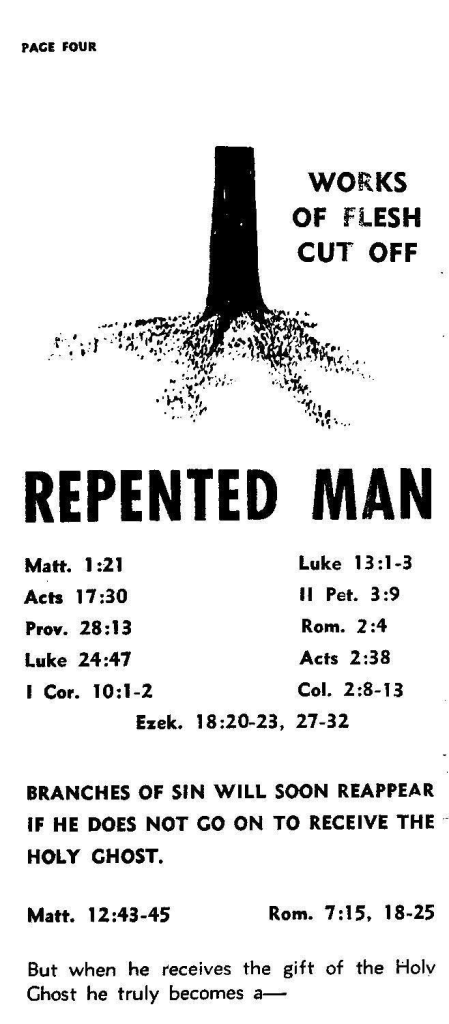
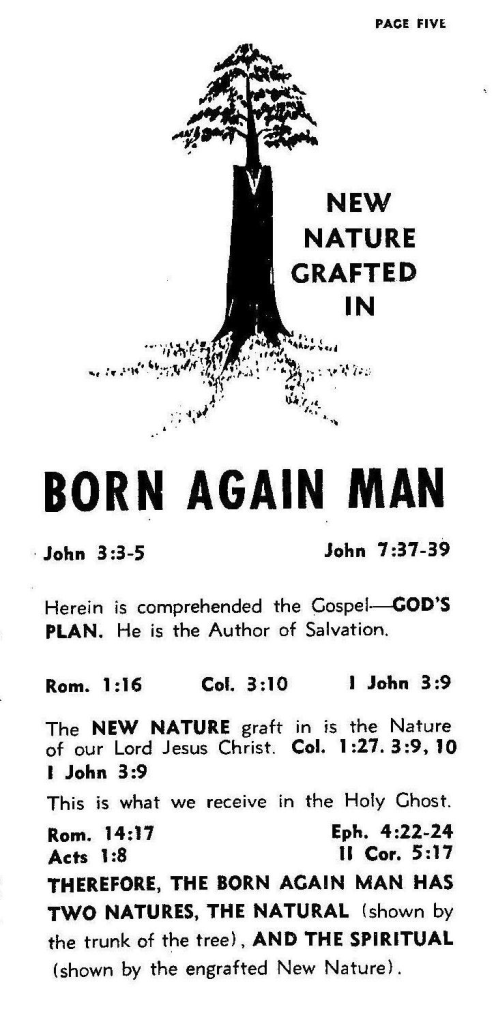
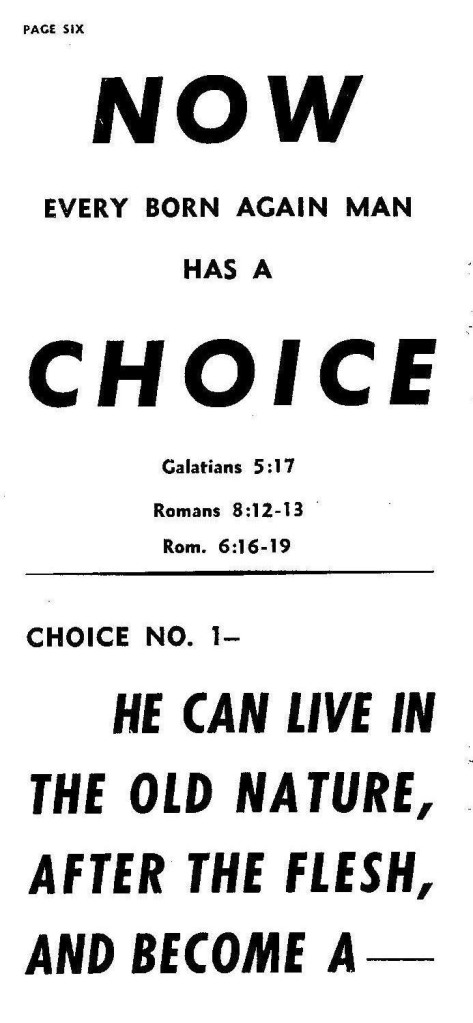
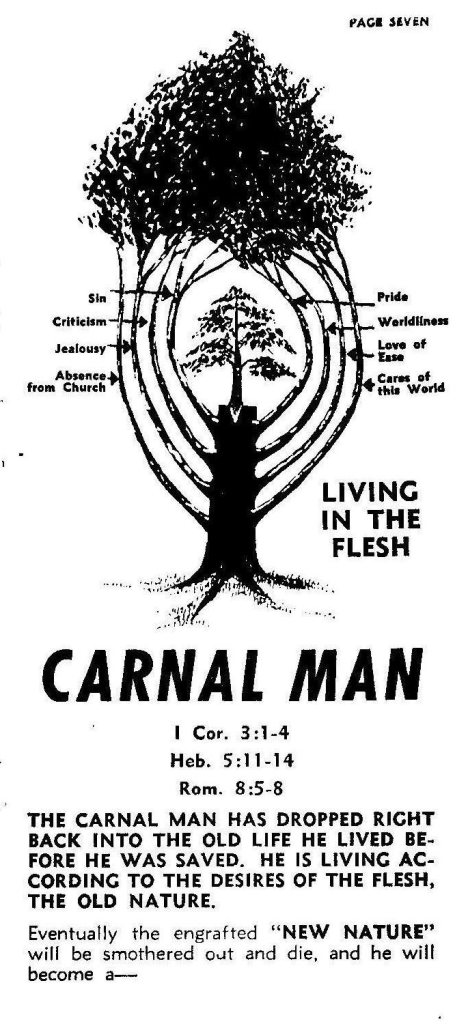
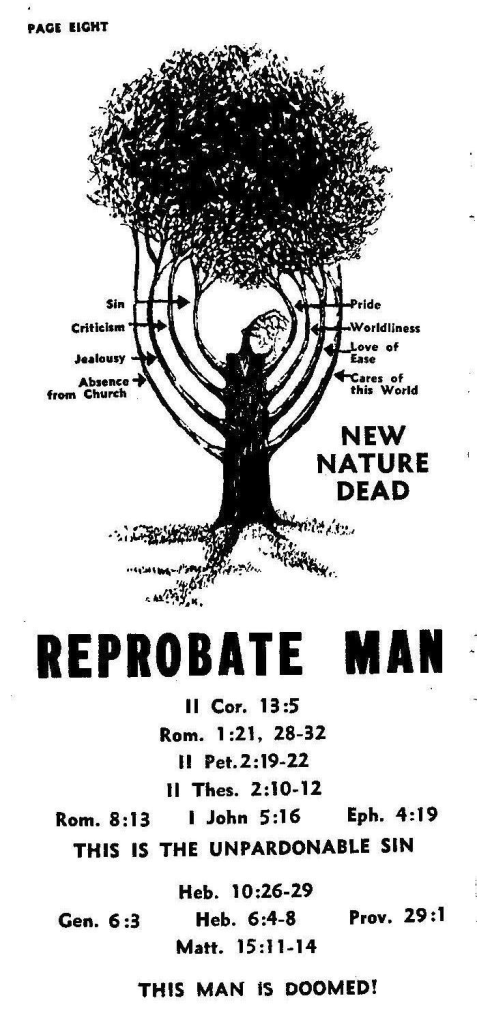
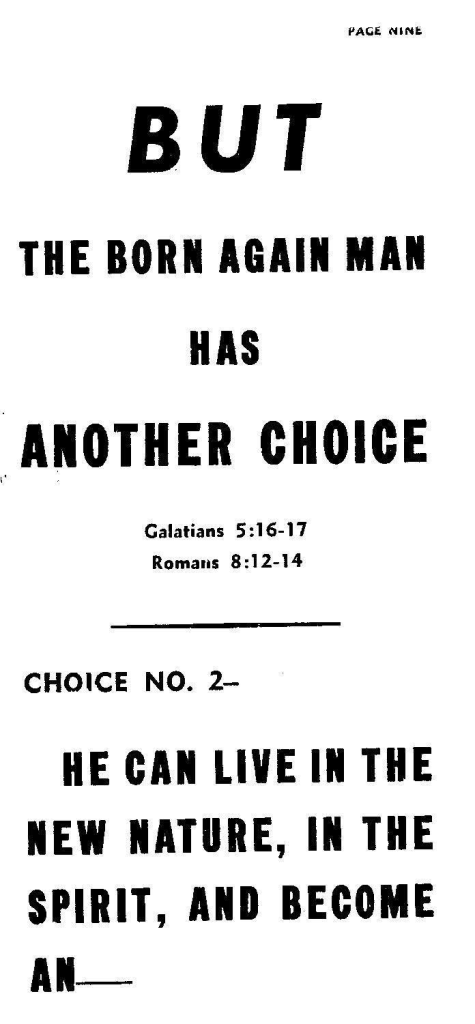
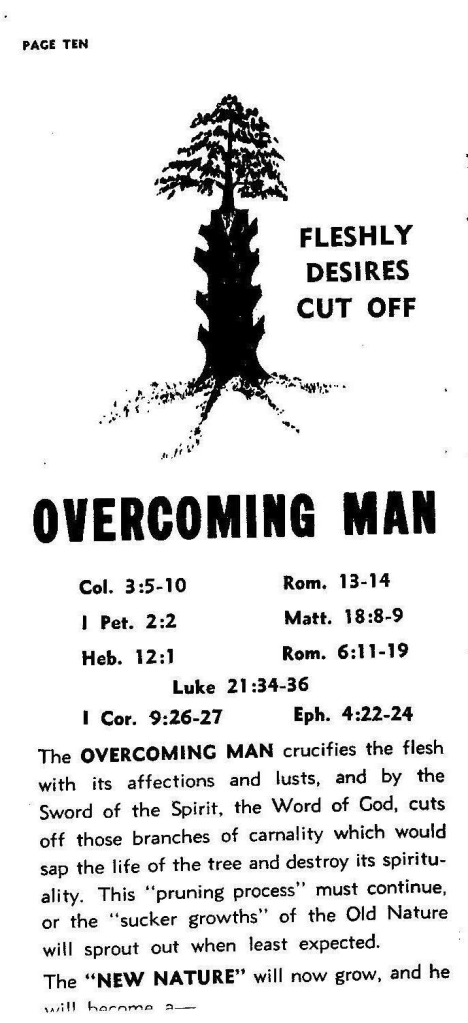
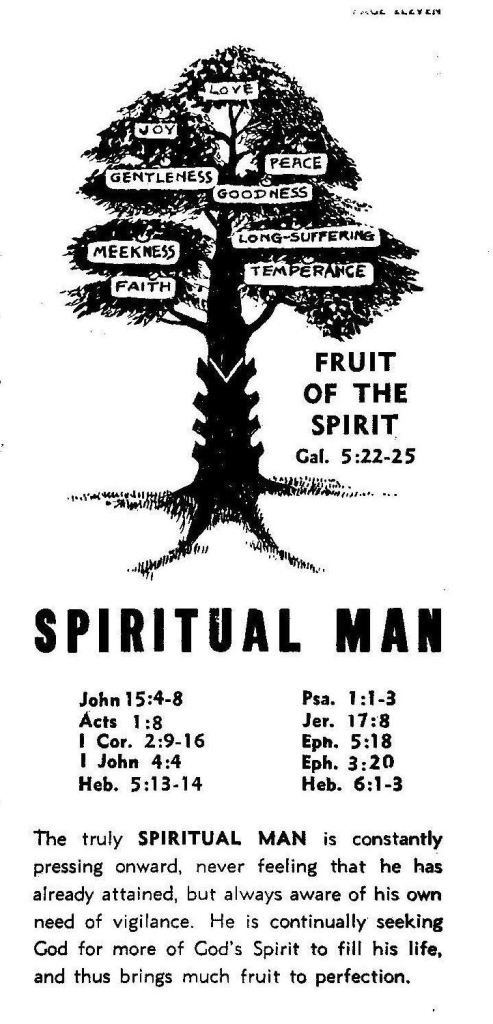
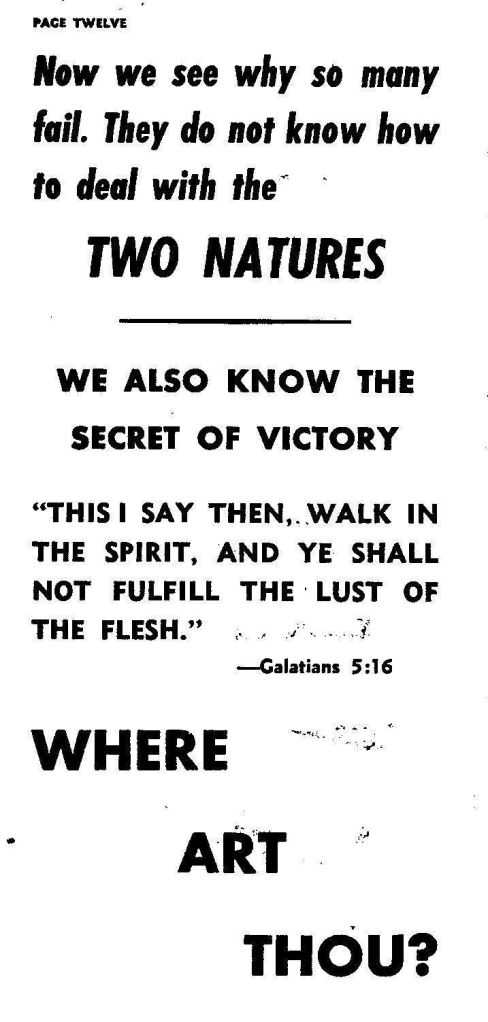
Here is an excellent pamphlet written by the late David F. Gray, entitled “Chart of the Seven Men and the Two Natures the Secret of Victory Over satan and Power with God,” which he wrote and published in 1957.
Read and enjoy!
Title: Chart of the Seven Men and the Two Natures
Author: David F. Gray
Publisher: David F. Gray
Year: 1957
Description: The secret of victory over satan and power with God.
“A gift, to be a gift, has to be accepted. Otherwise it lies like a burden between people.” –Robert Fisher, The Knight In Rusty Armor
I think that we are too casual in explaining the present of the Holy Ghost. Since it is in fact the Spirit of Christ in us, it is no wonder that He would be grieved by those who would not want Him in them. I think of those in the nominal church world who have the same access to the Holy Ghost as all of us in this age of grace and Holy Ghost outpouring, but who merely put it on a shelf and never unwrap it. The gift then lies unwrapped, unaccepted, and a burden.
My first date occurred at a banquet on February 14th, when I was twelve years old. I gave the young lady a present that night, which she accepted. However, later that evening, as she was preparing to go home, I misunderstood something she said. She wanted to go get her present, but I thought that she was saying something else. Consequently, she thought that I was refusing to let her keep the gift. To this day I think she still has little time for me and that event is a burden between two individuals.
LOL!! What a catastrophe!?!?
God is not like that. He not only gives a gift, but He never takes it back and He always knows exactly what we communicate – even when we don’t know how or what to say.
My grandfather began his journey towards God in the late 1940s. He had such an experience in repentance that he received the joy that the Samaritans had in Acts 8, but he had not received the Holy Ghost. His wife then met some Pentecostals and received the Holy Spirit. Grandpa would get upset with her at night because she spoke in tongues before going to bed at night and insisted that he needed more than what he had. It lay as a burden between them. Finally, Grandpa prayed to God and said that he knew he had all that God had for him, but to make his wife happy, would God let him speak in tongues. Instantly, the presence of God that he’d felt since his repentance left him. This was when he knew that God had more for him – it lay as a burden between him and God. He then cried out in repentance for His pride and God filled him with the Holy Ghost speaking in tongues.
Salvation is a gift that unless received in totality will be forfeit no matter who we are. Paul wrote about receiving the abundance of grace and the gift of righteousness, which is only accessible through Jesus Christ, who is our portion and free gift through grace (Ro. 5:21). Refusal of this gift, in this particular text, results in the refusal of eternal life.
Paul also wrote of the gift he was given charge of by the churches of Macedonia, who gave it to bless the Corinthian church (2 Cor. 8). I imagine that if this gift had been refused that there would have been ought among these two groups.
Unrequited love is often mentioned in literature and even God Himself is mentioned by some as a jilted lover covering His eyes in grief as His Jewish bride rejects Him and He then turns to the Gentiles for succor. I only know that He wept at their obtuseness and they became a people who had eyes but did not see. This rejection of Jesus still lies as a burden between God and the nation of Israel as a whole, but, praise God, Israel did not stumble to fall. I believe that the burden will be lifted when they look on Him whom they pierced and acknowledge Him as Messiah.
We call it the gift of the Holy Ghost and it is, by one man’s estimation, being received by 35,000 people a day throughout the world. Why wouldn’t people want to receive this phenomenon that Christ has paid for with His blood and made available to all people?
The following essay is from a wonderful and revelatory book written by Bishop Garfield Thomas (G.T.) Haywood, who was the Presiding Bishop of the Pentecostal Assemblies of the World from 1925-1931. Haywood was a pioneer of truth and an influential leader of the Oneness Pentecostal movement in the early years of its restoration in North America. I thank God for men of his high caliber.
Man is a threefold creature, consisting of Spirit, soul, and body. All that is visible is the body. Man is the masterpiece of God’s workmanship, and is “wonderfully and fearfully” made. Nothing like him has ever been brought into being.
The body was formed from the dust of the ground. God breathed into his nostrils the breath (spirit) of life, and he became a living soul. The union of the Spirit and the body apparently produced the soul. (Gen 2:7.)
The soul is never separated from the body. It is the seat of affections. It is the subconscious realm of human activity. On it is impressed the desires, or affections gathered by the spirit through the mental realm, and afterwards carried into actions by the body. The soul is to the body what the records are to the phonograph. (See Rom. 1:20.) Whatever is imprinted on the soul will be acted out unconsciously by the body.
When the spirit of man begins to reach out after evil things, evil impressions are stamped upon the soul, thus resulting in evil deeds, wicked works and practices. The Psalmist says man is “estranged from the womb; they go astray as soon as they are born, speaking lies.” Psa. 58:3. The soul is often spoken of as the “heart”. (Gen. 6:5; Psa. 51:10; 84:2.)
The preaching of the gospel stirs one’s spirit to seek after righteousness. Though the spirit may be inclined towards righteousness, yet it cannot do the things they desire to do on the account of the soul being, as it were, filled with evil engravings of past affections. Hence there is a struggle between the spirit and the body, because the body is inclined to fulfill deeds recorded on the soul, while the spirit endeavors to perform the works of righteousness. (Rom. 7:9-24.) This is genuine conviction unto godly sorrow, working repentance unto salvation.
There is nothing that can remove those evil records engraved upon the soul, or heart, but faith in the blood of Jesus, the Bishop of our souls. The true cry of a penitent spirit is, “0 wretched man that I am! who shall deliver me from the body of this death?” “Create in me a clean heart, 0 God; and renew a right spirit within me!” “What must I do to be saved?” When a soul reaches that state he should be taught full faith and obedience in the command of God, “Repent and be baptized in the name of Jesus Christ for the remission of sins, and ye shall receive the gift of the Holy Spirit,” and God will confirm His word.
When the soul is cleansed the Holy Spirit comes in to help the spirit to place new records on the soul, that the body might perform the will of God, walking in the newness of life. Through the Holy Spirit He will “put My laws in their minds (spirit), and write them upon their hearts” (soul). See John 14:26; 16:13; Heb. 8:10. The mind is the realm of the spirit’s activity, while the heart is the seat of the soul’s affections. Thus by having new records on the soul it becomes as easy for a man to walk and live righteous as it was for him to live wickedly in his former life. Many are cleansed and filled with the Spirit, but fail to get God’s truth hidden, or engraved in their hearts. Psa. 119:11; Hos. 4:6. They need the TRUTH, and not tradition! John 8:32; 17:17.
The modern purchasing plan beautifully illustrates the purpose of spirit, soul, and body, and their final disposition. Whenever an article is purchased the salesman writes out the price, date, and description of the article on two bills at one writing,—an original and a duplicate bill. When the goods are delivered the duplicate goes with the article purchased, while the original is signed and returned to the Company that gave it. Should any question arise over the goods they are returned with the duplicate, which is immediately compared with the original, and judgment is rendered according to the records of the two bills. Thus it is with the spirit, soul and body.
The body is the article of purchase. The spirit and the soul are the two bills,—original and duplicate, respectively. The records of bodily action originate with the spirit, and are duplicated on the soul. When the body is delivered up to death and the grave, the deeds of the body are still imprinted on the soul. The soul and body enter the grave together. (Job 33:18, 22, 28, 30; Psa. 16:10, and Acts 2:27, 31. Psa. 49:14, 15.) But the spirit returns to the God that gave it. (Ecc. 3:21; 12:7; Lu. 23:14, and Acts 2:31; Acts 7:59, 60.) The dead know not anything that is transpiring in this life after their departure, but they do know what is transpiring in the realm wherein they are confined. The spirit of the wicked is tormented by remorse, being conscious of his future destiny. His soul is harassed while sleeping, like a man with wicked, horrible, tormenting dreams, but unable to awake. And when he awakes on the morning of the second resurrection (Rev. 20:10-15), he will awake expecting relief, but will find that his punishment has in reality just begun. (See Luke 16:22-31.)
As for the righteous their spirit departs to be with Christ in Paradise (Phil. 1:23), while the soul is at rest sweetly sleeping in Christ like “one who has folded the drapery of his couch about him and laid down to pleasant dreams.” And in the resurrection morning he “shall be satisfied when he awakes with His likeness.” His spirit and soul will be united in “a glorious body” and shall enter into that realm of life eternal, where there shall be no death, no night, no sleep, no sorrow to break in on the feast of unending joy in the presence of the Lord. (See Psa. 17:15; Isa. 26:19; Dan. 12:1-3; 1 Cor. 15:49-55; 1 Thes. 4:13-17.)
[1] Haywood, G.T. (n.d.). The Finest of the Wheat. “God’s Masterpiece.” Christ Temple Book Store:Indianapolis, IN. Ch. IV. P. 12-15.
Ex. 29:38-46, “38 Now this is that which thou shalt offer upon the altar; two lambs of the first year day by day continually. 39 The one lamb thou shalt offer in the morning; and the other lamb thou shalt offer at even: 40 And with the one lamb a tenth deal of flour mingled with the fourth part of an hin of beaten oil; and the fourth part of an hin of wine for a drink offering. 41 And the other lamb thou shalt offer at even, and shalt do thereto according to the meat offering of the morning, and according to the drink offering thereof, for a sweet savour, an offering made by fire unto the LORD. 42 This shall be a continual burnt offering throughout your generations at the door of the tabernacle of the congregation before the LORD: where I will meet you, to speak there unto thee. 43 And there I will meet with the children of Israel, and the tabernacle shall be sanctified by my glory. 44 And I will sanctify the tabernacle of the congregation, and the altar: I will sanctify also both Aaron and his sons, to minister to me in the priest’s office. 45 And I will dwell among the children of Israel, and will be their God. 46 And they shall know that I am the LORD their God, that brought them forth out of the land of Egypt, that I may dwell among them: I am the LORD their God.”
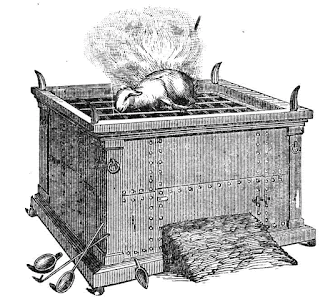
Altar of Sacrifice / Brazen Altar
The Word of God contains specifications for how the Hebrews could go about fulfilling a perpetual/continual sacrifice unto God (Numbers 28 & 29).
Altars play a central role in the Word of God. It is the place where man meets his Maker. It is a hallowed place necessary for the relationship between the man and his God to flourish.
The Law of Sacrifice is that we are to be in constant communication and prayer with God. Altars play an important role in fulfilling this law.
Exodus 20:24, “An altar of earth thou shalt make unto me, and shalt sacrifice thereon thy burnt offerings, and thy peace offerings, thy sheep, and thine oxen: in all places where I record my name I will come unto thee, and I will bless thee.”
According to Walter L. Wilson, “It is called an altar of earth because it belongs strictly to this earth. God makes no provision for forgiveness and salvation after death. No sacrifice of any kind is available to the lost sinner after he dies. There is no altar in hell.”[1]
There is no altar in hell! In hell you become totally and eternally cut-off from God.
There can be no relationship without communication.
Psalm 66:18-20, “18 If I regard iniquity in my heart, the Lord will not hear me: 19 But verily God hath heard me; he hath attended to the voice of my prayer. 20 Blessed be God, which hath not turned away my prayer, nor his mercy from me.”
To paraphrase this passage in a more common vernacular: “If I hold with affection an evil or unjust act, God will not listen to me.” God is not going to listen to my prayer when He knows that I am insincere about my relationship with Him and that I enjoy sin.
The Apostle Paul put it another way when writing of those who “did not like to retain God in their knowledge” and were “full of all unrighteousness,” by stating: “Who knowing the judgment of God, that they which commit such things are worthy of death, not only do the same, but have pleasure in them that do them” (See: Romans 1:18-32).
These regarders of iniquity and seekers of sinful pleasures will not be heard by God when they pray to Him in their insincerity, but for the sincere the psalmist did write, “But verily God hath heard me; he hath attended to the voice of my prayer” (Ps. 66:19). Why? Because the psalmist cried out to God and extolled Him (Ps. 66:17). He was retaining God in his knowledge – – acknowledging God and prioritizing Him above all else.
Ps. 84:1-4, “1 How amiable are thy tabernacles, O LORD of hosts! 2 My soul longeth, yea, even fainteth for the courts of the LORD: my heart and my flesh crieth out for the living God. 3 Yea, the sparrow hath found an house, and the swallow a nest for herself, where she may lay her young, even thine altars, O LORD of hosts, my King, and my God. 4 Blessed are they that dwell in thy house: they will be still praising thee. Selah.”
Vs. 3 = A Deserted Altar
Again, Wilson writes, “God’s people had forsaken both the worship and the service of the Lord to such an extent that the fires had gone out, the altar was cold, and no priest was near. The birds felt so much at home around these altars that they built their nests where the priests should have been serving, and the fires should have been burning.”[2]
The people of the Name failed to make Him the true Lord and King of their life and lost their intimacy with Him.
They allowed idols to replace their time at the altar of God. When do you pray? Where do you pray? How often do you pray? Have you a specific place of prayer? Is your daily and continual desire to be in constant communion with the Lord? What is the constant in your daily affairs?
You can’t hear God clearly if you are not listening to Him.
Active Listening is part and parcel of continual prayer, which is why the Apostle admonished the early Church to “pray without ceasing” (1 Thess. 5:17).
However, it is often too true that we allow the cares and troubles of life to gather in the place we once dedicated to God and now those birds and nests live in the place where once we came regularly for fellowship, repentance, communication, and relationship with God.
2 Cor. 10:3-6 contains what should be our response to the nesting birds that attempt to lodge themselves into our lives: “3 For though we walk in the flesh, we do not war after the flesh: 4 (For the weapons of our warfare are not carnal, but mighty through God to the pulling down of strong holds;) 5Casting down imaginations, and every high thing that exalteth itself against the knowledge of God, and bringing into captivity every thought to the obedience of Christ; 6 And having in a readiness to revenge all disobedience, when your obedience is fulfilled.
Two men in the Old Testament found themselves in opposite positions of relationship to God due entirely upon their habits regarding the altar and the law of sacrifice.
ABRAHAM:
Gen. 19:27, “And Abraham gat up early in the morning to the place where he stood before the LORD.”
Do you have a place where you daily stand before the Lord? A lifestyle of faithfulness in communion with the Lord?
The Akedah (binding of Isaac) & The Seven-Fold Blessing of Abraham (Gen. 22). Abraham prioritized his relationship with God above all things, and the Lord revealed to him an attribute of His character – Jehovah-jireh (“Jehovah sees”).[3]
Abraham is known in Scripture as the friend of God.
JOAB:
1 Kings 2:28, “Then tidings came to Joab: for Joab had turned after Adonijah, though he turned not after Absalom. And Joab fled unto the tabernacle of the LORD, and caught hold on the horns of the altar.”
There is no other passage in the OT where a pattern of prayer and sacrifice was established by Joab.
He had no resources to pull from because he had no relationship with God. He attempted to gain the mercy and the authority of the altar without first building a foundation of relationship with God.
God was not his priority.
Joab’s first allegiance was to himself.
Jesus Christ has paved the way for our access to the Divine with His sacrifice on the altar of Calvary. He said, “And I, if I be lifted up from the earth, will draw all men unto me” (Jn. 12:32). This “lifting” refers to the lifting up of the sacrifice upon the brazen altar by the priests. Because of Christ’s sacrifice we have been granted an avenue of access to God that Man lost in the Garden of Eden.
Hebrews 4:14-16, “14 Seeing then that we have a great high priest, that is passed into the heavens, Jesus the Son of God, let us hold fast our profession. 15 For we have not an high priest which cannot be touched with the feeling of our infirmities; but was in all points tempted like as we are, yet without sin. 16 Let us therefore come boldly unto the throne of grace, that we may obtain mercy, and find grace to help in time of need.”
Heb. 13:15-16, “By him therefore let us offer the sacrifice of praise to God continually, that is, the fruit of our lips giving thanks to his name. But to do good and to communicate forget not: for with such sacrifices God is well pleased.”
The continual faithfulness of Abraham carried eternal significance for himself, his lineage, and the rest of mankind. Our prayer habits also carry eternal weight, not only for ourselves but for others as well. When we begin to comprehend this truth we can understand the wisdom of that great missionary Billy Cole, who espoused the following ideology: “The reward for sacrifice is more sacrifice.” He also opined that “Until Jesus Christ comes there is no end to sacrifice,” which is, in this author’s opinion, the definition of the law of sacrifice because it contains the necessary ingredient of constancy.[4]
__________________
SOURCE: [1] Wilson, Walter L. (1957, 1999). A Dictionary of Bible Types. Peabody, MA: Hendrickson Publishers, Inc. p. 9-11.
Romans 5:12-21 12 Wherefore, as by one man sin entered into the world, and death by sin; and so death passed upon all men, for that all have sinned: 13 (For until the law sin was in the world: but sin is not imputed when there is no law. 14 Nevertheless death reigned from Adam to Moses, even over them that had not sinned after the similitude of Adam’s transgression, who is the figure of him that was to come. 15 But not as the offence, so also is the free gift. For if through the offence of one many be dead, much more the grace of God, and the gift by grace, which is by one man, Jesus Christ, hath abounded unto many. 16 And not as it was by one that sinned, so is the gift: for the judgment was by one to condemnation, but the free gift is of many offences unto justification. 17 For if by one man’s offence death reigned by one; much more they which receive abundance of grace and of the gift of righteousness shall reign in life by one, Jesus Christ.) 18 Therefore as by the offence of one judgment came upon all men to condemnation; even so by the righteousness of one the free gift came upon all men unto justification of life. 19 For as by one man’s disobedience many were made sinners, so by the obedience of one shall many be made righteous. 20 Moreover the law entered, that the offence might abound. But where sin abounded, grace did much more abound: 21 That as sin hath reigned unto death, even so might grace reign through righteousness unto eternal life by Jesus Christ our Lord.
In the beginning God made Man perfect and complete in His image and after His likeness (Gen. 1:26).
Man (Adam & Eve) was absolute in his spirit, soul, & body.
ABSOLUTE = “Perfect in quality or nature; complete. Not mixed; pure. Something regarded as the ultimate basis of all thought and being.” [1]
There are absolutes of truth, which are held by all true orthodox Christians (Christians who follow the teachings of Jesus, first century Apostles, and the prophets), and these truths include:
The eternality of the Word of God: “For Ever, O LORD, thy word is settled in heaven” (Ps. 119:89).
One God
The Bible standard of salvation: “…Repent, and be baptized every one of you in the name of Jesus Christ for the remission of sins, and ye shall receive the gift of the Holy Ghost” (Acts 2:38).
The necessity of the “born again” experience: “Jesus answered…Except a man be born again, he cannot see the kingdom of God” (Jn. 3:3).
With the existence of these (and other) absolutes, there is also another truth. The devil wishes to pervert the beauty of Man’s original design and separate him completely from his Maker.
The spirit of perversion is at work today and began with Lucifer and his rebellion against God, moved to the Garden of Eden and the serpent’s tactic of questioning and corrupting the relationship between Man and God.
PERVERSION in 1388 was defined as “action of turning aside from truth, corruption, distortion (originally of religious beliefs).”[3]
This is the devil’s tactic; to subvert, corrupt, bend, misshape, and distort what God calls “good” into something perverse. Perversion is not, of necessity sexual in connotation, but it is the turning of something pure into a wrong use.
The Fall of Man resulted in the perversion of our original state into a nature – – the Adamic nature. Because Man has fallen so far from his original state we find examples in the bible of many types of perverseness (one such illustration is the Jezebel spirit found in 1 Kings 16:31-21:25; 2 Kings 9:7-37; & Rev. 2:20-23). Trinitarianism, cessationism, & the Jezebel spirit are all perversions, but Jesus has given the Church the power and authority to help bring those stuck in error back to completeness in God and in truth.
Sin is the state of perversion from the original design and purpose of Man. The account of the Good Samaritan can be viewed as Jesus’ attempt to warn the Apostles and Church of the dangers of perversion.
Jesus came to return what was once perverted back to its original state, by His love: “For when we were yet without strength, in due time Christ died for the ungodly. For scarcely for a righteous man will one die: yet peradventure for a good man some would even dare to die. But God commendeth his love toward us, in that, while we were yet sinners, Christ died for us” (Ro. 5:6-8).
Because of Jesus Christ we now have the opportunity to walk in right relationship with Him. You’ve never met a man like Jesus. He never withdrew Himself from the lost sinners of the world (as many in the church do once they are “saves”). Instead, He went to the perverted (in spirit, soul, and body) who were looking for a change and a return to purity. He did not condemn the world, but He saved it through the work of redemption and reconciliation. He did not revile the perverse, but He removed the crookedness in them and returned them to a state of completeness. He, as the Potter, took the misshapen clay and created vessels of honor. Jesus heals, delivers, sets the captive free, restores broken homes, and places His love into right relationships.
Although tempted in all things, Jesus is our perfect example of a sinless life, and His obedience is what has reconciled Man to God. This ministry of reconciliation is the recovery of purity in our relationship with God.
“Therefore if any man be in Christ, he is a new creature: old things are passed away; behold, all things are become new. And all things are of God, who hath reconciled us to himself by Jesus Christ, and hath given to us the ministry of reconciliation; To wit, that God was in Christ, reconciling the world unto himself, not imputing their trespasses unto them; and hath committed unto us the word of reconciliation. Now then we are ambassadors for Christ, as though God did beseech you by us: we pray you in Christ’s stead, be ye reconciled to God. For he hath made him to be sin for us, who knew no sin; that we might be made the righteousness of God in him” (2 Cor. 5:17-21).




 The Pillar and Ground of Truth