1 Timothy 3:15, "...that thou mayest know how thou oughtest to behave thyself in the house of God, which is the church of the living God, the pillar and ground of the truth."
If memory serves, I was eighteen, my sister was sixteen, my brother was fourteen, and my mother was thirty-eight. We were in Indianapolis for a weekend getaway while my father was working somewhere.
So, we four headed to Indy for some fun. It was a great weekend and filled with all the highs and lows that being with your siblings often exposes.
For example, my brother couldn’t swim, and I…unwisely…tried to help him get his head out of the water by swimming below him, grabbing his feet, and pushing him upward. Now, in my mind he was going to automatically stiffen his legs and would then get the air he needed, but in his mind I was trying to drown him. In fact, to this day, he still believes I was out to kill him, and I’ve given up trying to convince him otherwise. The upshot – he learned to swim.
It was also on this trip that my mother let me drive around I-465 as we traveled to the Ringling Bros. and Barnum & Bailey Circus being held in old Market Square Arena. We were in my dad’s 1986 white Ford F-150 and I guess I thought that since I was in Indianapolis traveling a circular course (I-465) that this meant I could also drive like I was at the Indianapolis Motor Speedway. So, I did.
To this day, I smile and sometimes even laugh out loud when I remember hearing my mother yell out, “Slow this buggy down!” It was funny then, and it’s funny now, but there’s a lesson to be had here.
It’s during the Christmas season when people become so busy that they forget to slow down and think about what it’s really all about, and we all just need to slow our collective buggies down and ponder, remember, reminisce, and give thanks for the Wonderful child who is the good news of this season.
Martin Luther referred to this kind of deliberate reflecting centuries ago when he wrote about the Christmas Gospel:
The Christmas Gospel is so clear that there is little need of learned interpretation. It is only necessary to ponder it well, to contemplate it, and to take it completely into your heart. None will derive more benefit from it than they whose hearts hold still and who divest themselves of material considerations and concentrate diligently on it. This lesson is just like [the reflection of] the sun: in a quiet and still pond it can be seen clearly and warms the water powerfully, but in a rushing current it cannot be seen as well nor can it warm up the water as much. So if you wish to be illumined and warmed here, to see God’s mercy and wondrous deeds, so that your heart is filled with fire and light and becomes reverent and joyous, then go to where you may be still and impress the picture deep into your heart. You will find no end of wondrous deeds.
It’s during this time of year when Christmas Carols and holiday songs are sung and played all over the place. In fact, we sometimes get tired of hearing them. There’s a beautiful song sung by Tony Bennett and played by the late Bill Evans that I like to listen around Christmas time. It would not really be identified as a Christmas carol or a holiday song, but the words, when thought of in the context of the Christmas season really drive home the beauty of the Christmas Gospel.
So, with all we’re doing and all we’re trying to accomplish with just two more shopping days left until Christmas, take time to go somewhere quiet to think about Jesus Christ and what His birth really means to you, or to quote my mother, “Slow This Buggy Down!”
Here is a man who was born in an obscure village, the child of a peasant woman. He grew up in another village. He worked in a carpenter shop until He was thirty, and for three years He was an itinerant preacher. He never wrote a book. He never held an office. He never owned a house. He never had a family. He never went to college. He never put His feet inside a big city. He never traveled two hundred miles from the place where He was born. He never did one of the things that usually accompany greatness. He had no credential but Himself.
While still a young man, the tide of popular opinion turned against Him. His friends ran away. One of them denied Him. He was turned over to His enemies. He went through the mockery of a trial. He was nailed upon a cross between two thieves. His executioners gambled for the only piece of property He owned and that was His coat. When He was dead He was taken down and laid in a borrowed grave through the pity of a friend.
Nineteen wide centuries have come and gone, and today He is the centerpiece of the human race and the leader of the column of progress.
Iam far within the mark when I say that all the armies that ever marched and all the navies that were ever built, and that all the parliaments that ever sat and all kings that ever reigned, put together have not affected the life of a man upon this earth as did that One Solitary Life.
Philippians 4:18, “Finally, brethren, whatsoever things are true, whatsoever things are honest, whatsoever things are just, whatsoever things are pure, whatsoever things are lovely, whatsoever things are of good report; if there be any virtue, and if there be any praise, think on these things.”
In 1985, Neil Postman argued; in his seminal work Amusing Ourselves to Death: Public Discourse in the Age of Show Business, that the public had an oppressive addiction to entertainment through the content available on television.[1] Today, media and technology have advanced to the place where this entertainment addiction has risen to epidemic proportions.
The use of gaming consoles, televisions, smartphones, laptops, personal computers, mp3 players, DVDs, tablets, and so on has swept our culture. These technologies entertain people from the cradle to the tomb. It is common today to see a 4 year old playing a game on a mobile device while nearby a74 year old is playing a Scrabble game on a smartphone.
Other forms of entertainment include: movies, sporting events, amusement parks, outdoor activities, and even literature. It’s not our suggestion that Christians divorce themselves from all forms of entertainment, but that we choose our entertainment based upon the principles of our faith found in the Word of God.
As Christians we understand the necessity of adhering to Paul’s teaching when considering what choices we make regarding our entertainment. Therefore, we need to be vigilant when it comes to the content of entertainment we allow into our homes, minds, and even the church house.
With that in mind, Texas pastor and writer Rodney Shaw suggests that Christians ask themselves the following questions when making entertainment choices:[2]
Can I maintain my Christian witness and engage in this activity?
Can I glorify God in this activity?
Can I invoke the blessings of God, praying in the name of Jesus, for my involvement in this activity?
Does this activity leave me feeling as if I have compromised my values?
Would I be comfortable inviting my spiritual mentor to engage in this activity with me?
Does this activity promote godly attitudes and behaviors?
Do I leave this activity more or less equipped for the spiritual life?
Does this activity appeal to my carnal nature, i.e., the lust of the flesh, the lust of the eyes, or the pride of life?
Does this activity portray, promote or condone behaviors, attitudes or philosophies which are condemned in the Bible?
Do I feel guilty, like I am violating my conscience, or the need to repent after I have engaged in this activity?
Am I committed to ceasing my involvement in any activity which turns out to be in violation of biblical principles, including but not limited to turning off a device or walking out of a venue?
How does my commitment of time and resources to this activity compare to my commitment to spiritual disciplines and participation in the life of the church?
I was going about my daily activity recently when this thought entered my mind: “while you are waiting, God is shaping your life.” I believe that this was God’s way of speaking to me in that moment. So, bear with me as I try to convey this idea in a clear and concise manner.
Joseph was an immature younger brother and it’s possible that he was also a spoiled son doted upon by his father. He had a dream, but he was not ready to receive the fruition of that dream. So, God, in His great wisdom, allowed the 17 year old to be put into precarious situations and he did not see his father until he was 41 years old, at which time his dreams were fully realized. Each trial in Joseph’s life added responsibility and served to increase Joe’s maturity and integrity preparing him for the role he was to play in his dream.
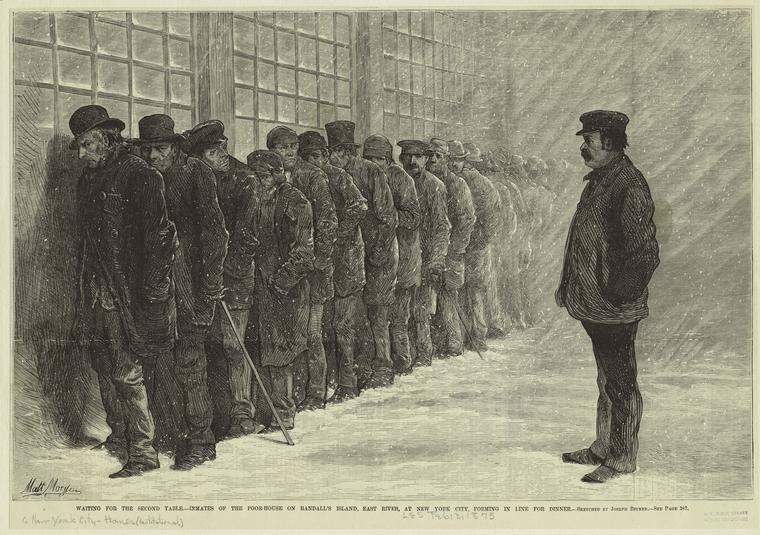
Waiting for the second table : Inmates of the Poor-House on Randall’s Island, East River, at New York City, forming in line for dinner | Artist: Joseph Becker | 13 February 1875
Just as Joseph was not ready, we sometimes find that while we are impatient for fulfillment, we are not quite ready for what God has promised us, or given us in dreams and visions. Therefore, while we are waiting, God is shaping and preparing us to receive the fullness of His promise.
Instead of becoming impatient, we need to learn how to let God shape us. All too often, we can get in the way of God’s plan by allowing the flesh to rise up and prolong the shaping that God’s hand is doing on our inner man as the Great Potter molds us into a vessel that He can use, and if we’re not awfully careful, we can get in the way of the Master’s preparation.
Joseph is a great example to us of one who suffered for his dream, but we read in no passage where he complained or charged God foolishly. In fact, the Word of God indicates twice God’s continued presence even in circumstances where the carnal mind would doubt His proximity (Genesis 39:2 & 21 “…the LORD was with Joseph…”), but Joseph teaches us a principle that will serve us well when our ambition collides with God’s timing.
I admonish you today to trust God in your time of preparation and allow the maturing process to complete its cycle because while you’re waiting, God is shaping your life.
What evidence is there that the Bible is in fact God’s Word?[1]
By: Adrian Rogers
I want to give you five reasons to affirm the Bible is the Word of God.
First, I believe the Bible is the Word of God because of its scientific accuracy. The Truth of the Word of God tells us that God “hangeth the earth upon nothing” (Job 26:7). How did Job know that the earth hung in space before the age of modern astronomy and space travel? The Holy Spirit told him. The scientists of Isaiah’s day didn’t know the topography of the earth, but Isaiah said, “It is [God] that sitteth upon the circle of the earth” (Isaiah 40:22). The word for “circle” here means a globe or sphere. How did Isaiah know that God say upon the circle of the earth? By divine inspiration.
Secondly, the Bible is affirmed through historical accuracy. Do you remember the story about the handwriting on the wall that is found in the fifth chapter of Daniel? Belshazzar hosted a feast with a thousand of his lords and ladies. Suddenly, a gruesome hand appeared out of nowhere and began to write on a wall. The king was disturbed and asked for someone to interpret the writing. Daniel was found and gave the interpretation. After the interpretation, “Then commanded Belshazzar, and they clothed Daniel with scarlet, and put a chain of gold about his neck, and made a proclamation concerning him, that he should be the third ruler in the kingdom.” (Daniel 5:29). Basing their opinion on Babylonian records, the historians claim this never happened. According to the records, the last king of Babylon was not Belshazzar, but a man named Nabonidas. And so, they said, the Bible is in error. There wasn’t a record of a king named Belshazzar. Well, the spades of archeologists continued to do their work. In 1853, an inscription was found on a cornerstone of a temple built by Nabonidas, to the god Ur, which read: “May I, Nabonidas, king of Babylon, not sin against thee. And may reverence for thee dwell in the heart of Belshazzar, my first-born favorite son.” From other inscriptions, it was learned that Belshazzar and Nabonidas were co-regents. Nabonidas traveled while Belshazzar stayed home to run the kingdom. Now that we know that Belshazzar and Nabonidas were co-regents, it makes sense that Belshazzar would say that Daniel would be the third ruler. What a marvelous nugget of truth tucked away in the Word of God!
Third, from Genesis to Revelation, the Bible reads as one book. And there is incredible unity to the Bible. The Bible is one book, and yet it is made up of 66 books, was written by at least 40 different authors over a period of about 1600 years, in 13 different countries and on three different continents. It was written in at least three different languages by people in all professions. The Bible forms one beautiful temple of truth that does not contradict itself theologically, morally, ethically, doctrinally, scientifically, historically, or in any other way.
Fourth, did you know the Bible is the only book in the world that has accurate prophecy?When you read the prophecies of the Bible, you simply have to stand back in awe. There are over 300 precise prophecies that deal with the Lord Jesus Christ in the Old Testament that are fulfilled in the New Testament. To say that these are fulfilled by chance is an astronomical impossibility.
Finally, the Bible is not a book of the month, but the Book of the ages.First Peter 1:25 says: “But the word of the Lord endureth for ever. And this is the Word which by the gospel is preached unto you.” No book has ever had as much opposition as the Bible. Men have laughed at it, scorned it, burned it, ridiculed it, and made laws against it. But the Word of God has survived. And it is applicable today as much as it was yesterday and will be tomorrow.
It’s so majestically deep that scholars could swim and never touch the bottom. Yet so wonderfully shallow that a little child could come and get a drink of water without fear of drowning. That is God’s precious, holy Word. The Word of God. Know it. Believe it. It is True.
“A gift, to be a gift, has to be accepted. Otherwise it lies like a burden between people.” –Robert Fisher, The Knight In Rusty Armor
I think that we are too casual in explaining the present of the Holy Ghost. Since it is in fact the Spirit of Christ in us, it is no wonder that He would be grieved by those who would not want Him in them. I think of those in the nominal church world who have the same access to the Holy Ghost as all of us in this age of grace and Holy Ghost outpouring, but who merely put it on a shelf and never unwrap it. The gift then lies unwrapped, unaccepted, and a burden.
My first date occurred at a banquet on February 14th, when I was twelve years old. I gave the young lady a present that night, which she accepted. However, later that evening, as she was preparing to go home, I misunderstood something she said. She wanted to go get her present, but I thought that she was saying something else. Consequently, she thought that I was refusing to let her keep the gift. To this day I think she still has little time for me and that event is a burden between two individuals.
LOL!! What a catastrophe!?!?
God is not like that. He not only gives a gift, but He never takes it back and He always knows exactly what we communicate – even when we don’t know how or what to say.
My grandfather began his journey towards God in the late 1940s. He had such an experience in repentance that he received the joy that the Samaritans had in Acts 8, but he had not received the Holy Ghost. His wife then met some Pentecostals and received the Holy Spirit. Grandpa would get upset with her at night because she spoke in tongues before going to bed at night and insisted that he needed more than what he had. It lay as a burden between them. Finally, Grandpa prayed to God and said that he knew he had all that God had for him, but to make his wife happy, would God let him speak in tongues. Instantly, the presence of God that he’d felt since his repentance left him. This was when he knew that God had more for him – it lay as a burden between him and God. He then cried out in repentance for His pride and God filled him with the Holy Ghost speaking in tongues.
Salvation is a gift that unless received in totality will be forfeit no matter who we are. Paul wrote about receiving the abundance of grace and the gift of righteousness, which is only accessible through Jesus Christ, who is our portion and free gift through grace (Ro. 5:21). Refusal of this gift, in this particular text, results in the refusal of eternal life.
Paul also wrote of the gift he was given charge of by the churches of Macedonia, who gave it to bless the Corinthian church (2 Cor. 8). I imagine that if this gift had been refused that there would have been ought among these two groups.
Unrequited love is often mentioned in literature and even God Himself is mentioned by some as a jilted lover covering His eyes in grief as His Jewish bride rejects Him and He then turns to the Gentiles for succor. I only know that He wept at their obtuseness and they became a people who had eyes but did not see. This rejection of Jesus still lies as a burden between God and the nation of Israel as a whole, but, praise God, Israel did not stumble to fall. I believe that the burden will be lifted when they look on Him whom they pierced and acknowledge Him as Messiah.
We call it the gift of the Holy Ghost and it is, by one man’s estimation, being received by 35,000 people a day throughout the world. Why wouldn’t people want to receive this phenomenon that Christ has paid for with His blood and made available to all people?
I’m reminded of the Andre Crouch song “Take Me Back” (1975). So often in my life it’s been the older songs that I grew up hearing and singing, which resonate deep in my spirit. Here are the words that still speak to me:
Take me back, Take me back, dear Lord, To the place, Where I first received You. Take me back, Take me back, dear Lord, Where I first believed.
I feel that I’m so far from You Lord, But still I hear You calling me. Those simple things, That I once knew, The memories are drawing me.
I must confess, Lord, I’ve been blessed, But yet, my soul’s not satisfied. Renew my faith, Restore my joy, Then dry my weeping eyes.
I tried so hard To make it all alone I need Your help Just to make it home.
Zion Tabernacle Kokomo, IN
Today, and every day, we need to renew our relationship with God. He is looking for an authenticity from us based on a continuing renewal of the fervor we first had at our initial conversion. The simplicity of our faith and our humility combined with the simplicity of the Gospel resulted in an authentic conversion.
The words “renew my faith, renew my joy, then dry my weeping eyes” is a call get back to the place where we first gave our will to God.
What is it about us that having first come to Jesus with empty hands and totally dependent upon him we now, after being “in the Church” for some time, think we can somehow do it all on our own?
I think that there are many people, especially in their 20s and 30s, that received an initial conversion experience at a young age (6-10), but did not really get converted until later, when they were more mature. This may be why we have trouble as young adults. We “got” the Holy Ghost at a young age, but the Holy Ghost did not “get” get us until later.
It is amazing to me to witness the blessing of God on us and yet we are not satisfied in our relationship with Him because of our own self-sufficiency, pride, and vain living. It is a crutch – a trap of the enemy and the flesh to alienate us from intimacy with Jesus Christ, not a “Jesus is my boyfriend” type of intimacy that we are constantly barraged with in this self-absorbed culture we live in, but a closeness that comes from a genuine relationship with our Savior – a relationship that is deepened every day in the good and the bad that life throws at us.
Paul wrote of a desire to know our Lord Jesus Christ in every facet of life in order that he might one day be resurrected from the dead: “I want to know Christ and experience the mighty power that raised him from the dead. I want to suffer with him, sharing in his death, so that one way or another I will experience the resurrection from the dead!” (Philippians 3:10, NLT).
C. S. Lewis addressed the purpose of suffering in his book The Problem of Pain in this way:
My own experience is something like this. I am progressing along the path of life in an ordinary contentedly fallen and godless condition, absorbed in a merry meeting with my friends for the morrow or a bit of work that tickles my vanity to-day, a holiday or a new book, when suddenly a stab of abdominal pain that threatens serious disease, or a headline in the newspapers that threatens us all with destruction, sends this whole pack of cards tumbling down.
At first I am overwhelmed, and all my little happinesses look like broken toys. Then, slowly and reluctantly, bit by bit, I try to bring myself into the frame of mind that I should be in at all times. I remind myself that all these toys were never intended to possess my heart, that my true good is in another world and my only real treasure is Christ. And perhaps, by God’s grace, I succeed, and for a day or two become a creature consciously dependent on God and drawing its strength from the right sources. But the moment the threat is withdrawn, my whole nature leaps back to the toys: I am even anxious, God forgive me, to banish from my mind the only thing that supported me under the threat because it is now associated with the misery of those few days. Thus the terrible necessity of tribulation is only too clear. God has had me for but forty-eight hours and then only by dint of taking everything else away from me.
Let Him but sheathe that sword for a moment and I behave like a puppy when the hated bath is over – I shake myself as dry as I can and race off to reacquire my comfortable dirtiness, if not in the nearest manure heap, at least in the nearest flower bed. And that is why tribulations cannot cease until God either sees us remade or sees that our remaking is now hopeless.
Our problem is that we become desensitized to those “Take Me Back” moments and even brush them aside when God calls us to some personal time with Him. Jesus wants us to give ourselves to Him and surrender our will to His will. One way we can do that is to take the time to go back to those simpler times when all we had was our faith in Him and all we wanted was His presence in our lives guiding, keeping, and sustaining us.
Ephesians 5:15-16, “See then that ye walk circumspectly, not as fools, but as wise, redeeming the time, because the days are evil.”
It is healthy for a soul to want to do more for God and to be in a perpetual state of personal improvement and spiritual maturity. There are 168 hours in a week, and if you tithe your time to God as you do your monetary increase then that leaves you with nearly 17 hours a week that you can dedicate solely to God.
Assuming you are faithful in your church attendance, an average service is 2 hours, then you have 11 hours left to invest in your relationship with God in a week, and the real question becomes: “What do you do with these 11 hours of great Spiritual potential?” Consider these suggestions:
1. Pray. You don’t have to start out praying an hour a day, but whatever time you invest in prayer will bring results. Prayer is essential to growing in the Lord. Learn to intercede, but don’t let intercession overwhelm you and rob you of joy.
2. Read. Read the Word of God. Some people spend so much time studying and chasing down rabbit tracks in the Bible that they fail to simply read the Bible. Pray, clear your mind, then read. Let His written Word be as food to your spirit and absorb it. Remember: The greatest and final source of self-examination is the Word of God.
3. Study. This is the time to follow those rabbit trails. This is the time to look into the deeper meaning of the Scriptures. This is the time to search the Scriptures.
4. Listen. Invest time in active listening. Many people talk to God in prayer, but ignore the richest half of prayer time — listening to what Jesus is saying to them. He hears your prayer, but do you hear His? Prayer is dialogue, not monologue.
5. Fast. You want to draw closer to God? Fast one day a week, one meal a day, or three days (typically, 3 days is what it takes to crucify the flesh). You can also fast by setting aside time spent on things that you enjoy (other than food), like the Internet, movies, Starbucks, chocolate, etc.
6. Praise. There needs to be some time in your week, or day, where you loudly and demonstratively praise God. Dance before Him in secret prayer; sing in the Holy Ghost loudly as you’re sweeping the carpet; let tears of praise flow. We praise God for what He’s done. Shout! Clap! Jump! Sing! Extol!
7. Worship. Worship is different than praise. Study the difference and then apply it to your life. We worship God for who He is. Lie prostrate before God.
8. Obey. Whatever God tells you to do in His Word, in prayer, or by His messengers (Pastor, preachers, teachers…) do! Remember: God will never ask/tell you to do something that violates His written Word. Of course, there will be days when you feel like you’ve been with God all day, and others when He seems to be unavailable, but every day is full of potential investment opportunities in your relationship with your Lord and Savior Jesus Christ as you tithe your time to Him.
In the middle of the last century (1900s) Anthony F. C. Wallace, the historian and anthropologist, developed the concept of “Revitalization Movements.” Here are a few of his ideas:
A revitalization movement is defined as a deliberate, organized, conscious effort by members of a society to construct a more satisfying culture. Revitalization is thus, from a cultural standpoint, a special kind of culture change phenomenon: the persons involved in the process of revitalization must perceive their culture, or some major areas of it, as a system (whether accurately or not); they must feel that this cultural system is unsatisfactory; and they must innovate not merely discrete items, but a new cultural system, specifying new relationships as well as, in some cases, new traits.
…Cultures can change within one generation; and the process…is the revitalization process.
The term “revitalization” implies an organismic analogy.
“Stress is defined as a condition in which some part, or the whole, of the social organism is threatened with more or less serious damage.”
“Messianic Movements” emphasize the participation of a divine savior in human flesh in the mazeway transformation.
The presence of these movements are seen throughout history, and it can even be argued that the Scriptures make reference to language and events that are Revitalistic in nature. For example, Isaiah 30:19-23 (vs. 21, “…the is the way, walk ye in it, when ye turn to the right hand, and when ye turn to the left”).
Wallace coined the term “revitalization movements” to explain some particular historical phenomena that have taken place in the past, and according to Wallace, revitalization movements have specific identifiers:
When a culture has reached its lowest point a prophet/statesman will arise to help the people gain what has been lost.
This leader makes a plea and call to return to the conservative and fundamentalist ideas of the past.
The result is the formation of a religious method that renews the culture and continues to grow even after the prophet dies.
Some examples would be:
Handsome Lake, the Seneca Prophet (1799), called for an end on reliance of European goods, and a return to traditional ways.
Jonathan Edwards preached “Sinners in the Hands of an Angry God” at a normal tone of voice at a wicked and perverse time in New England and universal repentance erupted in the audience.
John Wesley and his methodism was a call to renewed holiness.
Jesus Christ formed a new method that hearkened back to some of the principles and spirit of the Old Testament (i.e. Golden Rule) and boldly declared, “I am the way, the truth, and the life…” (John 14:6) while establishing Himself as the only “divine savior in human flesh.”
Moses reminded the Hebrews of Jehovah’s directive to them concerning their responsibility to Him and their reward for obedience and faithfulness: “Ye shall observe to do therefore as the LORD your God hath commanded you: ye shall not turn aside to the right hand or to the left. Ye shall walk in all the ways which the LORD your God hath commanded you, that ye may live, and that it may be well with you, and that ye may prolong your days in the land which ye shall possess” (Deut. 5:32-33).
Unfortunately, Jewish history is rife with stories of their backsliding and falling headlong into idolatry and depravity. They did not cherish their faith, not wholly, which is why the Lord said, “All day long I have stretched forth my hands unto a disobedient and gainsaying people” (Ro. 10:21).
The Old Testament prophets even took pains to draw the backslidden people of the Divided Kingdom back to Jehovah through language that echoes the idea of what Wallace called “a religious revival.” Jeremiah does so with this portion of text: “…stand ye in the ways, and see, and ask for the old paths, where is the good way, and walk therein, and ye shall find rest for your souls. But they said, We will not walk therein” (Jer. 6:16). the problem here was that the call was made for revitalization but the people did not want it. The result for their rebellion was captivity and dispersion.
Thankfully, God had another plan and through His prophets prepared a way out of captivity and a return to Jerusalem for a remnant, who would help to usher in the arrival of the only true Savior of Mankind — Jesus Christ. This God-man divested Himself of His Heavenly glory to manifest Himself in flesh and become the Savior, but even He spoke out when he addressed Jerusalem and said (Matt. 23:37), “O Jerusalem, Jerusalem, thou that killest the prophets, and stonest them which are sent unto thee, how often would I have gathered thy children together, even as a hen gathereth her chickens under her wings, and ye would not!”
In today’s society it is vital that we continue to move forward without letting loose of core faith values. This can only take place when each generation of Oneness Pentecostals has a first generation experience, which, I think, will continue the march of revitalization and revival in our movement and the world.
The modern Apostolic Movement is more than a subculture. It is a counter-culture – – a new culture based on the teachings of our Messiah – the Lord Jesus Christ.