Categories
Bible Preaching

More Vile

Stephen Kuntzman | March 9, 2025 | 6:30 PM

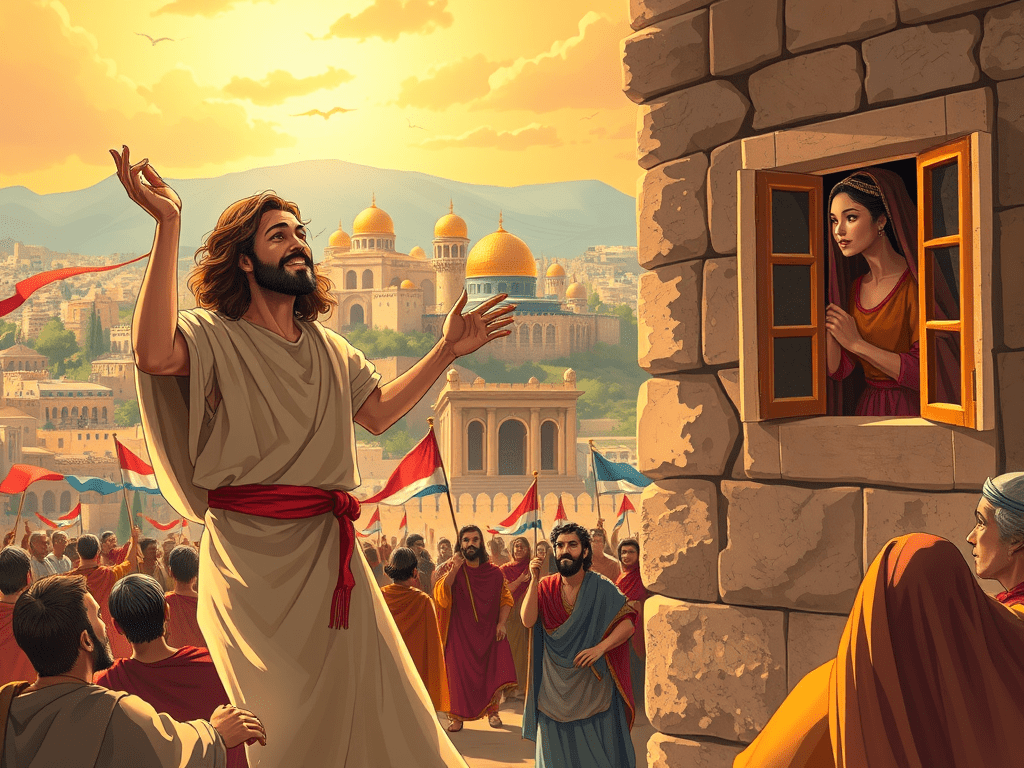
Text: 2 Samuel 6:16-23, “(16)  And as the ark of the LORD came into the city of David, Michal Saul’s daughter looked through a window, and saw king David leaping and dancing before the LORD; and she despised him in her heart. (17)  And they brought in the ark of the LORD, and set it in his place, in the midst of the tabernacle that David had pitched for it: and David offered burnt offerings and peace offerings before the LORD. (18)  And as soon as David had made an end of offering burnt offerings and peace offerings, he blessed the people in the name of the LORD of hosts. (19)  And he dealt among all the people, even among the whole multitude of Israel, as well to the women as men, to every one a cake of bread, and a good piece of flesh, and a flagon of wine. So all the people departed every one to his house. (20)  Then David returned to bless his household. And Michal the daughter of Saul came out to meet David, and said, How glorious was the king of Israel to day, who uncovered himself to day in the eyes of the handmaids of his servants, as one of the vain fellows shamelessly uncovereth himself! (21)  And David said unto Michal, It was before the LORD, which chose me before thy father, and before all his house, to appoint me ruler over the people of the LORD, over Israel: therefore will I play before the LORD. (22)  And I will yet be more vile than thus, and will be base in mine own sight: and of the maidservants which thou hast spoken of, of them shall I be had in honour. (23)  Therefore Michal the daughter of Saul had no child unto the day of her death.

Picture the moment:

  • The ark of the covenant is being returned to Jerusalem to the city of David (on a hill south of Mt. Moriah, the Temple Mount, where Solomon’s Temple will one day stand to permanently house it).
  • It was been away from Israel for 20 year.
    • 7 months with the Philistines
    • Then the Ark was taken to Abinadab’s house in Kiriath-Jearim, where his son Eleazar, watched over it for 20 years.
    • Then the house of Obededom cared for it for 3 months.
    • “And it was told king David, saying, The LORD hath blessed the house of Obededom, and all that pertaineth unto him, because of the ark of God. So David went and brought up the ark of God from the house of Obededom into the city of David with gladness. And it was so, that when they that bare the ark of the LORD had gone six paces, he sacrificed oxen and fatlings. And David danced before the LORD with all his might; and David was girded with a linen ephod. So David and all the house of Israel brought up the ark of the LORD with shouting, and with the sound of the trumpet” (2 Samuel 6:12-15).
      • “With gladness” = with joyful music, jubilant dancing and passionate singing.

Peering from their home, Michal watched David and despised him for his worship to God.

She so reviled him that the moment he came into the courtyard shemet him and with words dripping with sarcasm, irony, disrespect and even hate, she mocked him for his act of worship –

for making himself small in humble worship to His Lord.

True worshippers forget their surroundings.

They forget what their positions, titles, and roles

They got lost in adoration of the One who fills all space and time.

True worshippers don’t take into account others may think or say, they simply want to offer their praise and worship to their God.

Michal was bitter and like her father, Saul, she was more concerned about the people’s opinion than she was that her husband worshipped his God.

So, in a move of manipulation, she tried to shame David with words that she thought would reduce his joy and gladness, but David had already faced this attack before.

Years before, Saul dangled his daughter as a prize. It was witchcraft anf manipulation.

One day Saul said to David, “I am ready to give you my older daughter, Merab [Michal], as your wife. But first you must prove yourself to be a real warrior by fighting the LORD’s battles.” For Saul thought, “I’ll send him out against the Philistines and let them kill him rather than doing it myself.”[1]

Not an offer out of friendship or good will, but a trap.

Saul’s main struggle was his overwhelming concern with what the people would think of him, which is why he said, “Let not mine hand be upon him, but let the hand of the Philistines be upon him.”

In other words, let them do my dirt work for me so that the people won’t think badly of me.

Manipulation and control – witchcraft.

The struggle every leader faces is “their faces” (Jer. 1:4-10), and Saul failed miserably in this area.

You will remember what the LORD said to Jeremiah:

Then the word of the LORD came unto me, saying, Before I formed thee in the belly I knew thee; and before thou camest forth out of the womb I sanctified thee, and I ordained thee a prophet unto the nations. Then said I, Ah, Lord GOD! behold, I cannot speak: for I am a child. But the LORD said unto me, Say not, I am a child: for thou shalt go to all that I shall send thee, and whatsoever I command thee thou shalt speak. Be not afraid of their faces: for I am with thee to deliver thee, saith the LORD. Then the LORD put forth his hand, and touched my mouth. And the LORD said unto me, Behold, I have put my words in thy mouth. See, I have this day set thee over the nations and over the kingdoms, to root out, and to pull down, and to destroy, and to throw down, to build, and to plant.[2]

Saul’s attempt in trying to persuade David to wear his armor in his fight with Goliath was for the same reason he wanted Samuel to worship with him after God rejected him.

He was more interested in what the people thought. He was terrified of public opinion.

Saul thought that David wearing his armor would be good for Saul.

Saul was two years into his kingship when he showed his fear of public opinion and it was here that he lost the dynasty:

“And Samuel said, What hast thou done? And Saul said, Because I saw that the people were scattered from me, and that thou camest not within the days appointed, and that the Philistines gathered themselves together at Michmash; therefore said I, The Philistines will come down now upon me to Gilgal, and I have not made supplication unto the LORD: I forced myself therefore, and offered a burnt offering. And Samuel said to Saul, Thou hast done foolishly: thou hast not kept the commandment of the LORD thy God, which he commanded thee: for now would the LORD have established thy kingdom upon Israel for ever. But now thy kingdom shall not continue: the LORD hath sought him a man after his own heart, and the LORD hath commanded him to be captain over his people, because thou hast not kept that which the LORD commanded thee.”[3]

In 1 Samuel 15 it looks as if God was willing to give Saul a second chance of sorts, but his disobedience led to his ruin and it was partly due to fear of public opinion:

“And Saul said unto Samuel, I have sinned: for I have transgressed the commandment of the LORD, and thy words: because I feared the people, and obeyed their voice.”[4]

Later Saul lies to Samuel, but still asked for special favor before the people:

“Now therefore, I pray thee, pardon my sin, and turn again with me, that I may worship the LORD. And Samuel said unto Saul, I will not return with thee: for thou hast rejected the word of the LORD, and the LORD hath rejected thee from being king over Israel. And as Samuel turned about to go away, he laid hold upon the skirt of his mantle, and it rent. And Samuel said unto him, The LORD hath rent the kingdom of Israel from thee this day, and hath given it to a neighbour of thine, that is better than thou. And also the Strength of Israel will not lie nor repent: for he is not a man, that he should repent. Then he said, I have sinned: yet honour me now, I pray thee, before the elders of my people, and before Israel, and turn again with me, that I may worship the LORD thy God.”

Saul’s worship wasn’t from his heart to God, but from his mind to manipulate the peoples’ perception.

This was what Saul taught Michal.

If David had never laid down his kingly robes, but instead marched stoically before the Ark, Michal would have been thrilled with this display of Royal pomp and circumstance.

The key difference between Saul and David is here:

“And Samuel said, When thou [Saul] wast little in thine own sight, wast thou not made the head of the tribes of Israel, and the LORD anointed thee king over Israel?” (1 Samuel 15:17)

Humility – the willingness to make himself “MORE VILE” – is what separated David from Saul and distinguished him in God’s eyes as “a man after his own heart.”

David laid down his kingly robes and returned to his humble origins where he first met God as a shepherd boy.

In the Ancient Hebrew, vile also means “gathering to the staff.”

When the shepherd called the sheep they swiftly came to him.

The staff of the shepherd was his tool of authority. With it he would direct, discipline and protect the flock.[5]

David heard the voice of the Shepherd and gathered himself to His Staff in an offering both of animal sacrifices or worship and in a spirited display of  a Living Sacrifice.

David learned worship shepherding in the fields long before he became a king, it was east to lay aside his kingly robe to worship his King.

“I beseech you therefore, brethren, by the mercies of God, that ye present your bodies a living sacrifice, holy, acceptable unto God, which is your reasonable service. And be not conformed to this world: but be ye transformed by the renewing of your mind, that ye may prove what is that good, and acceptable, and perfect, will of God” (Romans 12:1-2).

You must make yourself More Vile.

It’s easy in our multigenerational Pentecostal culture to think that worship is in the dance, the shout, the jump, the tongues,

BUT real worship is when you become vile and base to yourself.

You submit your self in an act or personal requirement to lay down your pride, personal rights, what you consider “justice” — lay down your gift and be reconciled.

Why? Because someone has ought against you, not you against them.

We wear robes of dignity, pride, position (that’s beneath me), entitlement, religion, but Jesus is looking for His robe on you: garments of praise, robes of righteousness.

More Vile:

  • But it doesn’t make any sense
  • What will people think
  • Costs you something – a sacrifice
  • Requires a demonstration of true leadership – a true shepherd (Jesus at Calvary became “more vile”)

Michal, if she ever had it, lost it that day when she reviled and mocked a true worshipper because of her fear of what others might say,

But David, that shepherd-king gave it all in worship.

Jesus is here and He knows what it is like to humble Himself and be seen as vile:

Philippians 2:5-11, “(5) Let this mind be in you, which was also in Christ Jesus:  (6)  Who, being in the form of God, thought it not robbery to be equal with God:  (7)  But made himself of no reputation, and took upon him the form of a servant, and was made in the likeness of men:  (8)  And being found in fashion as a man, he humbled himself, and became obedient unto death, even the death of the cross.  (9)  Wherefore God also hath highly exalted him, and given him a name which is above every name:  (10)  That at the name of Jesus every knee should bow, of things in heaven, and things in earth, and things under the earth;  (11)  And that every tongue should confess that Jesus Christ is Lord, to the glory of God the Father.”


[1] 1 Samuel 18:17, NLT.

[2] Jeremiah 1:4-10

[3] 1 Samuel 13:11-14

[4] 1 Samuel 15:24

[5] H7043. Ancient Hebrew Lexicon of the Bible.

Categories
Bible Teaching

12 Stones

Apostolic Life Cathedral | 5/26/2024 | 10:00 AM

Text: Joshua 4:1-9

(1)  And it came to pass, when all the people were clean passed over Jordan, that the LORD spake unto Joshua, saying,

(2)  Take you twelve men out of the people, out of every tribe a man,

(3)  And command ye them, saying, Take you hence out of the midst of Jordan, out of the place where the priests’ feet stood firm, twelve stones, and ye shall carry them over with you, and leave them in the lodging place, where ye shall lodge this night.

(4)  Then Joshua called the twelve men, whom he had prepared of the children of Israel, out of every tribe a man:

(5)  And Joshua said unto them, Pass over before the ark of the LORD your God into the midst of Jordan, and take ye up every man of you a stone upon his shoulder, according unto the number of the tribes of the children of Israel:

(6)  That this may be a sign among you, that when your children ask their fathers in time to come, saying, What mean ye by these stones?

(7)  Then ye shall answer them, That the waters of Jordan were cut off before the ark of the covenant of the LORD; when it passed over Jordan, the waters of Jordan were cut off: and these stones shall be for a memorial unto the children of Israel for ever.

(8)  And the children of Israel did so as Joshua commanded, and took up twelve stones out of the midst of Jordan, as the LORD spake unto Joshua, according to the number of the tribes of the children of Israel, and carried them over with them unto the place where they lodged, and laid them down there.

(9)  And Joshua set up twelve stones in the midst of Jordan, in the place where the feet of the priests which bare the ark of the covenant stood: and they are there unto this day.

A Memorial of Twelve Stones[1]:

Memorials are extremely important in our society, so that we will remember our heritage and the sacrifices we and others have made to make them possible.

Importance of spiritual memorials for our personal lives and for the church.

A Memorial for Israel, Joshua 4:1-8

  1. Commanded by God.
  2. Fulfilled by Joshua and the people.
  3. Twelve stones from Jordan.

What about the Twelve Stones?

  1. Represented all the people (twelve tribes), verse 2.
  2. Participation by the people, verse 3.
  3. Related to the miracle, verse 3.
  4. Permanence because of the durability and number of the stones.

The Purpose of the Memorial, Joshua 4:20-24

  1. A reminder that God is the one who performed the miracle of deliverance.
  2. Just as He did for previous generations.
  3. A sign to future generations.
  4. A sign to other nations of the power of God.
  5. So that Israel would fear—honor, respect—the Lord forever.

What about it?

  1. We need memorials in our lives. Example: our family’s testimony of conversion.
  2. We need visible memorials that every family and church member participates in.
  3. Not a dead memorial, but a living one, for the same reasons as in Joshua 4.
  4. Heartfelt and demonstrative worship.
  5. Personal and group prayer, including the prayer closet, the prayer room, and the altar.
  6. Praying in the Holy Ghost – Speaking in tongues.
  7. Visible standards of holiness.
  8. Personal witness.
  9. Of course, a memorial is no good without the continuing reality of a transformed life.

Continue shoring up the memorials in your life.


[1] Source: italicized parts – Bernard, David K. (2004). Preaching the Apostolic Faith. p. 83.

Categories
Bible Preaching church history History

The Burning of Guyandotte

Apostolic Life Cathedral | 1/28/2024 | 6:30 pm

Text: Hebrews 12:28-29, “(28)  Wherefore we receiving a kingdom which cannot be moved, let us have grace, whereby we may serve God acceptably with reverence and godly fear: (29)  For our God is a consuming fire.”

Ancillary: 2 Timothy 1:6-7, “(6) Wherefore I put thee in remembrance that thou stir up the gift of God, which is in thee by the putting on of my hands. (7)  For God hath not given us the spirit of fear; but of power, and of love, and of a sound mind.”

November 11, 1861: The burning of Guyandotte[1]

The Civil War hit home in the Cabell County town of Guyandotte on November 11, 1861. Union troops burned the town in retaliation over a raid pulled off the day before by Confederate cavalry.

Joe Geiger, who has written a book about the Civil War in Cabell County, says Guyandotte’s fate was the result of suspected collaboration with the Confederate raiders and the town’s secessionist reputation.

Geiger said, It’s not really clear exactly how many buildings were burnt. But practically the entire business section was burned and a number of houses as well.

It’s interesting to note Confederate sympathizers’ houses were not the only ones targeted. Many houses belonging to people of Union sympathies were burned as well.

In the fall of 1861, Guyandotte served as a hostile host to a Union recruit camp. The recruits weren’t able to put up much of a fight against the raiders. They were taken prisoner and forced to march to New Bern, Virginia.

According to Geiger, some of the animosity came about because of the march of the prisoners. It began at a full run. They were tied two-by-two with rope and were herded out of town. Apparently, quite a few of the Guyandotte secessionist women were dressed up with their aprons and were yelling at the prisoners and such. The march was very torturous…

The Wheeling Intelligencer newspaper called Guyandotte the “ornaryest place on the Ohio River” and said it ought to have been burned earlier.

That event is called

The Burning of Guyandotte.”

I’m praying that another fresh fire will begin to burn in Guyandotte tonight and its flames will burn through the Tri-State.

One hundred years ago, In 1924, a Pioneer of the Pentecostal Movement, Lill Horton had a dream. She was in a Church full of stoves, but she was shivering with cold. So, she sought for an interpretation and this was what she received:

“There’s plenty of people (stoves) who need to have the fire of God kindled in them, but they do not have the Holy Ghost to kindle the fire. You need to go where the Holy Ghost fire is burning.”[2]

You are in a Church tonight where God’s fire and shekinah falls and fills the stoves of all who will willingly reach out to Him in faith, call out in repentance and praise Him with their whole heart.

Others in this room tonight have received the Holy Spirit of God, but you’ve allowed the flame to become a barely glowing ember.

You need to hear, heed, listen and obey Paul’s words to Timothy:

“(6) Wherefore I put thee in remembrance that thou stir up the gift of God, which is in thee by the putting on of my hands.  (7)  For God hath not given us the spirit of fear; but of power, and of love, and of a sound mind” (2 Timothy 1:6-7).

It is absolutely necessary that you stir the embers and bring forth a fresh fire tonight.

For 100 years there has been a fire in Guyandotte.

It started in Guyandotte and that same Holy Ghost fire is here tonight.

This campus in located at 350 Staunton Street in the Guyndotte section of Huntington…

But this fire I’m preaching isn’t confined to any street of section.

“Our God Is A Consuming Fire”

The fire of the Holy Ghost crosses rivers and bridges

Social divisions, economic disparities, prejudicial thinking, generational gaps

The Holy Ghost fire I am talking about is a cord of flame uniting every Spirit-filled believer together in their faith and experience:

“For as the body is one, and hath many members, and all the members of that one body, being many, are one body: so also is Christ. For by one Spirit are we all baptized into one body, whether we be Jews or Gentiles, whether we be bond or free; and have been all made to drink into one Spirit” (1 Corinthians 12:12-13).

Our God is a consuming fire!

Look at our text: Hebrews 12:28-29, “(28)  Wherefore we receiving a kingdom which cannot be moved, let us have grace, whereby we may serve God acceptably with reverence and godly fear: (29)  For our God is a consuming fire.”

This kingdom that began on the Day of Pentecost in Acts 2 (And when the day of Pentecost was fully come), placed in those 120 Holy Ghost divine power:

“But ye shall receive power, after that the Holy Ghost is come upon you: and ye shall be witnesses unto me both in Jerusalem, and in all Judaea, and in Samaria, and unto the uttermost part of the earth” (Acts 1:8).

This kingdom cannot be moved.

It is built and established on a Rock – The Lord Jesus Christ – and the gates of Hell cannot prevail against it.

A consuming fire?

God in Christ is a consuming fire. Our Lord Jesus is “full of grace and mercy, yet He will appear in great wrath to His enemies, who will not let Him reign over them.”[3]

There is a payday someday.

So, we worship Him with reverence –  a humility recognizing our unworthiness, and Godly fear – a desire from our most tender area of faith and affection not to offend God.[4]

Why? Although we see Him in this present church age as a God of mild majesty, He still possesses the tremendous power He displayed at mount Sinai, and one day, maybe tonight, He will break forth as a consuming fire against all those who violate His law and despise his gospel.[5]

I used the fire pit last night while cleaning out my garage,

The fire was hot, bright and even singed hair on the back of my hand.

The smoke got all over my clothes, my skin, hair, and even nostrils were full of the smoke…the lasting residue of the fire.

Paul told us what lasting effect the Gift, the fire, of the Holy Ghost has on us:

Wherefore I put thee in remembrance that thou stir up the gift of God, which is in thee by the putting on of my hands. For God hath not given us the spirit of fear; but of power, and of love, and of a sound mind” (2 Timothy 1:6-7).

  • No Fear – no timidity, no cowardice, but boldness
  • Power – a holy courage, dunamis, miraculous power, strength,
    • “Power to encounter foes and dangers; power to bear up under trials; power to triumph in persecutions.”[6]
  • Love – God & Man
    • “There is no fear in love; but perfect love casteth out fear: because fear hath torment. He that feareth is not made perfect in love” (1 John 4:18).
  • Sound Mind – To think clearly. Discretion. The Mind of Christ.
    • Philippians 2:1-11, (1) If there be therefore any consolation in Christ, if any comfort of love, if any fellowship of the Spirit, if any bowels and mercies,  (2)  Fulfil ye my joy, that ye be likeminded, having the same love, being of one accord, of one mind.  (3)  Let nothing be done through strife or vainglory; but in lowliness of mind let each esteem other better than themselves.  (4)  Look not every man on his own things, but every man also on the things of others.  (5)  Let this mind be in you, which was also in Christ Jesus:  (6)  Who, being in the form of God, thought it not robbery to be equal with God:  (7)  But made himself of no reputation, and took upon him the form of a servant, and was made in the likeness of men:  (8)  And being found in fashion as a man, he humbled himself, and became obedient unto death, even the death of the cross.  (9)  Wherefore God also hath highly exalted him, and given him a name which is above every name:  (10)  That at the name of Jesus every knee should bow, of things in heaven, and things in earth, and things under the earth;  (11)  And that every tongue should confess that Jesus Christ is Lord, to the glory of God the Father.

[1] http://archive.wvculture.org/hiStory/timetrl/ttnov.html#1111. Accessed: 1/28/2024.

[2] Mary H. Wallace. (1981) Pioneer Pentecostal Women (Vol. I). Word Aflame Press. 119-120.

[3] Hebrews 12:29. John Gill’s Exposition of the Bible.

[4] Ibid.

[5] Ibid.

[6] Albert Barnes.

Categories
Consider this...

Redeeming the Time

Ephesians 5:15-16, “See then that ye walk circumspectly, not as fools, but as wise, redeeming the time, because the days are evil.”

It is healthy for a soul to want to do more for God and to be in a perpetual state of personal improvement and spiritual maturity.  There are 168 hours in a week, and if you tithe your time to God as you do your monetary increase then that leaves you with nearly 17 hours a week that you can dedicate solely to God.

Assuming you are faithful in your church attendance, an average service is 2 hours, then you have 11 hours left to invest in your relationship with God in a week, and the real question becomes: “What do you do with these 11 hours of great Spiritual potential?”  Consider these suggestions:

1.      Pray.  You don’t have to start out praying an hour a day, but whatever time you invest in prayer will bring results.  Prayer is essential to growing in the Lord.  Learn to intercede, but don’t let intercession overwhelm you and rob you of joy.

2.      Read.  Read the Word of God.  Some people spend so much time studying and chasing down rabbit tracks in the Bible that they fail to simply read the Bible.  Pray, clear your mind, then read.  Let His written Word be as food to your spirit and absorb it. Remember: The greatest and final source of self-examination is the Word of God.

3.      Study.  This is the time to follow those rabbit trails. This is the time to look into the deeper meaning of the Scriptures. This is the time to search the Scriptures.

4.      Listen.  Invest time in active listening.  Many people talk to God in prayer, but ignore the richest half of prayer time — listening to what Jesus is saying to them.  He hears your prayer, but do you hear His?  Prayer is dialogue, not monologue.

5.      Fast.  You want to draw closer to God? Fast one day a week, one meal a day, or three days (typically, 3 days is what it takes to crucify the flesh). You can also fast by setting aside time spent on things that you enjoy (other than food), like the Internet, movies, Starbucks, chocolate, etc.

6.      Praise.  There needs to be some time in your week, or day, where you loudly and demonstratively praise God.  Dance before Him in secret prayer; sing in the Holy Ghost loudly as you’re sweeping the carpet; let tears of praise flow. We praise God for what He’s done. Shout! Clap! Jump! Sing! Extol!

7.     Worship.  Worship is different than praise.  Study the difference and then apply it to your life.  We worship God for who He is. Lie prostrate before God.

8.      Obey.  Whatever God tells you to do in His Word, in prayer, or by His messengers (Pastor, preachers, teachers…) do!  Remember: God will never ask/tell you to do something that violates His written Word.
Of course, there will be days when you feel like you’ve been with God all day, and others when He seems to be unavailable, but every day is full of potential investment opportunities in your relationship with your Lord and Savior Jesus Christ as you tithe your time to Him.


Original post on 9 March 2011 on https://thepillarandgroundoftruth.blogspot.com/2011/03/tithing-your-time.html