Categories
Consider this...

Be a Risk Taker & Trust the Riskbreaker

Psalm 20:7-8, “Some trust in chariots, and some in horses: but we will remember the name of the LORD our God. They are brought down and fallen: but we are risen, and stand upright.”

There are some who have traded their trust in God for that which they’ve made with their own hands. They trust in chariots and are more confident in human talent, philosophy, and ability than in the provision and strength of the Lord.

They trust in human sufficiency and abort God’s will by their doubt and forgetfulness. They trust in their own ideas and manufacture scenarios thinking their finite understanding is better than the infinite wisdom of the LORD.

They use the policies of the world to obtain that which can only come by the proven principles of the Word of God. They invent strategies without prayer and forget (or ignore) to call upon God. They’ve forgotten His name, fame, and reputation. What He’s done and what He wants takes a backseat to what these purveyors of self foist onto the good and trusting flock of God.

Lack of trust is evident by their preoccupation with what they can form, cultivate, or influence. Afraid to show faith in something outside of themselves they resist what they don’t understand and grasp onto that which is temporal, known, and comfortable.

Isaiah 31:1, “Woe to them that go down to Egypt for help; and stay on horses, and trust in chariots, because they are many; and in horsemen, because they are very strong; but they look not unto the Holy One of Israel, neither seek the LORD!”

Some have forgotten the freedom and liberty that comes with trust in God and have traded that assurance for the illusion of control. They’ve trusted in horses. They trust in what they think they can direct. Their attempt at control and manipulation is a mirage. The only control they have is the choice to trust in God, or to trust in their own frail human ways.

I was with Pastor Edwin S. Harper for a few days this week. He asked me this question (once asked of him), “How do you spell faith?” My first thought was the predictable one, “F-A-I-T-H,” but he said, “Faith is spelled R-I-S-K.”

RISK! You get nowhere in life without taking a risk. The four bearers of the Ark of the Covenant took a risk by stepping out into the Jordan, but their risk was rewarded with the miraculous parting of the waters, and, as I heard Buddy Buie say recently, “When they stepped into the Jordan their feet kicked up the dust in the dry riverbed.” God doesn’t just answer prayer, He goes the extra mile in displaying His majesty as He works on your behalf.

It is easy to sometimes be paralyzed by the need to know for sure what a decision will bring to pass before we do something, but this is not faith. Faith is taking God at His Word and risking everything of comfort for uncertainty.

The wonderful thing about taking a risk on God is that it’s not really a risk. Remember and trust in His reputation, fame, and power. Recall the authority resident in His name, the name of Jesus.

Next time you are thinking of taking a risk remember the true Riskbreaker and personalize these words: “Be strong and of a good courage, fear not, nor be afraid of them: for the LORD thy God, he it is that doth go with thee; he will not fail thee, nor forsake thee” (Deut. 31:6).
Vagrant Story

Shout out to my good friend, Stewart A. Bertram: Happy Birthday!

Originally posted on 24 May 2009 on https://thepillarandgroundoftruth.blogspot.com/2009/04/be-risk-taker-trust-riskbreaker.html
Categories
church history

Pre-1900 Examples of Apostolic Doctrine in North America

The following is derived from a symposium paper co-authored by Stewart A. Bertram and myself in the Spring of 2005 and presented to Parkersburg Bible College (Parkersburg, WV) during their annual colloquium.

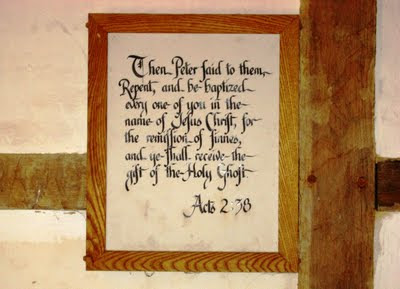
The oldest permanent English settlement in America was established on April 26, 1607, in Jamestown, Virginia. This plaque was posted on the wall of the lobby of the first church built there – Acts 2:38.

History undeniably records various elements of distinctly Orthodox Apostolic doctrine in North America as early as 1677, which was only 70 years after the first permanent settlement was established in Jamestown.[1]  What we will attempt to show is a chronological outline of these various apostolic doctrines and practices as they appear in the index of North American history.  While many will view this as a restoration of Apostolic Pentecostal experience we maintain that it actually proves the continued existence and growth of the orthodox teaching of the book of Acts.  We further assert that there have always been pockets of true believers in every century following and obeying the true message of the New Birth.  Some examples record partial alignment with the Apostles’ doctrine, the following is a list of some of those instances:

  • Society of Friends (Quakers) – “…our tongues loosed and our mouths opened, and we spake with new tongues as the Lord gave utterance, and as His Spirit led us.”[2]
  • John Wesley (1703-1791) – “What so impressed and encouraged John Wesley and his followers, what so shocked, startled, and bewildered his contemporaries, is no mystery to the modern psychologist, to whom it is known as glossolalia…”[3]
  • Charles G. Finney (1783-1875) – “I received a mighty baptism in the Holy Ghost…No words can express the wonderful love that was shed abroad in my heart.  I wept aloud with joy and love; and I do not know but I should say, I literally bellowed out the unutterable gushings of my heart.”[4]
  • John Miller – a Presbyterian minister wrote Is God a Trinity in 1876 and “believed that the doctrine of the trinity was not biblical and that it greatly hindered the Church….He emphatically declared the full deity of Jesus Christ.”[5]
  • D. L. Moody (1837-1899) – According to R. A. Torrey, Moody’s friend and associate, he once witnessed Moody walk to the pulpit to preach but instead of addressing the crowd in English he began to speak in another language.  This occurred one more time before he was able to gain control and preach to the audience, but “only after much prayer and praise.”[6]
  • Lowell, Ohio (1835) – a group of Camisards and/or French Huguenots establish an Orthodox Apostolic Acts 2:38 believing Church, but article IX of the church constitution changes the baptismal formula from Jesus’ name to the trinitarian formula in 1847.  In 1980 Dr. Nelson preaches the Apostolic message to the congregation and they convert back to the orthodox message of Acts 2:38.[7]
  • Dan Huntington (1850) – baptized people in Boston, Massachusetts in Jesus’ name.[8]
  • Canada (1854) – “There was an organization of Acts 2:38 clergymen in Canada.”[9]
  • America (1865) – More than 160,000 Americans spoke in tongues.[10] [11]
  • Alvin E. Velie (1884-1904) – all pre-1900:[12]

1)      Wrote the book Safety First Acts 2:38.

2)      Baptized over 1,500 people in Jesus’ name in Wisconsin.

3)       Preached in various locations along the Mississippi River.

4)      Preached a considerable amount of the time in the Salvation Army.

  • Charles Fox Parham – “the first leader in the twentieth century Pentecostal movement, began to administer water baptism in Jesus’ name, although he apparently did not link this practice with an explicit denial of trinitarianism.”[13]  Parham also “formulated the basic Pentecostal doctrine of ‘initial evidence’ after a student in his Bethel Bible School, Agnes Ozman, experienced glossolalia in January, 1901.”[14] 

[1] Weisser, Thomas. After the Way Called Heresy. 1981.

[2] Bresson, Bernard L. Studies in Ecstasy. New York: Vintage Press. 1966. p. 48-52.

[3] Bowen, Marjorie. Wrestling Jacob: a study of the life of John Wesley. London: Watts & Co. 1948.

[4] Finney, Charles G. Memoirs of Charles G. Finney, being an Autobiography. New York.
1876.

[5] Bernard, David K. The Oneness of God. Hazelwood: Pentecostal Publishing House. 1993. 31 May 2005.

[6] Darbee, Lennard. Tongues: the Dyanmite of God.

[7] Nelson, Joseph. Church History. Parkersburg Bible College. Lecture given and Church Constitution shown to class on 18 November 2002.

[8] Synan, V. Aspects of Pentecostal-Charismatic Origins, NJ: Logos. 1975.

[9] Arnold, Marvin M.  Apostolic History Outline. Arno Publications, Inc. 1985.

[10]Ibid.

[11] Blunt, John H. Dictionary Of Sects, Heresies, Ecclesiastical Parties, And Schools Of Religious Thought. Ann Arbor: Gryphon Books. 1971.

[12] Nelson, Joseph. Church History. Parkersburg Bible College. Lecture on 18 November 2002.

[13] Bernard, David K. The Oneness of God. Hazelwood: Pentecostal Publishing House. 1993. 31 May 2005.

[14] Synan, V. Pentecostalism. 16 April 2005. http://mb-soft.com/believe/txc/pentecos.htm.

[Originally posted on 17 August 2011 on https://thepillarandgroundoftruth.blogspot.com/2011/08/pre-1900-examples-of-apostolic-doctrine.html]