1 Timothy 3:15, "...that thou mayest know how thou oughtest to behave thyself in the house of God, which is the church of the living God, the pillar and ground of the truth."
I have always had a high regard for Bro. Pugh’s preaching and depth since the first time I heard him preach. Then I met the man and all that regard increased. In fact, as a young man, I would often say that I could gauge a young minister’s depth and maturity by what they thought, or said, about Bro. Pugh. Perhaps that was wrong of me, but I must admit that I still think this way.
Listen and let this man’s ministry continue to bless you.
“No person should ever feel that their lack inhibits them from being an influence for the Lord Jesus Christ. Nothing: Not a lack of education. Not a lack of Christian pedigree. Nor a lack of money. Not the lack of a polished personality Or being an introvert in a world drawn to extroverts. The evidence is clear. Almighty God uses unexpected people to influence the outcome of human history. You can be one of those He uses. Moreover, you should be one of those He uses.” -Carlton Coon, https://a.co/c4igeQs
Way back in 2008, Timothy A. Main asked me the following question: “What do you think are the three steps to revival?”
He had an interesting list and shared it with me.
At the time I was in a rush and didn’t have time to adequately respond to him. It was later in the day that I remembered something the Lord showed me over a year ago concerning sustained growth in our local churches.
Since this is traditionally the time of year when we prepare for the coming New Year I thought I’d post those thoughts for you all today.
I think that there are four key steps to effective and prolonged growth (what some might call “revival”) in the local Church and its surrounding communities.
The psalmist wrote, “He that goeth forth and weepeth, bearing precious seed, shall doubtless come again with rejoicing, bringing his sheaves with him” (Ps. 126:6). In this verse we find four keys to
Four P’s of Perpetual Growth
1. Prayer
Prayer sets the stage for the miraculous. Prayer is inextricably tied to spiritual growth, whether it is in the individual’s life or in the Church. People who pray consistently and persistently with passion will see results from their time with the Lord. Prayer takes discipline and consecration (not to be confused with concentration) but it is the conduit through which Heaven is reached. When we pray we not only speak to God, but He speaks to us. Prayer sets the stage for the miraculous.
2. Preaching
Preaching is the anointed message of the miraculous Gospel of Jesus Christ. Truly anointed preaching presents Jesus in such a way that people ask the same question asked so long ago on the day of Pentecost and they receive that same anointed answer: “Now when they heard this, they were pricked in their heart, and said unto Peter and to the rest of the apostles, Men and brethren, what shall we do? Then Peter said unto them, Repent, and be baptized every one of you in the name of Jesus Christ for the remission of sins, and ye shall receive the gift of the Holy Ghost” (Acts 2:37-38).
3. Praise
Praise sets the atmosphere for the miraculous. Those who have learned to praise God in everything eventually attain a level of spiritual maturity found only in praise. There are various methods of praise but only one way to praise. We must praise God with our whole heart. A whole heart is one that’s affections are not divided. True praise is authentic and sold out to Christ alone.
4. Personal Evangelism
Personal evangelism is passion for the miraculous. Personal evangelism is that element of inner passion and expectation that propels people to go and tell others about Jesus and what He’s doing today. It is spiritually mature and excellent practice to be a witness of the oneness of God. It is not something that only new converts should be doing. The longer one is in the Church the more they should be going forth to bring in a harvest of souls.
There is more that I could write about for each of these, but the main point is that as we step out of 2022 and into 2023, let’s strive to be praying, preaching, praising and personally evangelizing our communities. If we follow these steps, I’m convinced (and 43 years of living for God has given me some understanding) that we will experience sustained perpetual growth in our personal lives, our churches, and our communities this coming year – perpetually!
Philippians 4:18, “Finally, brethren, whatsoever things are true, whatsoever things are honest, whatsoever things are just, whatsoever things are pure, whatsoever things are lovely, whatsoever things are of good report; if there be any virtue, and if there be any praise, think on these things.”
In 1985, Neil Postman argued; in his seminal work Amusing Ourselves to Death: Public Discourse in the Age of Show Business, that the public had an oppressive addiction to entertainment through the content available on television.[1] Today, media and technology have advanced to the place where this entertainment addiction has risen to epidemic proportions.
The use of gaming consoles, televisions, smartphones, laptops, personal computers, mp3 players, DVDs, tablets, and so on has swept our culture. These technologies entertain people from the cradle to the tomb. It is common today to see a 4 year old playing a game on a mobile device while nearby a74 year old is playing a Scrabble game on a smartphone.
Other forms of entertainment include: movies, sporting events, amusement parks, outdoor activities, and even literature. It’s not our suggestion that Christians divorce themselves from all forms of entertainment, but that we choose our entertainment based upon the principles of our faith found in the Word of God.
As Christians we understand the necessity of adhering to Paul’s teaching when considering what choices we make regarding our entertainment. Therefore, we need to be vigilant when it comes to the content of entertainment we allow into our homes, minds, and even the church house.
With that in mind, Texas pastor and writer Rodney Shaw suggests that Christians ask themselves the following questions when making entertainment choices:[2]
Can I maintain my Christian witness and engage in this activity?
Can I glorify God in this activity?
Can I invoke the blessings of God, praying in the name of Jesus, for my involvement in this activity?
Does this activity leave me feeling as if I have compromised my values?
Would I be comfortable inviting my spiritual mentor to engage in this activity with me?
Does this activity promote godly attitudes and behaviors?
Do I leave this activity more or less equipped for the spiritual life?
Does this activity appeal to my carnal nature, i.e., the lust of the flesh, the lust of the eyes, or the pride of life?
Does this activity portray, promote or condone behaviors, attitudes or philosophies which are condemned in the Bible?
Do I feel guilty, like I am violating my conscience, or the need to repent after I have engaged in this activity?
Am I committed to ceasing my involvement in any activity which turns out to be in violation of biblical principles, including but not limited to turning off a device or walking out of a venue?
How does my commitment of time and resources to this activity compare to my commitment to spiritual disciplines and participation in the life of the church?
I was going about my daily activity recently when this thought entered my mind: “while you are waiting, God is shaping your life.” I believe that this was God’s way of speaking to me in that moment. So, bear with me as I try to convey this idea in a clear and concise manner.
Joseph was an immature younger brother and it’s possible that he was also a spoiled son doted upon by his father. He had a dream, but he was not ready to receive the fruition of that dream. So, God, in His great wisdom, allowed the 17 year old to be put into precarious situations and he did not see his father until he was 41 years old, at which time his dreams were fully realized. Each trial in Joseph’s life added responsibility and served to increase Joe’s maturity and integrity preparing him for the role he was to play in his dream.
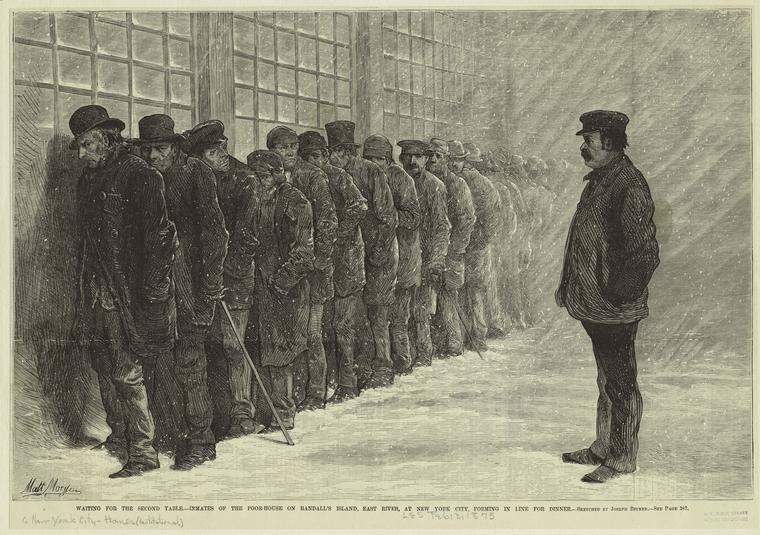
Waiting for the second table : Inmates of the Poor-House on Randall’s Island, East River, at New York City, forming in line for dinner | Artist: Joseph Becker | 13 February 1875
Just as Joseph was not ready, we sometimes find that while we are impatient for fulfillment, we are not quite ready for what God has promised us, or given us in dreams and visions. Therefore, while we are waiting, God is shaping and preparing us to receive the fullness of His promise.
Instead of becoming impatient, we need to learn how to let God shape us. All too often, we can get in the way of God’s plan by allowing the flesh to rise up and prolong the shaping that God’s hand is doing on our inner man as the Great Potter molds us into a vessel that He can use, and if we’re not awfully careful, we can get in the way of the Master’s preparation.
Joseph is a great example to us of one who suffered for his dream, but we read in no passage where he complained or charged God foolishly. In fact, the Word of God indicates twice God’s continued presence even in circumstances where the carnal mind would doubt His proximity (Genesis 39:2 & 21 “…the LORD was with Joseph…”), but Joseph teaches us a principle that will serve us well when our ambition collides with God’s timing.
I admonish you today to trust God in your time of preparation and allow the maturing process to complete its cycle because while you’re waiting, God is shaping your life.
I’m reminded of the Andre Crouch song “Take Me Back” (1975). So often in my life it’s been the older songs that I grew up hearing and singing, which resonate deep in my spirit. Here are the words that still speak to me:
Take me back, Take me back, dear Lord, To the place, Where I first received You. Take me back, Take me back, dear Lord, Where I first believed.
I feel that I’m so far from You Lord, But still I hear You calling me. Those simple things, That I once knew, The memories are drawing me.
I must confess, Lord, I’ve been blessed, But yet, my soul’s not satisfied. Renew my faith, Restore my joy, Then dry my weeping eyes.
I tried so hard To make it all alone I need Your help Just to make it home.
Zion Tabernacle Kokomo, IN
Today, and every day, we need to renew our relationship with God. He is looking for an authenticity from us based on a continuing renewal of the fervor we first had at our initial conversion. The simplicity of our faith and our humility combined with the simplicity of the Gospel resulted in an authentic conversion.
The words “renew my faith, renew my joy, then dry my weeping eyes” is a call get back to the place where we first gave our will to God.
What is it about us that having first come to Jesus with empty hands and totally dependent upon him we now, after being “in the Church” for some time, think we can somehow do it all on our own?
I think that there are many people, especially in their 20s and 30s, that received an initial conversion experience at a young age (6-10), but did not really get converted until later, when they were more mature. This may be why we have trouble as young adults. We “got” the Holy Ghost at a young age, but the Holy Ghost did not “get” get us until later.
It is amazing to me to witness the blessing of God on us and yet we are not satisfied in our relationship with Him because of our own self-sufficiency, pride, and vain living. It is a crutch – a trap of the enemy and the flesh to alienate us from intimacy with Jesus Christ, not a “Jesus is my boyfriend” type of intimacy that we are constantly barraged with in this self-absorbed culture we live in, but a closeness that comes from a genuine relationship with our Savior – a relationship that is deepened every day in the good and the bad that life throws at us.
Paul wrote of a desire to know our Lord Jesus Christ in every facet of life in order that he might one day be resurrected from the dead: “I want to know Christ and experience the mighty power that raised him from the dead. I want to suffer with him, sharing in his death, so that one way or another I will experience the resurrection from the dead!” (Philippians 3:10, NLT).
C. S. Lewis addressed the purpose of suffering in his book The Problem of Pain in this way:
My own experience is something like this. I am progressing along the path of life in an ordinary contentedly fallen and godless condition, absorbed in a merry meeting with my friends for the morrow or a bit of work that tickles my vanity to-day, a holiday or a new book, when suddenly a stab of abdominal pain that threatens serious disease, or a headline in the newspapers that threatens us all with destruction, sends this whole pack of cards tumbling down.
At first I am overwhelmed, and all my little happinesses look like broken toys. Then, slowly and reluctantly, bit by bit, I try to bring myself into the frame of mind that I should be in at all times. I remind myself that all these toys were never intended to possess my heart, that my true good is in another world and my only real treasure is Christ. And perhaps, by God’s grace, I succeed, and for a day or two become a creature consciously dependent on God and drawing its strength from the right sources. But the moment the threat is withdrawn, my whole nature leaps back to the toys: I am even anxious, God forgive me, to banish from my mind the only thing that supported me under the threat because it is now associated with the misery of those few days. Thus the terrible necessity of tribulation is only too clear. God has had me for but forty-eight hours and then only by dint of taking everything else away from me.
Let Him but sheathe that sword for a moment and I behave like a puppy when the hated bath is over – I shake myself as dry as I can and race off to reacquire my comfortable dirtiness, if not in the nearest manure heap, at least in the nearest flower bed. And that is why tribulations cannot cease until God either sees us remade or sees that our remaking is now hopeless.
Our problem is that we become desensitized to those “Take Me Back” moments and even brush them aside when God calls us to some personal time with Him. Jesus wants us to give ourselves to Him and surrender our will to His will. One way we can do that is to take the time to go back to those simpler times when all we had was our faith in Him and all we wanted was His presence in our lives guiding, keeping, and sustaining us.
Gal. 6:7-10 7 Be not deceived; God is not mocked: for whatsoever a man soweth, that shall he also reap. 8 For he that soweth to his flesh shall of the flesh reap corruption; but he that soweth to the Spirit shall of the Spirit reap life everlasting. 9 And let us not be weary in well doing: for in due season we shall reap, if we faint not. 10 As we have therefore opportunity, let us do good unto all men, especially unto them who are of the household of faith.
The Law of Harvest: Gal. 6:7, “…Whatsoever a man soweth, that shall he also reap.”
Consider your seed: What are you sowing, or planting in your life? What habits are you developing? What behavior do you manifest outwardly to others on a day-to-day basis? What are the secret thoughts that you consider in the privacy of your mind? What types of music, television programming, movies, and Internet sites do you allow to enter your spirit being through your sense gates? What kind of conversations do you entertain?
Whatever answers you may have to these questions, one thing is certain; you will reap what you’ve sown: Sow love and you’ll receive love Sow hate and you’ll receive the same Sow kindness and you will receive it in turn Sow cynicism and others will mistrust you as well
The Apostle is clear on this one issue: You get what you sow. You can’t plant an orange tree and expect apples. You can’t alter the inevitable law of harvest – – like begets like.
Romans 6 1 What shall we say then? Shall we continue in sin, that grace may abound? 2 God forbid. How shall we, that are dead to sin, live any longer therein? 3 Know ye not, that so many of us as were baptized into Jesus Christ were baptized into his death? 4 Therefore we are buried with him by baptism into death: that like as Christ was raised up from the dead by the glory of the Father, even so we also should walk in newness of life. 5 For if we have been planted together in the likeness of his death, we shall be also in the likeness of his resurrection: 6 Knowing this, that our old man is crucified with him, that the body of sin might be destroyed, that henceforth we should not serve sin. 7 For he that is dead is freed from sin. 8 Now if we be dead with Christ, we believe that we shall also live with him: 9 Knowing that Christ being raised from the dead dieth no more; death hath no more dominion over him. 10 For in that he died, he died unto sin once: but in that he liveth, he liveth unto God. 11 Likewise reckon ye also yourselves to be dead indeed unto sin, but alive unto God through Jesus Christ our Lord. 12 Let not sin therefore reign in your mortal body, that ye should obey it in the lusts thereof. 13 Neither yield ye your members as instruments of unrighteousness unto sin: but yield yourselves unto God, as those that are alive from the dead, and your members as instruments of righteousness unto God. 14 For sin shall not have dominion over you: for ye are not under the law, but under grace. 15 What then? shall we sin, because we are not under the law, but under grace? God forbid. 16 Know ye not, that to whom ye yield yourselves servants to obey, his servants ye are to whom ye obey; whether of sin unto death, or of obedience unto righteousness? 17 But God be thanked, that ye were the servants of sin, but ye have obeyed from the heart that form of doctrine which was delivered you. 18 Being then made free from sin, ye became the servants of righteousness. 19 I speak after the manner of men because of the infirmity of your flesh: for as ye have yielded your members servants to uncleanness and to iniquity unto iniquity; even so now yield your members servants to righteousness unto holiness. 20 For when ye were the servants of sin, ye were free from righteousness. 21 What fruit had ye then in those things whereof ye are now ashamed? for the end of those things is death. 22 But now being made free from sin, and become servants to God, ye have your fruit unto holiness, and the end everlasting life. 23 For the wages of sin is death; but the gift of God is eternal life through Jesus Christ our Lord.
The inevitable law of harvest declares that you will end up in one of two places. You Choose: Heaven or Hell
The choice of Hell, which designates you as a servant of sin, will reveal certain undeniable indicators in your life (i.e. the works of the flesh: adultery, fornication, uncleanness, lasciviousness, Idolatry, witchcraft, hatred, variance, emulations, wrath, strife, seditions, heresies, envyings, murders, drunkenness, revellings, and such like [Gal. 5:19-21]). When you yield yourself to these you are making a decision to do so.
The choice of Heaven, designating you as a servant of righteousness, will be seen by the presence of the Fruit of the Spirit: love, joy, peace, longsuffering, gentleness, goodness, faith, meekness, temperance (Gal. 5:22-23). Yielding to the Holy Ghost is also a conscious decision that you make.
The Law of Distribution: Gal. 6:10, “…let us do good unto all men…”
1 Cor. 7:1-24 1 Now concerning the things whereof ye wrote unto me: It is good for a man not to touch a woman. 2 Nevertheless, to avoid fornication, let every man have his own wife, and let every woman have her own husband. 3 Let the husband render unto the wife due benevolence: and likewise also the wife unto the husband. 4 The wife hath not power of her own body, but the husband: and likewise also the husband hath not power of his own body, but the wife. 5 Defraud ye not one the other, except it be with consent for a time, that ye may give yourselves to fasting and prayer; and come together again, that Satan tempt you not for your incontinency. 6 But I speak this by permission, and not of commandment. 7 For I would that all men were even as I myself. But every man hath his proper gift of God, one after this manner, and another after that. 8 I say therefore to the unmarried and widows, It is good for them if they abide even as I. 9 But if they cannot contain, let them marry: for it is better to marry than to burn. 10 And unto the married I command, yet not I, but the Lord, Let not the wife depart from her husband: 11 But and if she depart, let her remain unmarried, or be reconciled to her husband: and let not the husband put away his wife. 12 But to the rest speak I, not the Lord: If any brother hath a wife that believeth not, and she be pleased to dwell with him, let him not put her away. 13 And the woman which hath an husband that believeth not, and if he be pleased to dwell with her, let her not leave him. 14 For the unbelieving husband is sanctified by the wife, and the unbelieving wife is sanctified by the husband: else were your children unclean; but now are they holy. 15 But if the unbelieving depart, let him depart. A brother or a sister is not under bondage in such cases: but God hath called us to peace. 16 For what knowest thou, O wife, whether thou shalt save thy husband? or how knowest thou, O man, whether thou shalt save thy wife? 17 But as God hath distributed to every man, as the Lord hath called every one, so let him walk. And so ordain I in all churches. 18 Is any man called being circumcised? let him not become uncircumcised. Is any called in uncircumcision? let him not be circumcised. 19 Circumcision is nothing, and uncircumcision is nothing, but the keeping of the commandments of God. 20 Let every man abide in the same calling wherein he was called. 21 Art thou called being a servant? care not for it: but if thou mayest be made free, use it rather. 22 For he that is called in the Lord, being a servant, is the Lord’s freeman: likewise also he that is called, being free, is Christ’s servant. 23 Ye are bought with a price; be not ye the servants of men. 24 Brethren, let every man, wherein he is called, therein abide with God.
According to my former Pastor, Michael Seebaugh, of Parkersburg, WV, the beauty of this passage on marriage is that it reveals to us a beautiful present that is best described as the Gift of Perspective:
1. Your experiences prior to conversion and the subsequent ones afterwards give you a particular point-of-view that is unique to you.
2. Paul’s writing concerning marriage gives us insight into the fact that married couples, single individuals, divorced people, widows, and widowers all have various experiences that can benefit others.
3. Couples married for 50 years have wisdom in their perspective that the young married couples would be wise to heed.
4. The Church body is full of people who have many types of experiences and these are necessary for the distribution of the Gospel to the whole world.
What has God given to you that has been vitally important in your continual walk with Him?
Something He gave to you that you couldn’t have made it without?
These examples of God’s gift to you are the very things that He desires you to distribute to others. We need to learn how to distribute to others what God has produced in our lives.
Heed these words of wisdom: “The mercy you show is the mercy you’ll know.” – LouAnne Kuntzman
Rev. Seebaugh also suggests the following as Principles of Distribution:
1. You can’t distribute (give, divide, disperse, administer, bestow) what you don’t have. Look at the seven sons of Sceva (Acts 19:13-20). God will bring exponential growth to what you do have if you give it to Him (John 6:1-14)
2. You don’t have to produce the product, but you do need to be able to access it for yourself and for distribution. God is Love. You don’t produce that, but you do possess it, and can access it. You need seed if you intend to sow.
3. You need to be located where people can access your product easily. Are you approachable? Don’t hide behind your “shyness.”
4. You should be focused on how to get the product to the client. Are you “soul conscious?” Do you look for opportunities to distribute?
5. You need to have lots of room for your product. Your product is the testimony of God’s goodness in your life – – It is like seed to the sower. Sow seed by distributing it anywhere and everywhere you possibly can.
The diversity of gifts and offices were distributed for the purpose of Christian maturity in the Body of Christ – – the Church.
Eph. 4:11-16 11 And he gave some, apostles; and some, prophets; and some, evangelists; and some, pastors and teachers; 12 For the perfecting of the saints, for the work of the ministry, for the edifying of the body of Christ: 13 Till we all come in the unity of the faith, and of the knowledge of the Son of God, unto a perfect man, unto the measure of the stature of the fulness of Christ: 14 That we henceforth be no more children, tossed to and fro, and carried about with every wind of doctrine, by the sleight of men, and cunning craftiness, whereby they lie in wait to deceive; 15 But speaking the truth in love, may grow up into him in all things, which is the head, even Christ: 16 From whom the whole body fitly joined together and compacted by that which every joint supplieth, according to the effectual working in the measure of every part, maketh increase of the body unto the edifying of itself in love.
The law of harvest and the law of distribution are cyclic — they are similar to the law of cause and effect (causality).
Eph. 6:8, “Knowing that whatsoever good thing any man doeth, the same shall he receive of the Lord, whether he be bond or free.”
Luke 6:35-36 35 But love ye your enemies, and do good, and lend, hoping for nothing again; and your reward shall be great, and ye shall be the children of the Highest: for he is kind unto the unthankful and to the evil. 36 Be ye therefore merciful, as your Father also is merciful. 37 Judge not, and ye shall not be judged: condemn not, and ye shall not be condemned: forgive, and ye shall be forgiven: 38 Give, and it shall be given unto you; good measure, pressed down, and shaken together, and running over, shall men give into your bosom. For with the same measure that ye mete withal it shall be measured to you again.
This passage (verse 35) is the ultimate test for some: “…love ye your enemies…do good, and lend, hoping for nothing…”
You cannot hold back from sowing into others for any reason.
Verse 38 is significant because it contains the promise of harvest for those who distribute what they have to others, and your level of harvest is directly linked to your level of distribution.
Don’t distribute as rich people do, but as the certain poor widow: “For all they did cast in of their abundance; but she of her want did cast in all that she had, even all her living” (Mark 12:44).
Jesus Christ has distributed to you the Holy Ghost, which is Christ in you, and you are responsible to distribute the Gospel of Jesus Christ to others, in order that they can experience the same phenomenon.
This is why you are commanded by Jesus to “go ye into all the world, and preach the gospel to every creature.” It is here where we plainly see the law of distribution working in tandem with the law of harvest: “He that believeth and is baptized shall be saved; but he that believeth not shall be damned. And these signs shall follow them that believe; In my name shall they cast out devils; they shall speak with new tongues; They shall take up serpents; and if they drink any deadly thing, it shall not hurt them; they shall lay hands on the sick, and they shall recover” (Mark 16:15-18).
You are not told that every one will believe and obey the Gospel, but you are told that those who do receive what you distribute will receive an unprecedented harvest.
Refuse the excuse, “I have nothing to give.” Distribute what God has already given freely to you and you will witness a harvest. It is inevitable.
Ephesians 5:15-16, “See then that ye walk circumspectly, not as fools, but as wise, redeeming the time, because the days are evil.”
It is healthy for a soul to want to do more for God and to be in a perpetual state of personal improvement and spiritual maturity. There are 168 hours in a week, and if you tithe your time to God as you do your monetary increase then that leaves you with nearly 17 hours a week that you can dedicate solely to God.
Assuming you are faithful in your church attendance, an average service is 2 hours, then you have 11 hours left to invest in your relationship with God in a week, and the real question becomes: “What do you do with these 11 hours of great Spiritual potential?” Consider these suggestions:
1. Pray. You don’t have to start out praying an hour a day, but whatever time you invest in prayer will bring results. Prayer is essential to growing in the Lord. Learn to intercede, but don’t let intercession overwhelm you and rob you of joy.
2. Read. Read the Word of God. Some people spend so much time studying and chasing down rabbit tracks in the Bible that they fail to simply read the Bible. Pray, clear your mind, then read. Let His written Word be as food to your spirit and absorb it. Remember: The greatest and final source of self-examination is the Word of God.
3. Study. This is the time to follow those rabbit trails. This is the time to look into the deeper meaning of the Scriptures. This is the time to search the Scriptures.
4. Listen. Invest time in active listening. Many people talk to God in prayer, but ignore the richest half of prayer time — listening to what Jesus is saying to them. He hears your prayer, but do you hear His? Prayer is dialogue, not monologue.
5. Fast. You want to draw closer to God? Fast one day a week, one meal a day, or three days (typically, 3 days is what it takes to crucify the flesh). You can also fast by setting aside time spent on things that you enjoy (other than food), like the Internet, movies, Starbucks, chocolate, etc.
6. Praise. There needs to be some time in your week, or day, where you loudly and demonstratively praise God. Dance before Him in secret prayer; sing in the Holy Ghost loudly as you’re sweeping the carpet; let tears of praise flow. We praise God for what He’s done. Shout! Clap! Jump! Sing! Extol!
7. Worship. Worship is different than praise. Study the difference and then apply it to your life. We worship God for who He is. Lie prostrate before God.
8. Obey. Whatever God tells you to do in His Word, in prayer, or by His messengers (Pastor, preachers, teachers…) do! Remember: God will never ask/tell you to do something that violates His written Word. Of course, there will be days when you feel like you’ve been with God all day, and others when He seems to be unavailable, but every day is full of potential investment opportunities in your relationship with your Lord and Savior Jesus Christ as you tithe your time to Him.
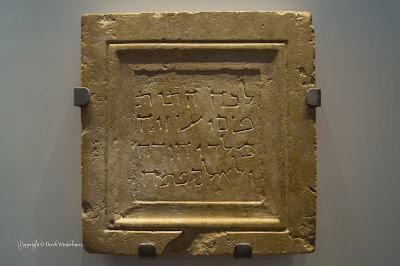
Inscription: “Hither were brought The bones of Uzziah King of Judah. Do not open!”
Uzziah, also called Azariah, became king of Judah at the tender age of sixteen (2 Chronicles 26:1) and ruled for 52 years (2 Kings 15:2).
During his reign he made significant contributions to the realm and was successful in many endeavors, but his life ends with a mark upon him that history has not been able to erase – he died a leper.
If we take a look at Uzziah’s leadership style we will discover early influences that molded him into the leader he was, his positive and negative characteristics as a ruler, and the affect his leadership had on his son and grandson.
It would be impossible to reflect on the direction Uzziah took as a leader without first looking to his upbringing. The adage is still as true today as it was when originally penned, “Train up a child in the way he should go: and when he is old, he will not depart from it” (Pr. 22:6).
The closest and most influential people in anyone’s life will usually be their parents. Amaziah was Uzziah’s father and a great influence on his life. The Bible speaks of Amaziah as a man who “did that which was right in the sight of the LORD, yet not like David his father” (2 Kings 14:3).
Another passage records, “he did that which was right in the sight of the LORD, but not with a perfect heart” (2 Chronicles 25). The reason this is written is due to the fact that towards the end of his reign he turned to the idols of the people of Seir and because he decided to “turn away from following the LORD” the LORD decided to destroy him. It was this failure to recognize who was truly responsible for Judah’s victory over the Edomites that caused Amaziah’s downfall. He rejected the prophet of God and did as he wanted by worshipping other gods and hiring soldiers from Israel. His was a sin of pride, disobedience, and a divided heart.
As Uzziah enters the pages of the Scriptures we see him as a king to be admired. In fact, one writer informs us that, according to 2 Chronicles chapter 26, Azariah ruled “with God’s help (verse 7) he became very successful as a builder (verse 9), farmer (verse 10) and a military leader (verse 11). So much so, that his fame spread far and wide.
The Bible issues a statement that gives us an idea of why Uzziah began to fall when it states, “he was marvellously helped, till he was strong. But when he was strong, his heart was lifted up to his destruction: for he transgressed against the LORD his God, and went into the temple of the LORD to burn incense upon the altar of incense” (2 Chronicles 26:15-16).
John L. Kachelman, Jr. offers us an accounting of Uzziah’s characteristics and accomplishments before his downfall:
1. His respect for God’s messenger (2 Chron. 26:5). A key to Uzziah’s success is his desire to seek God. It seems that the influence for this is attributable to a prophet or priest named “Zachariah.” This unknown prophet was able to know, understand, and explain God’s will so the King (and others) would understand and obey. As long as Uzziah was influenced by these forces to follow God’s will, he knew success and happiness. It was a good time for Judah! 2. His role as STATESMAN (2 Chron. 26:6-15). No politician could dream of a better tenure as a chief executive of a nation. Prosperity was enjoyed in all areas of life.a. POLITICALLY Uzziah’s leadership resulted in amazing successes. His armies were victorious (v. 6-8). His projects and programs were successful (v. 9-10).b. MILITARILY Uzziah’s leadership was superb (v. 11-15). He was an amazing military mind – organized, prepared, and inventive. Everyone studied his maneuvers and learned brilliant strategies of warfare.c. PERSONALLY Uzziah’s fame spread throughout then entire known world. He was famous and recognized. His “strength” was envied by other Kings (v. 8b, 15b).
In the midst of all this success we find that Uzziah rebelled against his God when he failed to acknowledge the source of his strength, and in so doing he attempted to presumptuously and proudly take God’s glory by offering incense in the Temple instead of allowing the priests to do their duty. We would do well to steer clear of the sin of presumption and pride becasue the Bible clearly states “that no flesh should glory in His (God’s) presence” (1 Corinthians 1:29).
Uzziah failed to realize that you don’t own God’s glory or favor because it is a gift from Him to you.
Why this change in Uzziah? The qualities that he learned from his father manifested themselves when Uzziah took his eyes off of the LORD and allowed pride to rule him.
Kachelman writes that Uzziah’s rebellion appears when we read the word “until”. Many times it appears that people are doing well and serving God faithfully “until” they forget who the source of their strength is. The irony is that Uzziah’s very name – “my strength is Jehovah” – was not enough to remind him of God’s hand on his life because pride will always take your eyes off of God and onto self.
God cursed Uzziah with leprosy because of his pride. It is significant that we never read of Uzziah repenting for his sin and it is possible to become so wrapped up in self and in our own arrogancy that we, like Uzziah, find that we cannot turn from sin.
One writer, Wilbur Wright, says that “the antidote for pride is humility. Humility is the measure of a leader whom God can use and it should be an ever-growing quality in their life and ministry. God places a very high premium on humility and its close companion of meekness (Matthew 5:5) and lowliness (Matthew 11:29).”
All Uzziah had to do was obey a simple principle, but he did not and consequently he was not healed of his leprosy. “Humble yourselves therefore under the mighty hand of God, that he may exalt you in due time” (1 Peter 5:6).
It is interesting that Jotham, as king of Judah following his father Uzziah, never went to the Temple. He was a mighty man and “he did that which was right in the sight of the LORD, according to all that his father Uzziah did: howbeit he entered not into the temple of the LORD” (2 Chronicles 27:1-2). Perhaps this was due to a fear that he deveolped as a result of what happened to his father. Sometimes people see the Church as a place of wrath and fail to realize that sin is what brings judgment because God loves those who he chastens. In actuality, Uzziah’s judgment was an opportunity for mercy, but he failed to take advantage and passed onto his son a mistrust of God.
Jotham was a man who prepared, set-up, erected, established, and set forth his ways before God, but he allowed the people of Judah to continue in their corruption (idol worship and backsliding). Because of his father’s rebellion and judgment he did not see the house of God as a place of worship, but of wrath and attributed that to God instead of to his father’s self-glory. As we follow the path of Uzziah’s faithlessness we come to his grandson Ahaz. The Bible informs us that Ahaz was a wicked an unjust king who “did not that which was right in the sight of the LORD” (2 Chronicles 28:1).
Ahaz not only sinned against God at every opportunity but he also sacrificed his children to other gods and “gathered together the vessels of the house of God, and cut in pieces the vessels of the house of God, and shut up the doors of the house of the LORD, and he made him altars in every corner of Jerusalem. And in every several city of Judah he made high places to burn incense unto other gods, and provoked to anger the LORD God of his fathers” (2 Chronicles 28:3, 24-25).
This then is the final end of all those who lift themselves up in pride against the LORD – destruction of self and others.
It mattered not how great Uzziah was or even how many accomplishments are attributed to him because his pride was a catalyst that spawned a family and a nation of rebellious backsliders. All he had to do to remove this possibility was repent, but he did not.
“But when he was strong, his heart was lifted up to his destruction: for he transgressed against the LORD his God, and went into the temple of the LORD to burn incense upon the altar of incense” (2 Chronicles 26:16).
The psalmist David wrote, “The LORD trieth the righteous: but the wicked and him that loveth violence his soul hateth.”[1]
In this passage, when we read that God “trieth” it simply means that this is God’s way of “examining, scrutinizing, proving, and testing” the hearts of those who are His people, and these tests are for the purpose of preparing us for greater responsibility and spiritual growth.[2]
The apostle Paul makes it quite clear that the process of being approved by God follows a particular process: “Therefore being justified by faith, we have peace with God through our Lord Jesus Christ: By whom also we have access by faith into this grace wherein we stand, and rejoice in hope of the glory of God. And not only so, but we glory in tribulations also: knowing that tribulation worketh patience; And patience, experience; and experience, hope: And hope maketh not ashamed; because the love of God is shed abroad in our hearts by the Holy Ghost which is given unto us.”[3]
As this process takes place we witness the varying degrees of preparation God places us in as they accomplish, work out, and achieve God’s purpose for our lives. Therefore, in the end, what we think of as pressures, stressors, or trials are tools God uses as a means to bring about a patient, enduring, sustaining, perseverant, and steadfast quality to our Christian character. When this quality is part of our spiritual nature we have become God-proven because our character has been tried and He can then trust us for greater measures of responsibility and authority.
This experience results in the establishment of hope in our lives, which is the “joyful and confident expectation of eternal salvation” and the understanding that because I came through previous trials intact then I’ll make it through this one as well because God is with me.[4]







 The Pillar and Ground of Truth