Categories
Bible Teaching

A Heaven to Gain

Stephen Kuntzman | August 24th, 2025 | 10 am

Text: Revelation 21:4-5, “(4)  And God shall wipe away all tears from their eyes; and there shall be no more death, neither sorrow, nor crying, neither shall there be any more pain: for the former things are passed away. (5) And he that sat upon the throne said, Behold, I make all things new. And he said unto me, Write: for these words are true and faithful.”

A Heaven to Gain[1]

Because Jesus has prepared heavenly home for His church, let us live with Heaven in mind.

JOHN’S VISION

John was one of Jesus’ twelve apostles and the brother of the apostle James. John referred to himself as “the disciple whom Jesus loved” (John 21:20). Although the other original disciples (except Judas) died as martyrs, John died of natural causes at a good, old age.

However, he was still persecuted, and it was Roman emperor Domitian wo ordered John to be boiled in oil and exiled to a prison island – Patmos – to die.

Without doubt he faced intense persecution, but on that unforgiving, rocky island, separated by a seemingly endless sea from all his friends and family, Jesus gifted John with the greatest vision of his life.

What do you think John struggled with most on the island of Patmos?

How did he get through it?

John’s Vision Came as Hope While He Was Exiled on a Prison Island

John saw Jesus, and John saw Heaven.

He caught a glimpse of Who and what awaited him on the other side of this life.

God instructed John to share this vision with us in the book known as Revelation, or more accurately: The Revelation of Jesus Christ.

When you think of the island of Patmos, don’t think of a vacation; think Alcatraz.

When he was sentenced, he expected to wither away and die on that island, which meant “my killing.”[2]

He had no idea that in this place of his greatest testing and point of loneliness, God would pull back the curtain and let John see eternity.

Heaven Will Be Heaven for What Will Not Be There

John’s view and description of Heaven contained what he did not see.

In our world, we struggle with pain, death, sorrow, hatred, racism, violence—all poisonous fruit of sin.

Here people are disappointed, discouraged, rejected, abandoned, betrayed, lied to, lied on, deceived, and feel invisible.

They battle cancer and other diseases, financial setbacks, relationship problems, and addictions of all kinds.

On this planet families are torn apart by divorce, mental health issues, promiscuity, domestic violence, and poverty.

Not in Heaven.

In the middle of his own calamity wrote: “And God shall wipe away all tears from their eyes; and there shall be no more death, neither sorrow, nor crying, neither shall there be any more pain: for the former things are passed away” (Revelation 21:4).

John was even impressed that there was no more sea.

We love the sea for what it means to us who like to take our summer vacations to the ocean,

but on Patmos the sea was an undefeated obstacle keeping prisoners from escaping to their families, friends, and freedom.

John was also saying there would be no separation in Heaven.

Nothing to keep us from one another.

Heaven is free of all the struggles this world has to offer.

In John’s vision he heard a loud voice saying:

“And God shall wipe away all tears from their eyes.”

Jesus Himself will wipe every tear from our eyes.

It may seem overwhelmingly difficult at times to fight the good fight, finish the race, and keep the faith (II Timothy 4:7), but the reward of Heaven is far better than anything this earth has to offer.

Paul wrote: “Henceforth there is laid up for me a crown of righteousness, which the Lord, the righteous judge, shall give me at that day: and not to me only, but unto all them also that love his appearing” (II Timothy 4:8).

Faith is a fight, but faith is worth the fight.

What would you add to the list of struggles you won’t deal with in Heaven?

I Will Remember My Heavenly Home When I Feel Discouraged

It is sad that we hear less and less singing about Heaven because those hymns and contemporary songs remind us of our hope. These songs are our battle cry and expression of confidence.

You don’t set out to forget Heaven, but it can easily happen without fighting to keep your daily devotion and spiritual disciplines priority.

God offers grace to follow Him, but you must maintain your daily consecration to Jesus Christ and make the firm choice to follow Him wholeheartedly.

Keep your eyes on Heaven. Hear and heed Paul’s admonition:

“Set your affections on things above, not on things on the earth” (Colossians 3:2).

Life is filled with struggles and hardships, which are out of your control.

In the last five years you have seen many people die, fight disease, endure financial setbacks, fought your own personal private struggles, but here you are worshipping Jesus this morning and holding on to the promise of Heaven.

Look around and you will see on the pew beside you people whose faithfulness will inspire you to keep your eyes on Heaven?

How can you inspire others to do the same?

THAT GREAT CITY

Heaven is a topic of conversation and debate for many Christians and non-Christians alike.

What will it be like? Who will be there? How can we make it there?

These are the questions frequently discussed.

What we know about Heaven we find throughout God’s Word with most of the information coming from the Book of Revelation.

It declares we will dwell with God forever in a wonderous place without sin or evil.

We will spend our days worshiping our God with an untold number of other Christians from every nation, tribe, and tongue.

We will rule and reign with Christ.

Heaven will be perfect beyond what we can comprehend.

Heaven Will Be Adorned with Jasper Walls, Golden Streets, Bejeweled Foundations

Nothing is quite as breathtaking as a scenic view in nature, like the snow-covered mountains of West Virginia, a rainbow displayed across the clouds near the lake, the Shenandoah Valley viewed from the top I-64, the dolphins in the ocean or the Blue Ridge Mountains.

In fact, all of God’s creations on this earth are a privilege to witness and experience. They are awe inspiring and exceptional.

However, they are nothing compared to what we will see and encounter in Heaven.

Think of your most beautiful, breathtaking vacation spot. Multiply its beauty, peace, and perfection by thousands, and Heaven begins to come into view.

Heaven will be beautifully adorned with precious stones, metals, and gems overflowing with brilliant colors.

John told us the city was pure gold like transparent glass, he also got a closer view of the construction materials, and he wrote what he saw.

Here we use concrete for foundations, studs, and sheetrock for walls, but there, the foundations are built of precious gems and the walls of jasper.

Even the foundation sparkles in Heaven. Heaven is glorious because it is filled with the glory of God.

The gates are made of pearls, each of the twelve gates cut of one beautiful pearl.

The best way John could describe Heaven, or New Jerusalem as he called it, was “as a bride adorned for her husband” (Revelation 21:2).

It will be beautiful, pure, holy, perfect for God is Heaven’s architect and builder.

Heaven Will Be Heaven Because Jesus Reigns There

If the walls were drywall, the streets were gravel, the gates were wrought iron, and the foundations were concrete, Heaven is still Heaven because of who is there.

There Jesus Christ, God incarnate, reigns as King of kings and Lord of lords.

His perfect will is done in Heaven, which is why we pray for His will to also be done in earth.

You remember this song written by Lanny Wolfe:

“Heaven for Me:”[3]

Verse One:

I’ve heard of a land that is wondrously fair

They say that’s its splendor is far beyond compare!

In that place that’s called Heaven my soul longs to be

For where Jesus is it will be Heaven for me.

Verse Two:

Now, if walls there weren’t jasper

And if streets were not gold

If mansions would crumble and if folks still grew old

Still I’d see ev’rything I’ve been longing to see

For if Jesus is there it will be heaven for me!

Chorus:

Heaven for me

It will be Heaven for me

Jesus will be what makes it Heaven for me

All its beauty and wonder I’m longing to see

But Jesus will be what makes it Heaven for me.

Jesus Christ died for your sins on the cross and defeated death, Hell, and the grave. He rose from the dead on the third day and graciously provided a way through the gospel for you to live in Heaven with Him as your Lord and Savior.

Jesus said, “I go to prepare a place for you. And if I go and prepare a place for you, I will come again, and receive you unto myself; that where I am, there ye may be also” (John 14:2–3).

Every neighbor in Heaven will worship Jesus Christ as Almighty God.

You will worship Jesus in a place of purity and innocence. The purpose for our creation will be fulfilled to the fullest as we sing around the throne of the Most High.

John saw “a throne set in heaven, and one sat on the throne. And he that sat was to look upon like a jasper and a sardine stone: and there was a rainbow round about the throne, in sight like unto an emerald” (Revelation 4:2–3).

Jesus, the Lamb of God, will sit on the throne, reigning over all creation.

I Will Praise God on Earth in Preparation to Praise God in Heaven

If you have a tough time worshipping Jesus now, then it is doubtful you will enjoy Heaven.

If you are not thankful here for what Jesus has done for you or haven’t allowed grace to pull out of you a gratitude for Jesus’ work in your life, then Heaven may not be as enjoyable for you as others.

When John finally saw Jesus as He truly is, he fell at His feet as though John were dead. (See Revelation 1:17.)

Although John walked with Jesus for three years, he finally saw Him as He is, and John promised us that one day we would, too:

“Beloved, now are we the sons of God, and it doth not yet appear what we shall be: but we know that, when he shall appear, we shall be like him; for we shall see him as he is” (I John 3:2).

John also saw “ten thousand times ten thousand and thousands of thousands” of angels, and he heard them cry out, “Worthy is the Lamb that was slain to receive power, and riches, and wisdom, and strength, and honour, and glory, and blessing” (Revelation 5:11–12).

He saw elders, people Jesus had redeemed, fall and worship Him.

John did not have to wait until He made it to Heaven to worship Jesus like the angels and elders are worshiping in Heaven right now, and we don’t either.

We praise God here because God is worthy, and we are practicing for when we get there.

If you love to worship Jesus here, you are going to love Heaven.

CONCLUSION

In 1983 Tom Trimble wrote a song entitled “I’m Just Warming Up.”

When I see those pearly gates and they swing open wide

I’m gonna shout for joy when I’ve reached the other side

All of my pain and sorrow there I will forget

And if you think I shout down here, you ain’t seen nothing yet

I’m just warming up, I’m just warming up

I’m just warming up, for that meeting in the sky

If you think I’m strange, don’t wait for me to change

(‘Cause) I’m just warming up for when I reach the other side

Everyone wants to go to Heaven (at least the wise do), but we need to be reminded that this world is not our home. Even our darkest days here are not worthy to be compared to the glory over there:

This world is not my home

I’m just a-passing through

My treasures are laid up

Somewhere beyond the blue

The angels beckon me

From heaven’s open door

And I can’t feel at home

In this world anymore

Oh Lord, you know

I have no friend like you

If heaven’s not my home

Then Lord, what will I do?

The angels beckon me

From heaven’s open door

And I can’t feel at home

In this world anymore[4]


[1] SOURCE: God’s Word for Life Adult Lesson Guide Summer 2025. Pentecostal Publishing House. Lesson 3.4 – A Heaven to Gain.

[2] Thayer’s Greek Definitions. G3963

[3] Song Title: “Heaven for Me” (sometimes referred to as “Jesus Will Be What Makes It Heaven for Me”). Original Release Artist: The Speers. Original Release Album: God Gave the Song. Original Release Year: 1974. Writer: Lanny Wolfe.

[4] Jim Reeves. This World Is Not My Home.

Categories
Bible Teaching

Bound but Free, Free but Bound

Stephen Kuntzman | 7/29/2025 | 7:00 PM

Text: Genesis 50:15-21 

(15) And when Joseph’s brethren saw that their father was dead, they said, Joseph will peradventure hate us, and will certainly requite us all the evil which we did unto him.  (16)  And they sent a messenger unto Joseph, saying, Thy father did command before he died, saying, (17) So shall ye say unto Joseph, Forgive, I pray thee now, the trespass of thy brethren, and their sin; for they did unto thee evil: and now, we pray thee, forgive the trespass of the servants of the God of thy father. And Joseph wept when they spake unto him.  (18)  And his brethren also went and fell down before his face; and they said, Behold, we be thy servants.  (19)  And Joseph said unto them, Fear not: for am I in the place of God?  (20)  But as for you, ye thought evil against me; but God meant it unto good, to bring to pass, as it is this day, to save much people alive.  (21)  Now therefore fear ye not: I will nourish you, and your little ones. And he comforted them, and spake kindly unto them.

First time “Forgive” is found in the Bible.

<<Tell the story of Joseph and his brethren>>

He wept because his ten elder brothers had forgotten his forgiveness.

He had forgiven them 17 years ago, but they were in bondage to their own sordid past, fearful emotions and unbelief.

Joseph had released them, but they could not enjoy their freedom.

They were physically free, but spiritually bound.

“Joseph was a type of Christ in the Old Testament. The famine was an event designed to bring the brothers to repentance and a saving knowledge, both physically and spiritually. The tragedy of the famine created the circumstances that led to freedom for these men, for they had been in bondage to a wicked crime against their brother for many years. It was forgiveness from Joseph that led to that freedom.”

-Os Hillman

Freedom

-President Franklin D. Roosevelt named Four Freedoms in his State of the Union Address to the Congress on January 6, 1941:

  1. Freedom of speech, and expression—everywhere in the world.
  2. Freedom of every person to worship God in his own way—everywhere in the world.
  3. Freedom from want—which, translated into world terms, means economic understandings which will secure to every nation a healthy peacetime life for its inhabitants—everywhere in the world.
  4. Freedom from fear—which, translated into world terms, means a world-wide reduction of armaments to such a point and in such a thorough fashion that no nation will be in a position to commit an act of physical aggression against any neighbor—anywhere in the world.

It was that last fear that bond those ten brothers.

The fear was, “Now that Dad is dead, what will Joseph do?”

They did not judge Joseph as he was, but as they were.

The reason so many people continue to live in bondage and cannot enjoy the freedom that Jesus offers is because they have never truly received His forgiveness.

When you are truly free your priorities change and you are no longer drowning in a quagmire of past regrets

True freedom means you trust God’s mercy and, grow in His grace, and your relationship with Jesus becomes intimate, close and full of trust.

When you have truly accepted the forgiveness of God the chains fall and you experience true freedom:

1. Freedom from hate, unconditionally. 

2. Freedom from self-pity. 

3. Freedom from fear of possibly doing something that may help someone else more than it would help you.

4. Freedom from the kind of pride that could make a man feel that he is better than his brother.[1]

Gal. 4:21-5:1, “Stand fast therefore in the liberty wherewith Christ hath made us free, and be not entangled again with the yoke of bondage.” 

  • Paul is referring to the bondage of the flesh versus the freedom of the Spirit referring to Ishmael and Isaac: “But he who was of the bondwoman was born after the flesh; but he of the freewoman was by promise…. we are not children of the bondwoman, but of the free.”
  • Then Paul refers to the liberty – freedom – Christ grand us with as He frees, liberates, and releases us from:
    • “…the yoke of bondage”
    • Liberty from the power and guilt of sin, which nothing but the grace of Christ can take away[2]

Romans 8:1-2, “There is therefore now no condemnation to them which are in Christ Jesus, who walk not after the flesh, but after the Spirit. For the law of the Spirit of life in Christ Jesus hath made me free from the law of sin and death.”

When you truly know Jesus – The Truth – you are free from sin:

(31) Then said Jesus to those Jews which believed on him, If ye continue in my word, then are ye my disciples indeed; (31) And ye shall know the truth, and the truth shall make you free. (32) They answered him, We be Abraham’s seed, and were never in bondage to any man: how sayest thou, Ye shall be made free? (34) Jesus answered them, Verily, verily, I say unto you, Whosoever committeth sin is the servant of sin. (35) And the servant abideth not in the house for ever: but the Son abideth ever. (36) If the Son therefore shall make you free, ye shall be free indeed.[3]

Bondage

Over the last twenty years, I have seen a rising infatuation with inspiration, but an aversion to real anointing.

“Inspiration does not break the yoke of bondage. Only the anointing breaks the yoke of bondage.”[4]

And it shall come to pass in that day, that his burden shall be taken away from off thy shoulder, and his yoke from off thy neck, and the yoke shall be destroyed because of the anointing.[5]

You can tell how bound a person is by the way they speak. In 1956 Evangelist T. L. Osborn wrote Faith’s Testimony: and it is a true today as it was then:

The Importance of Confession

You said that you could not do it, and the moment you said it you were whipped.

You said you did not have faith, and in that moment, doubt arose like a giant and bound you.

Perhaps you never realized that, to a great extent, you are ruled by your words.

You talked failure, and failure held you in bondage.

You talked fear, and fear increased its grip on you.

Solomon said, “Thou art snared with the words of thy mouth. Thou art taken (captive) with the words of thy mouth” (Pr. 6:2).

Testifying – Witnessing – Confessing

Few Christians have recognized the importance of confession and the place it holds in their lives. Whenever the word “confession” is used, they automatically think of confessing sin, weakness, and failure. But this is only the negative side of the subject.[6]

Positive Confessions:

  • “I can do all things through Christ who strengthens me” (Philippians 4:13).
  • “God has not given me a spirit of fear, but of power and of love and of a sound mind” (2 Timothy 1:7).
  • “I am fearfully and wonderfully made” (Psalm 139:14).
  • “My God shall supply all my needs according to His riches in glory by Christ Jesus” (Philippians 4:19).
  • “I am more than a conqueror through Him who loves me” (Romans 8:37).

Forgiveness 

Scars (mentally, emotionally, physically) are reminders of

past hurts that have healed.

You carry the reminder as a lesson in life, but that reminder need not paralyze you.

Forgiveness releases you from the feelings and bondage associated with the pain. 

Forgiveness is not saying that what happened was/is ok, but it’s releasing you from the pain associated with the hurt so

that you can move on.

The scar then becomes a gentle reminder that you are a survivor and you can overcome anything.

It ain’t easy forgiving God, people, or yourself sometimes, but it’s a decision that you make and then keep.

So, when that old pain flares up you remind yourself, “Wait, I choose to forgive and I refuse to fall back into that trap of turmoil, pain, and hurt.”

You do that enough times and eventually all that remains is a scar, and as time passes the scar fades.

“One of my wise teachers, Dr. Orr, told me, ‘There is only one thing evil cannot stand, and that is forgiveness.’” 

-Fred Rogers

Forgiveness Doesn’t Allow Abuse

Joseph’s own brothers had attacked him, thrown him into a cistern and sold him into slavery (see Genesis 37:12 – 28) — causing him to be separated from his loving father for over 20 years.

And though Joseph had much to forgive, he did not dwell on the offenses. He gained grace from God and let go of what others had done to him.

His response is a healthy model for us when we’ve been hurt or sinned against: we need to let it go and then get what we need from God and people who can give.

That is a better life.

Unforgiveness destroys a good life. Forgiveness creates it.

Forgiveness is not denial. We need to name the sin against us to forgive it, as Joseph did (see Genesis 45:4 – 5; 50:20). He worked through it. He named it. He expressed his feelings about it. And then he let it go.

We need to watch out for the resistance that will want us to stay in the past, trying to collect a debt that will never be paid.[7]

Forgiving People have been put in positions where they had to learn forgiveness. Have you been betrayed? Hurt? Offended? 

“Wherefore I say unto thee, Her sins, which are many, are forgiven; for she loved much: but to whom little is forgiven, the same loveth little” (Luke 7:47).

Forgiving is Releasing, you must learn to forgive and be free (Luke 6:27-38):

(27)  But I say unto you which hear, Love your enemies, do good to them which hate you,

(28)  Bless them that curse you, and pray for them which despitefully use you.

(29)  And unto him that smiteth thee on the one cheek offer also the other; and him that taketh away thy cloke forbid not to take thy coat also.

(30)  Give to every man that asketh of thee; and of him that taketh away thy goods ask them not again.

(31)  And as ye would that men should do to you, do ye also to them likewise.

(32)  For if ye love them which love you, what thank have ye? for sinners also love those that love them.

(33)  And if ye do good to them which do good to you, what thank have ye? for sinners also do even the same.

(34)  And if ye lend to them of whom ye hope to receive, what thank have ye? for sinners also lend to sinners, to receive as much again.

(35)  But love ye your enemies, and do good, and lend, hoping for nothing again; and your reward shall be great, and ye shall be the children of the Highest: for he is kind unto the unthankful and to the evil.

(36)  Be ye therefore merciful, as your Father also is merciful.

(37)  Judge not, and ye shall not be judged: condemn not, and ye shall not be condemned: forgive, and ye shall be forgiven:

(38)  Give, and it shall be given unto you; good measure, pressed down, and shaken together, and running over, shall men give into your bosom. For with the same measure that ye mete withal it shall be measured to you again.


[1] Source: Duke Ellington. (4/29/1969). Four Major Freedoms to Live By and Enjoy.

[2] Adam Clarke’s Commentary on the Bible. Galatians 4:21-5:1.

[3] John 8:31-36

[4] Lee Stoneking

[5] Isaiah 10:27

[6] T. L. Osborn. (1956). Faith’s Testimony : the Important Secret of Confession Unveiled and How to Keep Your Healing. https://archives.northwestu.edu/handle/nu/56853.

[7] Source: Forgive, Grow and Find God’s Path for You (21-Day Plan).  @YouVersion plan http://bible.com/r/Xv

Categories
Bible Preaching

Go In Power

Stephen Kuntzman | July 27, 2025 | 7:00 PM

1 Corinthians 2:1-5, “(1) And I, brethren, when I came to you, came not with excellency of speech or of wisdom, declaring unto you the testimony of God.  (2)  For I determined not to know any thing among you, save Jesus Christ, and him crucified.  (3)  And I was with you in weakness, and in fear, and in much trembling.  (4)  And my speech and my preaching was not with enticing words of man’s wisdom, but in demonstration of the Spirit and of power:  (5)  That your faith should not stand in the wisdom of men, but in the power of God.”

The Lord is seeking people who will press into Him: (12)  Not as though I had already attained, either were already perfect: but I follow after, if that I may apprehend that for which also I am apprehended of Christ Jesus. (13)  Brethren, I count not myself to have apprehended: but this one thing I do, forgetting those things which are behind, and reaching forth unto those things which are before, (14)  I press toward the mark for the prize of the high calling of God in Christ Jesus.[1]

Daniel 11:32, “…but the people that do know their God shall be strong, and do exploits.”

Albert Barnes says, “The word exploits…is supplied by the translators, but not improperly. The meaning is, that they would show great prowess, and perform illustrious deeds in battle.”

<you have held back and been held back long enough>

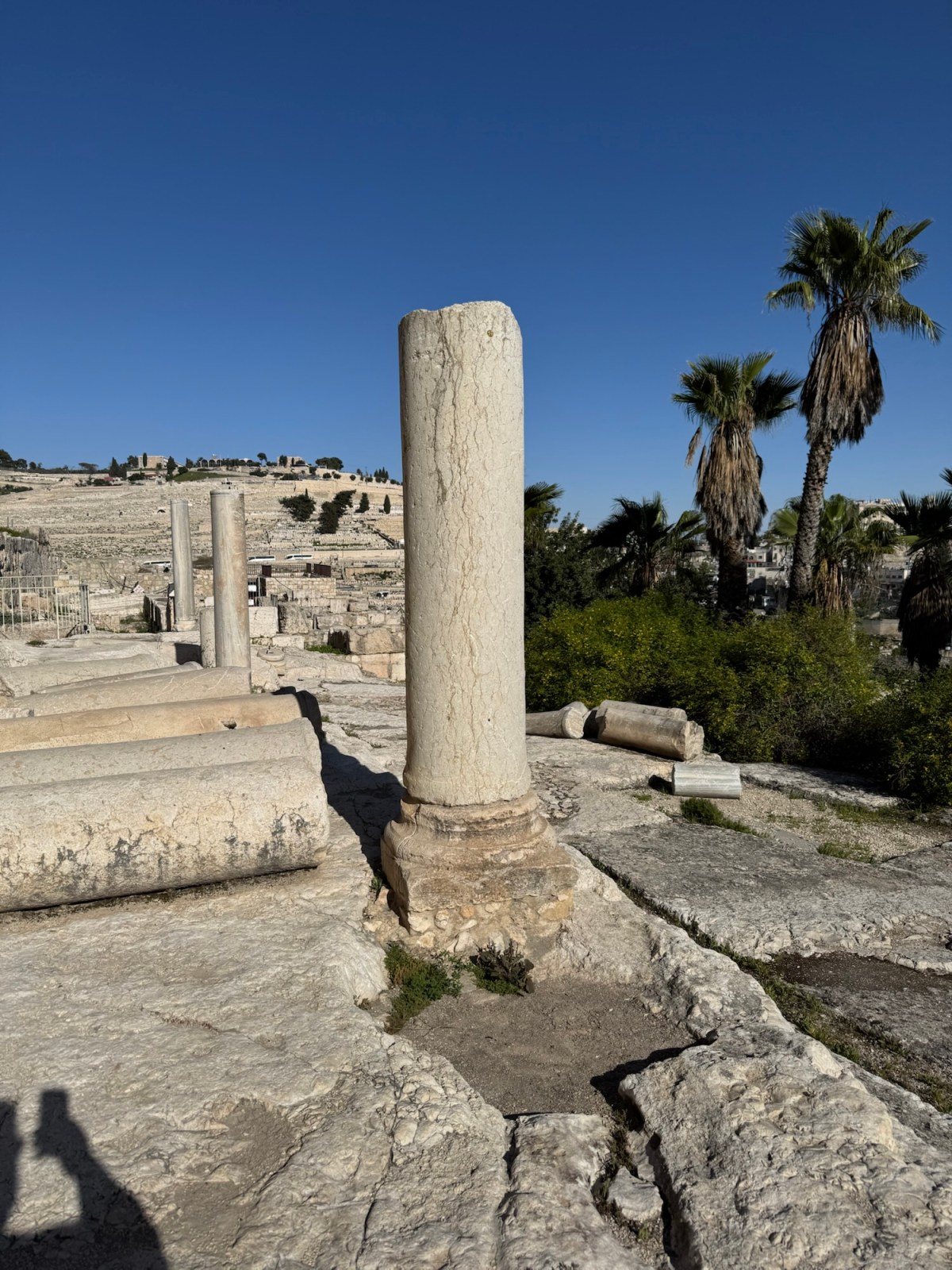
When you visit Jerusalem they will take you to:

  • The site of the Last Supper in the Upper Room
  • The Mount of Olives
  • Gethsemane
  • You’ll see the Eastern Gate
  • They’ll take you to Caiaphas’ Palace ans you’ll see the prison and pit they Jesus in there.
  • You’ll pass by Pilate’s Hall
  • You’ll see Golgotha and the probable area where our Lord was crucified
  • Just a little over a 100 yards you’ll see the empty tomb
  • They’ll take you to the Pool of Siloam
  • You’ll walk up the pilgrimage road from Siloam in the City of David up to the Temple walls
  • They’ll take you through a tunnel and when you exit you’ll be at the western wall of the temple
  • Just around the corner of the temple you’ll walk along the southern wall of the temple, you’ll see mikvah pools in front of the steps southern wall.
  • As you walk up the steps to the southern gate – the gate beautiful – you find an elevated area many call “the upper room,” and this is where the Holy Ghost was poured out on the Day of Pentecost in Acts 2.
  • It’s where they waited…

Acts 1:8 – they had to wait, we don’t. We have the power, it’s already been poured out: “But ye shall receive power, after that the Holy Ghost is come upon you: and ye shall be witnesses unto me both in Jerusalem, and in all Judaea, and in Samaria, and unto the uttermost part of the earth.”[2]

Hab 1:5, “Behold ye among the heathen, and regard, and wonder marvellously: for I will work a work in your days, which ye will not believe, though it be told you.”

So easy to look outside yourself, but the power or God is in you.


[1] Philippians 3:12-14

[2] Acts 1:8

Categories
Bible Teaching

Dynamic Duo

Stephen Kuntzman | July 27, 2025 | 10:00 AM

Text: James 2:14

What doth it profit, my brethren, though a man say he hath faith, and have not works? can faith save him?

The Dynamic Duo[1]

Ancillary Text: Genesis 22:1–14

(1) And it came to pass after these things, that God did tempt Abraham, and said unto him, Abraham: and he said, Behold, here I am. [availability]  (2)  And he said, Take now thy son, thine only son Isaac, whom thou lovest, and get thee into the land of Moriah; and offer him there for a burnt offering upon one of the mountains which I will tell thee of.  (3)  And Abraham rose up early in the morning, and saddled his ass, and took two of his young men with him, and Isaac his son, and clave the wood for the burnt offering, and rose up, and went unto the place of which God had told him. [faith in preparation]  (4)  Then on the third day Abraham lifted up his eyes, and saw the place afar off.  [faith tested with time] (5)  And Abraham said unto his young men, Abide ye here with the ass; and I and the lad will go yonder and worship, and come again to you.  [hope] (6)  And Abraham took the wood of the burnt offering, and laid it upon Isaac his son; and he took the fire in his hand, and a knife; and they went both of them together.  [faith in action] (7)  And Isaac spake unto Abraham his father, and said, My father: and he said, Here am I, my son. And he said, Behold the fire and the wood: but where is the lamb for a burnt offering? [Isaac is no mere boy, but a man of 37]  (8)  And Abraham said, My son, God will provide himself a lamb for a burnt offering: so they went both of them together. [a messianic prophecy, but also a rhema word for that moment] (9)  And they came to the place which God had told him of; and Abraham built an altar there, and laid the wood in order, and bound Isaac his son, and laid him on the altar upon the wood.  [faith and works] (10)  And Abraham stretched forth his hand, and took the knife to slay his son. [dynamic duo of Abraham and Isaac – trust in God and trust in the man of God]  (11)  And the angel of the LORD called unto him out of heaven, and said, Abraham, Abraham: and he said, Here am I.  (12)  And he said, Lay not thine hand upon the lad, neither do thou any thing unto him: for now I know that thou fearest God, seeing thou hast not withheld thy son, thine only son from me.  [God saw his faith and rewarded it] (13)  And Abraham lifted up his eyes, and looked, and behold behind him a ram caught in a thicket by his horns: and Abraham went and took the ram, and offered him up for a burnt offering in the stead of his son.  (14)  And Abraham called the name of that place Jehovahjireh: as it is said to this day, In the mount of the LORD it shall be seen. [God will see – or – God sees and provides]

Lesson Text: James 2:14–26

(14) What doth it profit, my brethren, though a man say he hath faith, and have not works? can faith save him?  (15)  If a brother or sister be naked, and destitute of daily food,  (16)  And one of you say unto them, Depart in peace, be ye warmed and filled; notwithstanding ye give them not those things which are needful to the body; what doth it profit?  (17)  Even so faith, if it hath not works, is dead, being alone.  (18)  Yea, a man may say, Thou hast faith, and I have works: shew me thy faith without thy works, and I will shew thee my faith by my works.  (19)  Thou believest that there is one God; thou doest well: the devils also believe, and tremble.  (20)  But wilt thou know, O vain man, that faith without works is dead?  (21)  Was not Abraham our father justified by works, when he had offered Isaac his son upon the altar?  (22)  Seest thou how faith wrought with his works, and by works was faith made perfect?  (23)  And the scripture was fulfilled which saith, Abraham believed God, and it was imputed unto him for righteousness: and he was called the Friend of God.  (24)  Ye see then how that by works a man is justified, and not by faith only.  (25)  Likewise also was not Rahab the harlot justified by works, when she had received the messengers, and had sent them out another way?  (26)  For as the body without the spirit is dead, so faith without works is dead also.

God calls us to put our faith into action, and so we demonstrate our faith through our works.

INTRODUCTION

Topeka, Kansas, is well known in American history for multiple reasons. In Topeka the events that led to the famous Brown v. Board of Education case occurred, which resulted in the desegregation of American schools.

Topeka was also the location of the Bible school where Charles Fox Parham and his students believed and taught that speaking in tongues was the initial sign of Holy Ghost baptism, helping to spark the modern Pentecostal movement.

Also, the city where Pastor Charles Sheldon, in 1896, decided to try something different during the Sunday night services.

Instead of a traditional sermon, he began reading a novel he was writing by presenting one chapter each week to the congregation. The story became so popular that soon the church was full of people wanting to find out about what would happen next.

Eventually the book would be published with the title In His Steps, and it remains a popular book to this day.

The story is set in fictional Raymond, a railroad town in the Eastern United States. It opens with the main character, Reverend Henry Maxwell, pastor of First Church of Raymond, sitting in his home on Friday afternoon preparing his Sunday sermon. When his efforts to concentrate are interrupted by a panhandler, the pastor brushes him aside and gets back to what he considers a more important activity.

On Sunday morning the same man shows up to service and addresses the congregation. He then immediately collapses and dies a few days later.

Reverend Maxwell is affected deeply by these events and begins to question his selfish behavior.

He challenges his congregation with a question that causes a revival in the lives of virtually everyone in the town: what would Jesus do?

Inspired by this simple, yet profound question, the members of Central Congregational Church begin to look for ways to use their position in the community to bring about changes that will form Raymond into a place God desires it to be.

What would Jesus do?

We would still do well to consider that provoking question because one of the essential components of true biblical theology should focus on what we believe and what we do.

Living for God is much more than simply listening to the preached Word of God on Sunday mornings; we must respond and follow what the Word of God calls us to do.

When God’s Word calls us to repent, we must repent.

When God’s Word calls us to love our neighbor and forgive those who hurt us, we must hear and heed.

We would do well to enter every service asking ourselves two questions:

  1. What does God want me to know?
  2. What does God want me to do?

THE DYNAMIC DUO OF FAITH AND WORKS

The Danger of Faith without Works

Peanut butter and jelly. Coffee and donuts. Rest and relaxation. Batman and Robin. Some things seem destined to always go together.

The same should be true of faith and works.

Bernard of Clairvaux wrote, “Hell is full of good wishes or desires.” Today, we say, “The road to Hell is paved with good intentions.”

Neither of these quotes are from the Word of God because they are not exactly accurate.

Being cast into outer darkness and eternally separated from God is not simply the end result of good intentions – it is the direct result of sin.

Likewise, we understand that good works alone cannot earn us entrance into heaven.

You will never be good enough to purchase your own salvation because, even on your best day, the Bible declares all your righteousness as nothing more than “filthy rags” (Isaiah 64:6).

It is impossible to do enough good deeds to erase the stain of one single sin.

You must apply the gospel to your life through the new-birth experience because neither good works nor good intentions are enough to save you.

This simple fact is demonstrated throughout the Word of God:

If Noah had the faith to believe it was going to rain but refused to build the ark, he would have drowned.

If Peter had answered the question, “Men and brethren, what shall we do?” by explaining that simply changing their mind about Jesus was enough for salvation, the people may have gone home with a repentance experience, but they would not have been born again. (See Acts 2:36–39.)

The Power of Faith with Works

When faith is combined with works the power of God is released.

Faith and works are both involved in all elements of obeying the gospel of Jesus Christ:

  • 2 Thessalonians 1:8, “In flaming fire taking vengeance on them that know not God, and that obey not the gospel of our Lord Jesus Christ”
  • 1 Peter 4:17, “For the time is come that judgment must begin at the house of God: and if it first begin at us, what shall the end be of them that obey not the gospel of God?” 

You must do more than have a change of mind about your sinful state; you must repent of your sins by turning from your old life. It is not enough to feel sorry for past mistakes; you must quit sinning.

For those who gathered to be baptized by John the Baptist, he demanded they “bring forth therefore fruits worthy of repentance” (Luke 3:8).

Jesus taught the same doctrine when He instructed the woman caught in adultery to “go, and sin no more” (John 8:11).

Repentance is how you obey the death of Jesus. You must have faith to believe that His death on the cross of Calvary was sufficient to pay your debt to sin, and then you must do the work of turning from sin.

After you repent of your sin, you respond to Jesus’ burial by being baptized in the name of Jesus Christ:

“Therefore we are buried with him by baptism into death: that like as Christ was raised up from the dead by the glory of the Father, even so we also should walk in newness of life.”[2]

When the first Gentiles were brought into the New Testament church in Acts 10, Peter did not just suggest they be baptized; rather, he “commanded them to be baptized in the name of the Lord” (Acts 10:48).

Your new birth is not complete without Spirit baptism. In His supreme wisdom, God provided you an undeniable sign that you have been filled with His Spirit.

Multiple experiences in life can make the hair stand up on your neck or give you moments of joy or a sense of peace.

However, only the baptism of the Holy Ghost allows you to worship God in a language you have never learned as you declare “the wonderful works of God” (Acts 2:11).

That experience involves a level of faith in the Word of God combined with surrendering your whole self to Him.

Faith without works is dead, but the combination of faith and works produces the new birth.

I Will Demonstrate My Faith through My Works

Just as faith apart from obedience will not result in salvation, your walk with God after the new birth is equally dependent upon the marriage of faith and works.

If Jesus had only declared His identity with words, the statements He made would have been true, but the opportunity to prove their accuracy may have been lost. The Bible declares: “Jesus . . . went about doing good” (Acts 10:38).

When John the Baptist sent messengers asking whether Jesus really was the Messiah, Jesus offered the works He had done as evidence:

“Go your way, and tell John what things ye have seen and heard; how that the blind see, the lame walk, the lepers are cleansed, the deaf hear, the dead are raised, to the poor the gospel is preached” (Luke 7:22).

Why do you think the majority of Jewish society rejected Jesus even after witnessing so many marvelous miracles?

The Book of James contains the most notable commentary on this subject. James asked these rhetorical questions: “What doth it profit, my brethren, though a man say he hath faith, and have not works? can faith save him?” (James 2:14).

James then gave a very practical example to illustrate his point. If we encounter a brother or sister needing clothing and food and say, “Depart in peace, be ye warmed and filled” without offering practical help, it is of no use (James 2:16).

“Even so faith, if it hath not works, is dead, being alone” (James 2:17).

THE FAITHFULNESS OF ABRAHAM

God Challenged Abraham’s Faith

To see faith in real life, let us look at the “father of the faithful” based on Paul’s description of Abraham as “the father of all them that believe” (Romans 4:11).

The first eleven chapters of the Book of Genesis chronicle approximately two thousand years. In those chapters we read about Adam and Eve, the story of Noah and the Flood, and how God confused the languages because of humanity’s disobedience in building the Tower of Babel.

We see some detail, but the Bible paints in rather broad brushstrokes until we reach chapter twelve where we are introduced to a man named Abram and his wife Sarai. The next fourteen chapters are devoted exclusively to that one man and his family. If we add in the portion of the Bible dedicated to Abraham’s son, grandson, and great-grandson, we see a total of thirty-nine chapters devoted to this one extended family.

Abraham is celebrated in God’s Hall of Faith in Hebrews 11: “By faith Abraham, when he was called to go out into a place which he should after receive for an inheritance, obeyed; and he went out, not knowing whither he went” (Hebrews 11:8).

Abraham was called, and then he obeyed.

Abraham combined faith with works.

If he had sat around his entire life bragging about God speaking to him and explaining how much he believed God’s promise without ever leaving his hometown, his spoken faith would have been dead words.

But to be proven faithful required more than one action. Abraham left his hometown, separated from his entire family (including his nephew Lot), and received the promised son named Isaac. Then the Lord challenged Abraham’s faith yet again with a call that must have been incredibly difficult to hear:

“Take now thy son, thine only son Isaac, whom thou lovest, and get thee into the land of Moriah; and offer him there for a burnt offering upon one of the mountains which I will tell thee of” (Genesis 22:2).

Abraham Proved to Be Faithful

No one can truly understand the anguish he felt to offer up his own son to God as a sacrifice. Abraham must have thought, God, this did not make sense. Is this really Your plan? Your nature? Yet Abraham’s response may be one of the most impressive examples of faith in God we read in the entire Bible.

Consider the test of Abraham’s faith. He had waited approximately twenty-five years for his promised son to be miraculously born. He had received the promise from God that through Isaac all nations of the earth shall be blessed. Then God said to sacrifice his promised son, Isaac.

Do not underestimate what this means: Abraham would have to lay his 37-year-old son on an altar and kill him as a sacrifice to God.

Can you think of any reason it would make sense for God to call Abraham to offer Isaac?

How could Abraham do something so barbaric? Offering Isaac directly conflicted with the promises God had given him. But there are two reasons for those concerns:

  • First, Abraham loved Isaac, but he loved God more. One of the main issues for Abraham was whether he loved the promise (Isaac) more than the promise keeper (God). Abraham passed the test by his willingness to sacrifice his son unto the one who gave him his son.
  • Secondly, Abraham had enough faith and trust that if he followed what God told him to do, the Lord was able to prove Himself faithful. Again we discover insight in the Book of Hebrews that helps explain Abraham’s thought process. The Bible explains Abraham reasoned that if God had promised all the nations of the earth would be blessed through Isaac, then when he followed God’s instructions and sacrificed his son, “God was able to raise him up, even from the dead” (Hebrews 11:19).

That is certainly faith with works.

But that resurrection miracle was unnecessary because as Abraham lifted the knife to sacrifice Isaac, the Lord stopped him and provided a ram as a sacrifice in place of Isaac, a beautiful Old Testament foreshadowing of our Savior, the Lord Jesus Christ.

I Will Seek to Be Found Faithful When Tested

Today we are faced with the same choice as every saint of God who has come before us. Unlike Noah, we will probably not be asked to build a large boat out of gopher wood, and we certainly should not expect God to call us to sacrifice our children. However, we must be mindful that living for God always has and always will require some level of sacrifice.

Only by a combination of faith with works is it possible to please God. The Book of James is often called the New Testament companion to the Old Testament Book of Proverbs. We are encouraged to be “doers of the word, and not hearers only.” If we only hear the word without taking proper action, we are guilty of deceiving our own selves (James 1:22).

This same principle can be applied to believing without taking action—faith without works.

You must daily decide to allow the Word of God to be the mirror through which you evaluate your actions and motives to ensure you are not guilty of Jesus’ warning in Luke 9:62, “No man, having put his hand to the plough, and looking back, is fit for the kingdom of God.”

A proper combination of faith and works will ensure we endure to the end and obtain salvation.

CONCLUSION

The year 1955 was significant. America had endured the Great Depression, experienced the thrill of victory in World War II, and found itself one decade into the Cold War with what was then known as the Soviet Union. President Eisenhower sent the first military advisors to Vietnam, and in that same year, a woman named Rosa Parks refused to give up her seat on a bus in Montgomery, Alabama, an event that sparked the Civil Rights Movement and inspired Martin Luther King, Jr.

Also in 1955 a recently retired man sat on his front porch and watched as his Social Security check was delivered to his mailbox. His life had been difficult. When Harland was only six years old, his father had died, causing young Harland to take the lead in caring for his younger brothers and sisters when their mother entered the workforce. He had dropped out of school in the sixth grade and held a wide variety of jobs since then: a railroad worker, a tire salesman, an unsuccessful politician, and others.

At the age of sixty-five, all he seemed to have to show for his efforts was the promise of another Social Security check being delivered. He went to the mailbox, retrieved his check, and thought to himself, Is this all my life is going to be, just sitting on the front porch waiting for my next check to arrive?

The thought was discouraging. Harland decided to pause and write down all the blessings in his life, listing everything, even the small things. You could say he was counting his blessings, naming them one by one. He wrote that he was the only person in the world who knew his mother’s recipe for fried chicken, which included eleven different herbs and spices. That day he decided to become a doer. He visited a local restaurant and asked if he could get a job cooking chicken. Soon his chicken became the most popular item on the menu.

Later Harland opened his own restaurant, which soon became a string of restaurants we now know as Kentucky Fried Chicken. He sold to a national organization for millions of dollars and served as their public representative until his death in 1980 at the age of ninety. All this became possible when “Colonel Sanders” refused to simply sit on the porch waiting to receive; he decided to do something with what he already had.

If Colonel Sanders realized his recipe and his fried chicken were gifts, and if his decision to do something with that knowledge allowed him to achieve fame in our society, what can the church of the living God do if we will become doers of the Word instead of hearers only?

Let’s Pray:

  • For God to help us become doers of the Word and not hearers only.
  • For God to give us the confidence to stand when life challenges our faith.
  • What types of sacrifice has God required from you in your walk with Him?

[1] SOURCE: God’s Word for Life Adult Lesson Guide Summer 2025. Pentecostal Publishing House. Lesson 2.4 – A Dynamic Duo.

[2] Romans 6:4

Categories
Bible Preaching

When God Remembers

Stephen Kuntzman | June 29, 2025 | 6:30 pm

Text: 1 Samuel 1:1-20

(1) Now there was a certain man of Ramathaimzophim, of mount Ephraim, and his name was Elkanah, the son of Jeroham, the son of Elihu, the son of Tohu, the son of Zuph, an Ephrathite:  (2)  And he had two wives; the name of the one was Hannah, and the name of the other Peninnah: and Peninnah had children, but Hannah had no children.  (3)  And this man went up out of his city yearly to worship and to sacrifice unto the LORD of hosts in Shiloh. And the two sons of Eli, Hophni and Phinehas, the priests of the LORD, were there.  (4)  And when the time was that Elkanah offered, he gave to Peninnah his wife, and to all her sons and her daughters, portions:  (5)  But unto Hannah he gave a worthy portion; for he loved Hannah: but the LORD had shut up her womb.  (6)  And her adversary also provoked her sore, for to make her fret, because the LORD had shut up her womb.  (7)  And as he did so year by year, when she went up to the house of the LORD, so she provoked her; therefore she wept, and did not eat.  (8)  Then said Elkanah her husband to her, Hannah, why weepest thou? and why eatest thou not? and why is thy heart grieved? am not I better to thee than ten sons?  (9)  So Hannah rose up after they had eaten in Shiloh, and after they had drunk. Now Eli the priest sat upon a seat by a post of the temple of the LORD.  (10)  And she was in bitterness of soul, and prayed unto the LORD, and wept sore.  (11)  And she vowed a vow, and said, O LORD of hosts, if thou wilt indeed look on the affliction of thine handmaid, and remember me, and not forget thine handmaid, but wilt give unto thine handmaid a man child, then I will give him unto the LORD all the days of his life, and there shall no razor come upon his head.  (12)  And it came to pass, as she continued praying before the LORD, that Eli marked her mouth.  (13)  Now Hannah, she spake in her heart; only her lips moved, but her voice was not heard: therefore Eli thought she had been drunken.  (14)  And Eli said unto her, How long wilt thou be drunken? put away thy wine from thee.  (15)  And Hannah answered and said, No, my lord, I am a woman of a sorrowful spirit: I have drunk neither wine nor strong drink, but have poured out my soul before the LORD.  (16)  Count not thine handmaid for a daughter of Belial: for out of the abundance of my complaint and grief have I spoken hitherto.  (17)  Then Eli answered and said, Go in peace: and the God of Israel grant thee thy petition that thou hast asked of him.  (18)  And she said, Let thine handmaid find grace in thy sight. So the woman went her way, and did eat, and her countenance was no more sad.  (19)  And they rose up in the morning early, and worshipped before the LORD, and returned, and came to their house to Ramah: and Elkanah knew Hannah his wife; and the LORD remembered her.  (20)  Wherefore it came to pass, when the time was come about after Hannah had conceived, that she bare a son, and called his name Samuel, saying, Because I have asked him of the LORD.

Shiloh = Tranquil.[1] A description for the Messiah, but also a description of the Church.

A safe place. A habitation of peace.

She came to the Tabernacle, to safety, to pray and to pour out her sorrow.

Samuel = heard of God.[2]

God heard her prayer and he remembered her.

She left Shiloh to go home with a promise from the man of God.

Make sure that when you say, “the Lord said,” that the LORD truly said it.

So many of our people are already broken-hearted and don’t deserve the added burden of a false word.

The reason they leave isn’t that they are disappointed in God, but they are hurt from the false word of propheliars (those who speak a false prophetic word).

Elkanah was a Levite, as was his son Samuel and Samuel’s grandson Heman:

(33) And these are they that waited with their children. Of the sons of the Kohathites: Heman a singer, the son of Joel, the son of Shemuel [Samuel],  (34)  The son of Elkanah, the son of Jeroham, the son of Eliel, the son of Toah,  (35)  The son of Zuph, the son of Elkanah, the son of Mahath, the son of Amasai,  (36)  The son of Elkanah, the son of Joel, the son of Azariah, the son of Zephaniah,  (37)  The son of Tahath, the son of Assir, the son of Ebiasaph, the son of Korah,  (38)  The son of Izhar, the son of Kohath, the son of Levi, the son of Israel.[3]

Heman = Faithful[4]

He was “the chief of the singers…composed psalms and hymns, which are in the book of Psalms.”[5]

Heman wrote Psalm 88. The most sorrowful and despairing psalm of the 150, it ends without any resolution.

Still, Heman keeps his focus on God, despite questioning God. “Why” is ok.

Like his great-grandmother Hannah, even though he feels forgotten he continues faithfully praying, seeking and worshipping God.

The psalm ends with no answer, but Heman never gives up His belief that God is the only source of deliverance and salvation.

Psalms 88:1-18  (A song and a psalm by the people of Korah for the music leader. To the tune “Mahalath Leannoth.” A special psalm by Heman the Ezrahite.)

(1) You keep me safe, LORD God. So when I pray at night,  (2)  please listen carefully to each of my concerns.  (3)  I am deeply troubled and close to death;  (4)  I am as good as dead and completely helpless.  (5)  I am no better off than those in the grave, those you have forgotten and no longer help.  (6)  You have put me in the deepest and darkest grave;  (7)  your anger rolls over me like ocean waves.  (8)  You have made my friends turn in horror from me. I am a prisoner who cannot escape,  (9)  and I am almost blind because of my sorrow. Each day I lift my hands in prayer to you, LORD.  (10)  Do you work miracles for the dead? Do they stand up and praise you?  (11)  Are your love and loyalty announced in the world of the dead?  (12)  Do they know of your miracles or your saving power in the dark world below where all is forgotten?  (13)  Each morning I pray to you, LORD.  (14)  Why do you reject me? Why do you turn from me?  (15)  Ever since I was a child, I have been sick and close to death. You have terrified me and made me helpless.  (16)  Your anger is like a flood! And I am shattered by your furious attacks  (17)  that strike each day and from every side.  (18)  My friends and neighbors have turned against me because of you, and now darkness is my only companion.

God hears your prayer, even when you don’t think He does.

God hears Your whispers.

Samuel then heard God: Samuel! Samuel! — Speak for thy servant heareth.


[1] Strong’s. H7886.

[2] Strong’s. H8050.

[3] 1 Chronicles 6:33-38 

[4] Strong’s. H1968.

[5] John Gill’s Exposition of the Bible. 1 Chr. 6:33-38.

Categories
Bible Preaching

More Vile

Stephen Kuntzman | March 9, 2025 | 6:30 PM

Text: 2 Samuel 6:16-23, “(16)  And as the ark of the LORD came into the city of David, Michal Saul’s daughter looked through a window, and saw king David leaping and dancing before the LORD; and she despised him in her heart. (17)  And they brought in the ark of the LORD, and set it in his place, in the midst of the tabernacle that David had pitched for it: and David offered burnt offerings and peace offerings before the LORD. (18)  And as soon as David had made an end of offering burnt offerings and peace offerings, he blessed the people in the name of the LORD of hosts. (19)  And he dealt among all the people, even among the whole multitude of Israel, as well to the women as men, to every one a cake of bread, and a good piece of flesh, and a flagon of wine. So all the people departed every one to his house. (20)  Then David returned to bless his household. And Michal the daughter of Saul came out to meet David, and said, How glorious was the king of Israel to day, who uncovered himself to day in the eyes of the handmaids of his servants, as one of the vain fellows shamelessly uncovereth himself! (21)  And David said unto Michal, It was before the LORD, which chose me before thy father, and before all his house, to appoint me ruler over the people of the LORD, over Israel: therefore will I play before the LORD. (22)  And I will yet be more vile than thus, and will be base in mine own sight: and of the maidservants which thou hast spoken of, of them shall I be had in honour. (23)  Therefore Michal the daughter of Saul had no child unto the day of her death.

Picture the moment:

  • The ark of the covenant is being returned to Jerusalem to the city of David (on a hill south of Mt. Moriah, the Temple Mount, where Solomon’s Temple will one day stand to permanently house it).
  • It was been away from Israel for 20 year.
    • 7 months with the Philistines
    • Then the Ark was taken to Abinadab’s house in Kiriath-Jearim, where his son Eleazar, watched over it for 20 years.
    • Then the house of Obededom cared for it for 3 months.
    • “And it was told king David, saying, The LORD hath blessed the house of Obededom, and all that pertaineth unto him, because of the ark of God. So David went and brought up the ark of God from the house of Obededom into the city of David with gladness. And it was so, that when they that bare the ark of the LORD had gone six paces, he sacrificed oxen and fatlings. And David danced before the LORD with all his might; and David was girded with a linen ephod. So David and all the house of Israel brought up the ark of the LORD with shouting, and with the sound of the trumpet” (2 Samuel 6:12-15).
      • “With gladness” = with joyful music, jubilant dancing and passionate singing.

Peering from their home, Michal watched David and despised him for his worship to God.

She so reviled him that the moment he came into the courtyard shemet him and with words dripping with sarcasm, irony, disrespect and even hate, she mocked him for his act of worship –

for making himself small in humble worship to His Lord.

True worshippers forget their surroundings.

They forget what their positions, titles, and roles

They got lost in adoration of the One who fills all space and time.

True worshippers don’t take into account others may think or say, they simply want to offer their praise and worship to their God.

Michal was bitter and like her father, Saul, she was more concerned about the people’s opinion than she was that her husband worshipped his God.

So, in a move of manipulation, she tried to shame David with words that she thought would reduce his joy and gladness, but David had already faced this attack before.

Years before, Saul dangled his daughter as a prize. It was witchcraft anf manipulation.

One day Saul said to David, “I am ready to give you my older daughter, Merab [Michal], as your wife. But first you must prove yourself to be a real warrior by fighting the LORD’s battles.” For Saul thought, “I’ll send him out against the Philistines and let them kill him rather than doing it myself.”[1]

Not an offer out of friendship or good will, but a trap.

Saul’s main struggle was his overwhelming concern with what the people would think of him, which is why he said, “Let not mine hand be upon him, but let the hand of the Philistines be upon him.”

In other words, let them do my dirt work for me so that the people won’t think badly of me.

Manipulation and control – witchcraft.

The struggle every leader faces is “their faces” (Jer. 1:4-10), and Saul failed miserably in this area.

You will remember what the LORD said to Jeremiah:

Then the word of the LORD came unto me, saying, Before I formed thee in the belly I knew thee; and before thou camest forth out of the womb I sanctified thee, and I ordained thee a prophet unto the nations. Then said I, Ah, Lord GOD! behold, I cannot speak: for I am a child. But the LORD said unto me, Say not, I am a child: for thou shalt go to all that I shall send thee, and whatsoever I command thee thou shalt speak. Be not afraid of their faces: for I am with thee to deliver thee, saith the LORD. Then the LORD put forth his hand, and touched my mouth. And the LORD said unto me, Behold, I have put my words in thy mouth. See, I have this day set thee over the nations and over the kingdoms, to root out, and to pull down, and to destroy, and to throw down, to build, and to plant.[2]

Saul’s attempt in trying to persuade David to wear his armor in his fight with Goliath was for the same reason he wanted Samuel to worship with him after God rejected him.

He was more interested in what the people thought. He was terrified of public opinion.

Saul thought that David wearing his armor would be good for Saul.

Saul was two years into his kingship when he showed his fear of public opinion and it was here that he lost the dynasty:

“And Samuel said, What hast thou done? And Saul said, Because I saw that the people were scattered from me, and that thou camest not within the days appointed, and that the Philistines gathered themselves together at Michmash; therefore said I, The Philistines will come down now upon me to Gilgal, and I have not made supplication unto the LORD: I forced myself therefore, and offered a burnt offering. And Samuel said to Saul, Thou hast done foolishly: thou hast not kept the commandment of the LORD thy God, which he commanded thee: for now would the LORD have established thy kingdom upon Israel for ever. But now thy kingdom shall not continue: the LORD hath sought him a man after his own heart, and the LORD hath commanded him to be captain over his people, because thou hast not kept that which the LORD commanded thee.”[3]

In 1 Samuel 15 it looks as if God was willing to give Saul a second chance of sorts, but his disobedience led to his ruin and it was partly due to fear of public opinion:

“And Saul said unto Samuel, I have sinned: for I have transgressed the commandment of the LORD, and thy words: because I feared the people, and obeyed their voice.”[4]

Later Saul lies to Samuel, but still asked for special favor before the people:

“Now therefore, I pray thee, pardon my sin, and turn again with me, that I may worship the LORD. And Samuel said unto Saul, I will not return with thee: for thou hast rejected the word of the LORD, and the LORD hath rejected thee from being king over Israel. And as Samuel turned about to go away, he laid hold upon the skirt of his mantle, and it rent. And Samuel said unto him, The LORD hath rent the kingdom of Israel from thee this day, and hath given it to a neighbour of thine, that is better than thou. And also the Strength of Israel will not lie nor repent: for he is not a man, that he should repent. Then he said, I have sinned: yet honour me now, I pray thee, before the elders of my people, and before Israel, and turn again with me, that I may worship the LORD thy God.”

Saul’s worship wasn’t from his heart to God, but from his mind to manipulate the peoples’ perception.

This was what Saul taught Michal.

If David had never laid down his kingly robes, but instead marched stoically before the Ark, Michal would have been thrilled with this display of Royal pomp and circumstance.

The key difference between Saul and David is here:

“And Samuel said, When thou [Saul] wast little in thine own sight, wast thou not made the head of the tribes of Israel, and the LORD anointed thee king over Israel?” (1 Samuel 15:17)

Humility – the willingness to make himself “MORE VILE” – is what separated David from Saul and distinguished him in God’s eyes as “a man after his own heart.”

David laid down his kingly robes and returned to his humble origins where he first met God as a shepherd boy.

In the Ancient Hebrew, vile also means “gathering to the staff.”

When the shepherd called the sheep they swiftly came to him.

The staff of the shepherd was his tool of authority. With it he would direct, discipline and protect the flock.[5]

David heard the voice of the Shepherd and gathered himself to His Staff in an offering both of animal sacrifices or worship and in a spirited display of  a Living Sacrifice.

David learned worship shepherding in the fields long before he became a king, it was east to lay aside his kingly robe to worship his King.

“I beseech you therefore, brethren, by the mercies of God, that ye present your bodies a living sacrifice, holy, acceptable unto God, which is your reasonable service. And be not conformed to this world: but be ye transformed by the renewing of your mind, that ye may prove what is that good, and acceptable, and perfect, will of God” (Romans 12:1-2).

You must make yourself More Vile.

It’s easy in our multigenerational Pentecostal culture to think that worship is in the dance, the shout, the jump, the tongues,

BUT real worship is when you become vile and base to yourself.

You submit your self in an act or personal requirement to lay down your pride, personal rights, what you consider “justice” — lay down your gift and be reconciled.

Why? Because someone has ought against you, not you against them.

We wear robes of dignity, pride, position (that’s beneath me), entitlement, religion, but Jesus is looking for His robe on you: garments of praise, robes of righteousness.

More Vile:

  • But it doesn’t make any sense
  • What will people think
  • Costs you something – a sacrifice
  • Requires a demonstration of true leadership – a true shepherd (Jesus at Calvary became “more vile”)

Michal, if she ever had it, lost it that day when she reviled and mocked a true worshipper because of her fear of what others might say,

But David, that shepherd-king gave it all in worship.

Jesus is here and He knows what it is like to humble Himself and be seen as vile:

Philippians 2:5-11, “(5) Let this mind be in you, which was also in Christ Jesus:  (6)  Who, being in the form of God, thought it not robbery to be equal with God:  (7)  But made himself of no reputation, and took upon him the form of a servant, and was made in the likeness of men:  (8)  And being found in fashion as a man, he humbled himself, and became obedient unto death, even the death of the cross.  (9)  Wherefore God also hath highly exalted him, and given him a name which is above every name:  (10)  That at the name of Jesus every knee should bow, of things in heaven, and things in earth, and things under the earth;  (11)  And that every tongue should confess that Jesus Christ is Lord, to the glory of God the Father.”


[1] 1 Samuel 18:17, NLT.

[2] Jeremiah 1:4-10

[3] 1 Samuel 13:11-14

[4] 1 Samuel 15:24

[5] H7043. Ancient Hebrew Lexicon of the Bible.

Categories
Bible Teaching

Just a Little Stone

Stephen Kuntzman | Feb. 23, 2025 | 10:00 AM

Text: Acts 4:8-12

(8)  Then Peter, filled with the Holy Ghost, said unto them, Ye rulers of the people, and elders of Israel,

(9)  If we this day be examined of the good deed done to the impotent man, by what means he is made whole;

(10)  Be it known unto you all, and to all the people of Israel, that by the name of Jesus Christ of Nazareth, whom ye crucified, whom God raised from the dead, even by him doth this man stand here before you whole.

(11)  This is the stone which was set at nought of you builders, which is become the head of the corner.

(12)  Neither is there salvation in any other: for there is none other name under heaven given among men, whereby we must be saved.

Just a Little Stone

verse 11, “This is the stone which was set at nought of you builders, which is become the head of the corner.”

Have you ever set something aside thinking that it was not useful for your purpose, only to comeback to it later in the project because it was exactly what you needed all along?

OR – have you rejected a person, thing or opportunity only to regret that decision later on.

In life, there are moments you can retrace in your mind that take you to a decision made that changed your life.

Something you “set a nought,” or what the psalmist wrote as being “refused,” and the apostle Matthew said it was “rejected.”

Whether despised, refused, or rejected, you relegated it in you mind to being Just a Little Stone.

This passage from our text quotes Psalms 118:22-23, “The stone which the builders refused is become the head stone of the corner.  (23)  This is the LORD’S doing; it is marvellous in our eyes.”

A small stone from the Valley of Elah.

It is considered a messianic prophecy, but it is also addressing David’s years of obscurity before he was anointed, accepted and crowned:

  • His own father discounted him, but the Lord of Heaven and Earth saw in him something of great value.
  • David’s time in the hills and valley caring for sheep prepared him for leadership
  • His time of solitude brought him close to God as he poured his heart to Him in prayer, praise, song and music.
  • The time spent looking for stray sheep offered discoveries that would later serve to hide him in safety from a king who wanted to destroy him.
  • He learned, in his obscurity, how to defend and protect the flock.
  • Nobody thought much of David before Samuel anointed him, but in those years of solitude, he was being prepared for his purpose.
  • While rejected, despised and even snubbed, these years with the sheep were the exact thing he needed to shape him into the kind of person that the Lord said was “a man after mine own heart, which shall fulfil all my will.”[1]

Our text also points to our Lord and Savior Jesus Christ. He was also set at nought, He was refused, rebuffed, despised and rejected of men.

For the most part, the religious leaders of His day did not want, recognize and desire what He was offering.

It did not fit within their understanding, framework, and teaching of how the messiah was to appear to them.

So, they rejected Him.

Instead of a headstone he was set aside and became a stone of stumbling.

Isaiah 28:16, “Therefore thus saith the Lord GOD, Behold, I lay in Zion for a foundation a stone, a tried stone, a precious corner stone, a sure foundation: he that believeth shall not make haste.”

Romans 9:30-33, “(30) What shall we say then? That the Gentiles, which followed not after righteousness, have attained to righteousness, even the righteousness which is of faith.  (31)  But Israel, which followed after the law of righteousness, hath not attained to the law of righteousness.  (32)  Wherefore? Because they sought it not by faith, but as it were by the works of the law. For they stumbled at that stumblingstone;  (33)  As it is written, Behold, I lay in Sion a stumblingstone and rock of offence: and whosoever believeth on him shall not be ashamed.”

In the 1800s, Edward Irving, a Scottish preacher came on the scene in London, England, and his preaching turned London upside down.

He preached to politicians, lords, ladies, the wealthy, the elite, and to the common man.

His effect was so widespread that people would come and sit for hours just to hear him preach God’s Holy Word,

But nobody in England knew about the years he spent in obscurity in Scotland preaching with little success and minor results.

In his biography it was told that he changed nothing about his preaching, style, delivery, and ministry to the people.

It was just that God had finally pulled him out of the corner he was set in and he became a cornerstone for a supernatural move of the work of the Holy Ghost.

Ephesians 2:19-22, “(19) Now therefore ye are no more strangers and foreigners, but fellowcitizens with the saints, and of the household of God;  (20)  And are built upon the foundation of the apostles and prophets, Jesus Christ himself being the chief corner stone;  (21)  In whom all the building fitly framed together groweth unto an holy temple in the Lord:  (22)  In whom ye also are builded together for an habitation of God through the Spirit.”

God has come to pull you out of obscurity…out of the shadows…where He has been:

  • Refining you
  • Training you
  • Preparing you
  • Arranging the place He wants to put you.

1 Peter 2:5-12, “(5)  Ye also, as lively stones, are built up a spiritual house, an holy priesthood, to offer up spiritual sacrifices, acceptable to God by Jesus Christ.  (6)  Wherefore also it is contained in the scripture, Behold, I lay in Sion a chief corner stone, elect, precious: and he that believeth on him shall not be confounded.  (7)  Unto you therefore which believe he is precious: but unto them which be disobedient, the stone which the builders disallowed, the same is made the head of the corner,  (8)  And a stone of stumbling, and a rock of offence, even to them which stumble at the word, being disobedient: whereunto also they were appointed.  (9)  But ye are a chosen generation, a royal priesthood, an holy nation, a peculiar people; that ye should shew forth the praises of him who hath called you out of darkness into his marvellous light:  (10)  Which in time past were not a people, but are now the people of God: which had not obtained mercy, but now have obtained mercy.  (11)  Dearly beloved, I beseech you as strangers and pilgrims, abstain from fleshly lusts, which war against the soul;  (12)  Having your conversation honest among the Gentiles: that, whereas they speak against you as evildoers, they may by your good works, which they shall behold, glorify God in the day of visitation.”

Romans 11:11, “I say then, Have they stumbled that they should fall? God forbid: but rather through their fall salvation is come unto the Gentiles, for to provoke them to jealousy.”

Just a Little Stone


[1] Acts 13:22

Categories
Bible Preaching

The Ever Present Ark

Stephen Kuntzman | April 20, 2025 | 6:30 PM

Jeremiah 3:15-16, “(15) And I will give you pastors according to mine heart, which shall feed you with knowledge and understanding.  (16)  And it shall come to pass, when ye be multiplied and increased in the land, in those days, saith the LORD, they shall say no more, The ark of the covenant of the LORD: neither shall it come to mind: neither shall they remember it; neither shall they visit it; neither shall that be done any more.”

2 Timothy 3:1-5, “(1) This know also, that in the last days perilous times shall come.  (2)  For men shall be lovers of their own selves, covetous, boasters, proud, blasphemers, disobedient to parents, unthankful, unholy,  (3)  Without natural affection, trucebreakers, false accusers, incontinent, fierce, despisers of those that are good,  (4)  Traitors, heady, highminded, lovers of pleasures more than lovers of God;  (5)  Having a form of godliness, but denying the power thereof: from such turn away.”

Zechariah 8:3-8, “(3) Thus saith the LORD; I am returned unto Zion, and will dwell in the midst of Jerusalem: and Jerusalem shall be called a city of truth; and the mountain of the LORD of hosts the holy mountain.  (4)  Thus saith the LORD of hosts; There shall yet old men and old women dwell in the streets of Jerusalem, and every man with his staff in his hand for very age.  (5)  And the streets of the city shall be full of boys and girls playing in the streets thereof.  (6)  Thus saith the LORD of hosts; If it be marvellous in the eyes of the remnant of this people in these days, should it also be marvellous in mine eyes? saith the LORD of hosts.  (7)  Thus saith the LORD of hosts; Behold, I will save my people from the east country, and from the west country;  (8)  And I will bring them, and they shall dwell in the midst of Jerusalem: and they shall be my people, and I will be their God, in truth and in righteousness.”

Exo 25:10-22, “And they shall make an ark of shittim wood: two cubits and a half shall be the length thereof, and a cubit and a half the breadth thereof, and a cubit and a half the height thereof. And thou shalt overlay it with pure gold, within and without shalt thou overlay it, and shalt make upon it a crown of gold round about. And thou shalt cast four rings of gold for it, and put them in the four corners thereof; and two rings shall be in the one side of it, and two rings in the other side of it. And thou shalt make staves of shittim wood, and overlay them with gold. And thou shalt put the staves into the rings by the sides of the ark, that the ark may be borne with them. The staves shall be in the rings of the ark: they shall not be taken from it. And thou shalt put into the ark the testimony which I shall give thee. And thou shalt make a mercy seat of pure gold: two cubits and a half shall be the length thereof, and a cubit and a half the breadth thereof. And thou shalt make two cherubims of gold, of beaten work shalt thou make them, in the two ends of the mercy seat. And make one cherub on the one end, and the other cherub on the other end: even of the mercy seat shall ye make the cherubims on the two ends thereof. And the cherubims shall stretch forth their wings on high, covering the mercy seat with their wings, and their faces shall look one to another; toward the mercy seat shall the faces of the cherubims be. And thou shalt put the mercy seat above upon the ark; and in the ark thou shalt put the testimony that I shall give thee. And there I will meet with thee, and I will commune with thee from above the mercy seat, from between the two cherubims which are upon the ark of the testimony, of all things which I will give thee in commandment unto the children of Israel.”

Categories
Bible Teaching

A Miracle at Joppa

Apostolic Life Cathedral | 1/19/2025 | 10:00 AM

Categories
Bible Preaching

But I Won

Text: 2 Cor. 2:14, “Now thanks be unto God, which always causeth us to triumph in Christ, and maketh manifest the savour of his knowledge by us in every place.” 

SONG:

The devil and I had a fight, BUT I WON!

Me and devil and can’t agree, I hate him and he hates me.

And I’m still winning!

Give God a victory praise…you’re still winning!

People may have talked, gossiped and judged, but you won.

2 Corinthians 6:14-18

“Be ye not unequally yoked together with unbelievers: for what fellowship hath righteousness with unrighteousness? and what communion hath light with darkness? And what concord hath Christ with Belial? or what part hath he that believeth with an infidel? And what agreement hath the temple of God with idols? for ye are the temple of the living God; as God hath said, I will dwell in them, and walk in them; and I will be their God, and they shall be my people. Wherefore come out from among them, and be ye separate, saith the Lord, and touch not the unclean thing; and I will receive you, And will be a Father unto you, and ye shall be my sons and daughters, saith the Lord Almighty.”

Shammah

(11) And after him was Shammah the son of Agee the Hararite. And the Philistines were gathered together into a troop, where was a piece of ground full of lentiles: and the people fled from the Philistines. (12) But he stood in the midst of the ground, and defended it, and slew the Philistines: and the LORD wrought a great victory.[1]

1 Tim. 6:12, “Fight the good fight of faith, lay hold on eternal life, whereunto thou art also called, and hast professed a good profession before many witnesses.”

Matthew 12:9-21

(9)  And when he was departed thence, he went into their synagogue:

(10)  And, behold, there was a man which had his hand withered. And they asked him, saying, Is it lawful to heal on the sabbath days? that they might accuse him.

(11)  And he said unto them, What man shall there be among you, that shall have one sheep, and if it fall into a pit on the sabbath day, will he not lay hold on it, and lift it out?

(12)  How much then is a man better than a sheep? Wherefore it is lawful to do well on the sabbath days.

(13)  Then saith he to the man, Stretch forth thine hand. And he stretched it forth; and it was restored whole, like as the other.

(14)  Then the Pharisees went out, and held a council against him, how they might destroy him.

(15)  But when Jesus knew it, he withdrew himself from thence: and great multitudes followed him, and he healed them all;

  • He knew of the plot which they had formed against his life; but his hour was not yet come, and he therefore sought security.
  • By remaining, his presence would only have provoked them further and endangered his own life. He acted, therefore, the part of prudence and withdrew.
  • Just because you can don’t mean you should.
  • “He healed them all.”  Jesus healed their diseases, and preached to them the good news of salvation.[2]

(16)  And charged them that they should not make him known:

(17)  That it might be fulfilled which was spoken by Esaias the prophet, saying,

(18)  Behold my servant, whom I have chosen; my beloved, in whom my soul is well pleased: I will put my spirit upon him, and he shall shew judgment to the Gentiles.

(19)  He shall not strive, nor cry; neither shall any man hear his voice in the streets.

  • He did not shout as a warrior.
  • He is meek, retiring, and peaceful.
  • He didn’t seek publicity, fame and popularity.[3]

(20)  A bruised reed shall he not break, and smoking flax shall he not quench, till he send forth judgment unto victory.

  • Jesus did not oppress the feeble and poor
  • The “bruised reed” is a type of the brokenness of the soul on account of sin; weeping and mourning for transgression.
  • Jesus will not break it; He will not be severe, unforgiving, and cruel. He will heal you, pardon you, and give you strength.
  • He will not further oppress those who have little strength; nor put out hope and life when it seems to be almost extinct.
  • He will cherish the feeble flame, tend to it and give it the oil of grace until it is kindled into a blaze.
  • He will not allow you to be defeated – BUT I WON!
  • The truth is that the Gospel of Jesus Christ conquer.[4]

(21)  And in his name shall the Gentiles trust.

The Portal of Victory:[5]

  1. Intense Prayer
  2. Intense Hunger & Desire
  3. Faith & Expectation

1 John 5:4-5

(4)  For whatsoever is born of God overcometh the world: and this is the victory that overcometh the world, even our faith.

(5)  Who is he that overcometh the world, but he that believeth that Jesus is the Son of God?

But I Won


[1] 2 Samuel 23:11-12

[2] Albert Barnes’ Notes on the Bible. Matthew 12:9-21.

[3] Ibid.

[4] Ibid.

[5] Missionary MVMUTHU. (n.d.). The River of God’s Glory.