1 Timothy 3:15, "...that thou mayest know how thou oughtest to behave thyself in the house of God, which is the church of the living God, the pillar and ground of the truth."
Our dogma revolves around the great biblical truth that there is One God, also called “monotheism.” In his book, The Oneness of God, David K. Bernard, J.D. defines monotheism in this manner: “The belief in only one God is called monotheism, which comes from two Greek words: monos, meaning alone, single, one; and theos, meaning God.”
Ralph V. Reynolds simply stated that “there is only one Supreme Being who is God; He cannot be multiplied nor pluralized.” He further declared, “There are over fifty passages of Scripture that teach that God is one and that there is no other.”
In fact, the Word of God naturally assumes this universal truth. Genesis 1:1, “In the beginning God created…” God here is the transliterated form of Elohim, which means “plenitude of might,” or more simply, “one God whose characteristics are many.”
This thought is carried further in Deuteronomy 6:4, “Hear, O Israel: the LORD our God is one LORD.”
In Colossians 2:9 we are told that in Jesus dwells all the fullness of the Godhead (all the characteristics of God) bodily, and we (the Church) are complete in Him (Jesus).
When addressing Timothy, Paul wrote of a mystery, but then he further explained what that mystery was, “And without controversy great is the mystery of godliness: God was manifest in the flesh, justified in the Spirit, seen of angels, preached unto the Gentiles, believed on in the world, received up into glory” (1 Timothy 3:16). Only Jesus Christ fulfills those six points. Therefore, Jesus Christ of the New Testament is Elohim of the Old Testament, which further explains why we are told that Jesus Christ is the image of the invisible God and that all things exist and consist by him, Colossians 1:12-17.
So, we are dogmatic in our belief that there is only one God and Jesus is His name. He is our Creator, Sustainer, Redeemer, and Savior. Isaiah 9:6, “For unto us a child is born, unto us a son is given: and the government shall be upon his shoulder: and his name shall be called Wonderful, Counsellor, The mighty God, The everlasting Father, The Prince of Peace.” Only Jesus fulfills this messianic prophecy. He is the Father in Creation, the Son in Redemption, and the Holy Spirit in us today. Keep this great truth in mind and heart as you celebrate this Christmas season. Merry Christmas!
Bernard, David K. The Oneness of God. St. Louis: Word Aflame Press, 1983.
Reynolds, Ralph V. Truth Shall Triumph. Hazelwood, MO: Pentecostal Publishing House, 1965.
Sometimes suffering and adversity appear senseless to us, and we ask questions like, “How can anyone possibly benefit from this calamity?” Or, “Can someone tell me what purpose this is serving?” Or, simply, “Why, Lord?”
“But the God of all grace, who hath called us unto his eternal glory by Christ Jesus, after that ye have suffered a while, make you perfect, stablish, strengthen, settle you” (1 Peter 5:10).
1. Perfect = “the idea of mending or repairing something that has been broken….It may be the will of God for believers to suffer temporarily, but the suffering will be followed by restoration and mending of whatever may have been broken during the suffering.”
2. Establish = “making something firm….a promise that God will firmly establish those who have suffered to any degree that they have experienced loss by their suffering.”
3. Strengthen = “making something strong, with specific application to the soul. God will remove any weakness that may have resulted from suffering.”
4. Settle = “laying a foundation or making something stable. Thus, if any believer’s stability has been damaged by suffering, God will correct it.”
The believer will suffer, but the blessing — Yes, the blessing — of suffering is God’s promise to perfect, stablish, strengthen, and settle each believer before they reach God’s eternal glory.
According to the late T. W. Barnes, many people pronounce the name of Jesus without really knowing how to say it. He specified four ways to say the name of Jesus:
Say His name with love; the early church had great success, because they loved not their lives, they loved that Name. Love is powerful. Their love gave them reverence for the Name.
Say His name with vision. Say it seeing the invisible. A woman said, “I resist the devil and he doesn’t leave.” Bro. Barnes asked her, “What do you look for? The Bible doesn’t say resist him and see him sitting on your shoulder; when you resist him you should see him running. The devil no doubt left you when you said in Jesus Name, but since you did not expect him to go, your thinking made you as miserable as if he stayed with you.”
Say His name with faith. Religious leaders in Israel asked the disciples, “How did you heal the man crippled from his mother’s womb?” Peter answered, “…by the name of Jesus Christ…”
Say His name while living a life of sacrifice. The disciples sacrificed everything for that name. We need to love it enough that no sacrifice is too great to make for Jesus.
God has always desired to fellowship with man, but sin came into the human family and separated God from man. The purpose of Sonship was so that God could provide the best means by which He and man could regain their fellowship, and to give dominion over the earth to man again. This fellowship is the result of the sacrifice of the Savior on Calvary. He could only do this by providing complete redemption for mankind. He is the Lamb that was slain from the foundation of the world, Rev. 13:8. In short, the Sonship is about God and man engaging in a loving and healthy relationship that is void of any hindrances (sin), which would separate each from the other. For that to take place a Mediator (the Son) had to provide reconciliation between God and man. This Mediator was realized in the person of Jesus Christ.
Who Fulfilled the Sonship
Jesus Christ fulfills the Sonship. In Colossians 2:9 we are told that in Jesus dwells all the fullness of the Godhead (all the characteristics of God) bodily, and we (the Church) are complete in Him (Jesus). Paul did say that the Gospel message was a mystery, but then he went on to explain what the mystery was: “And without controversy great is the mystery of godliness: God was manifest in the flesh, justified in the Spirit, seen of angels, preached unto the Gentiles, believed on in the world, received up into glory” (I Timothy 3:16). Only Jesus Christ fulfills these six points. Thus proving the adage, “Jesus Christ of the New Testament is Jehovah of the Old Testament.”
Gal. 6:7-10 7 Be not deceived; God is not mocked: for whatsoever a man soweth, that shall he also reap. 8 For he that soweth to his flesh shall of the flesh reap corruption; but he that soweth to the Spirit shall of the Spirit reap life everlasting. 9 And let us not be weary in well doing: for in due season we shall reap, if we faint not. 10 As we have therefore opportunity, let us do good unto all men, especially unto them who are of the household of faith.
The Law of Harvest: Gal. 6:7, “…Whatsoever a man soweth, that shall he also reap.”
Consider your seed: What are you sowing, or planting in your life? What habits are you developing? What behavior do you manifest outwardly to others on a day-to-day basis? What are the secret thoughts that you consider in the privacy of your mind? What types of music, television programming, movies, and Internet sites do you allow to enter your spirit being through your sense gates? What kind of conversations do you entertain?
Whatever answers you may have to these questions, one thing is certain; you will reap what you’ve sown: Sow love and you’ll receive love Sow hate and you’ll receive the same Sow kindness and you will receive it in turn Sow cynicism and others will mistrust you as well
The Apostle is clear on this one issue: You get what you sow. You can’t plant an orange tree and expect apples. You can’t alter the inevitable law of harvest – – like begets like.
Romans 6 1 What shall we say then? Shall we continue in sin, that grace may abound? 2 God forbid. How shall we, that are dead to sin, live any longer therein? 3 Know ye not, that so many of us as were baptized into Jesus Christ were baptized into his death? 4 Therefore we are buried with him by baptism into death: that like as Christ was raised up from the dead by the glory of the Father, even so we also should walk in newness of life. 5 For if we have been planted together in the likeness of his death, we shall be also in the likeness of his resurrection: 6 Knowing this, that our old man is crucified with him, that the body of sin might be destroyed, that henceforth we should not serve sin. 7 For he that is dead is freed from sin. 8 Now if we be dead with Christ, we believe that we shall also live with him: 9 Knowing that Christ being raised from the dead dieth no more; death hath no more dominion over him. 10 For in that he died, he died unto sin once: but in that he liveth, he liveth unto God. 11 Likewise reckon ye also yourselves to be dead indeed unto sin, but alive unto God through Jesus Christ our Lord. 12 Let not sin therefore reign in your mortal body, that ye should obey it in the lusts thereof. 13 Neither yield ye your members as instruments of unrighteousness unto sin: but yield yourselves unto God, as those that are alive from the dead, and your members as instruments of righteousness unto God. 14 For sin shall not have dominion over you: for ye are not under the law, but under grace. 15 What then? shall we sin, because we are not under the law, but under grace? God forbid. 16 Know ye not, that to whom ye yield yourselves servants to obey, his servants ye are to whom ye obey; whether of sin unto death, or of obedience unto righteousness? 17 But God be thanked, that ye were the servants of sin, but ye have obeyed from the heart that form of doctrine which was delivered you. 18 Being then made free from sin, ye became the servants of righteousness. 19 I speak after the manner of men because of the infirmity of your flesh: for as ye have yielded your members servants to uncleanness and to iniquity unto iniquity; even so now yield your members servants to righteousness unto holiness. 20 For when ye were the servants of sin, ye were free from righteousness. 21 What fruit had ye then in those things whereof ye are now ashamed? for the end of those things is death. 22 But now being made free from sin, and become servants to God, ye have your fruit unto holiness, and the end everlasting life. 23 For the wages of sin is death; but the gift of God is eternal life through Jesus Christ our Lord.
The inevitable law of harvest declares that you will end up in one of two places. You Choose: Heaven or Hell
The choice of Hell, which designates you as a servant of sin, will reveal certain undeniable indicators in your life (i.e. the works of the flesh: adultery, fornication, uncleanness, lasciviousness, Idolatry, witchcraft, hatred, variance, emulations, wrath, strife, seditions, heresies, envyings, murders, drunkenness, revellings, and such like [Gal. 5:19-21]). When you yield yourself to these you are making a decision to do so.
The choice of Heaven, designating you as a servant of righteousness, will be seen by the presence of the Fruit of the Spirit: love, joy, peace, longsuffering, gentleness, goodness, faith, meekness, temperance (Gal. 5:22-23). Yielding to the Holy Ghost is also a conscious decision that you make.
The Law of Distribution: Gal. 6:10, “…let us do good unto all men…”
1 Cor. 7:1-24 1 Now concerning the things whereof ye wrote unto me: It is good for a man not to touch a woman. 2 Nevertheless, to avoid fornication, let every man have his own wife, and let every woman have her own husband. 3 Let the husband render unto the wife due benevolence: and likewise also the wife unto the husband. 4 The wife hath not power of her own body, but the husband: and likewise also the husband hath not power of his own body, but the wife. 5 Defraud ye not one the other, except it be with consent for a time, that ye may give yourselves to fasting and prayer; and come together again, that Satan tempt you not for your incontinency. 6 But I speak this by permission, and not of commandment. 7 For I would that all men were even as I myself. But every man hath his proper gift of God, one after this manner, and another after that. 8 I say therefore to the unmarried and widows, It is good for them if they abide even as I. 9 But if they cannot contain, let them marry: for it is better to marry than to burn. 10 And unto the married I command, yet not I, but the Lord, Let not the wife depart from her husband: 11 But and if she depart, let her remain unmarried, or be reconciled to her husband: and let not the husband put away his wife. 12 But to the rest speak I, not the Lord: If any brother hath a wife that believeth not, and she be pleased to dwell with him, let him not put her away. 13 And the woman which hath an husband that believeth not, and if he be pleased to dwell with her, let her not leave him. 14 For the unbelieving husband is sanctified by the wife, and the unbelieving wife is sanctified by the husband: else were your children unclean; but now are they holy. 15 But if the unbelieving depart, let him depart. A brother or a sister is not under bondage in such cases: but God hath called us to peace. 16 For what knowest thou, O wife, whether thou shalt save thy husband? or how knowest thou, O man, whether thou shalt save thy wife? 17 But as God hath distributed to every man, as the Lord hath called every one, so let him walk. And so ordain I in all churches. 18 Is any man called being circumcised? let him not become uncircumcised. Is any called in uncircumcision? let him not be circumcised. 19 Circumcision is nothing, and uncircumcision is nothing, but the keeping of the commandments of God. 20 Let every man abide in the same calling wherein he was called. 21 Art thou called being a servant? care not for it: but if thou mayest be made free, use it rather. 22 For he that is called in the Lord, being a servant, is the Lord’s freeman: likewise also he that is called, being free, is Christ’s servant. 23 Ye are bought with a price; be not ye the servants of men. 24 Brethren, let every man, wherein he is called, therein abide with God.
According to my former Pastor, Michael Seebaugh, of Parkersburg, WV, the beauty of this passage on marriage is that it reveals to us a beautiful present that is best described as the Gift of Perspective:
1. Your experiences prior to conversion and the subsequent ones afterwards give you a particular point-of-view that is unique to you.
2. Paul’s writing concerning marriage gives us insight into the fact that married couples, single individuals, divorced people, widows, and widowers all have various experiences that can benefit others.
3. Couples married for 50 years have wisdom in their perspective that the young married couples would be wise to heed.
4. The Church body is full of people who have many types of experiences and these are necessary for the distribution of the Gospel to the whole world.
What has God given to you that has been vitally important in your continual walk with Him?
Something He gave to you that you couldn’t have made it without?
These examples of God’s gift to you are the very things that He desires you to distribute to others. We need to learn how to distribute to others what God has produced in our lives.
Heed these words of wisdom: “The mercy you show is the mercy you’ll know.” – LouAnne Kuntzman
Rev. Seebaugh also suggests the following as Principles of Distribution:
1. You can’t distribute (give, divide, disperse, administer, bestow) what you don’t have. Look at the seven sons of Sceva (Acts 19:13-20). God will bring exponential growth to what you do have if you give it to Him (John 6:1-14)
2. You don’t have to produce the product, but you do need to be able to access it for yourself and for distribution. God is Love. You don’t produce that, but you do possess it, and can access it. You need seed if you intend to sow.
3. You need to be located where people can access your product easily. Are you approachable? Don’t hide behind your “shyness.”
4. You should be focused on how to get the product to the client. Are you “soul conscious?” Do you look for opportunities to distribute?
5. You need to have lots of room for your product. Your product is the testimony of God’s goodness in your life – – It is like seed to the sower. Sow seed by distributing it anywhere and everywhere you possibly can.
The diversity of gifts and offices were distributed for the purpose of Christian maturity in the Body of Christ – – the Church.
Eph. 4:11-16 11 And he gave some, apostles; and some, prophets; and some, evangelists; and some, pastors and teachers; 12 For the perfecting of the saints, for the work of the ministry, for the edifying of the body of Christ: 13 Till we all come in the unity of the faith, and of the knowledge of the Son of God, unto a perfect man, unto the measure of the stature of the fulness of Christ: 14 That we henceforth be no more children, tossed to and fro, and carried about with every wind of doctrine, by the sleight of men, and cunning craftiness, whereby they lie in wait to deceive; 15 But speaking the truth in love, may grow up into him in all things, which is the head, even Christ: 16 From whom the whole body fitly joined together and compacted by that which every joint supplieth, according to the effectual working in the measure of every part, maketh increase of the body unto the edifying of itself in love.
The law of harvest and the law of distribution are cyclic — they are similar to the law of cause and effect (causality).
Eph. 6:8, “Knowing that whatsoever good thing any man doeth, the same shall he receive of the Lord, whether he be bond or free.”
Luke 6:35-36 35 But love ye your enemies, and do good, and lend, hoping for nothing again; and your reward shall be great, and ye shall be the children of the Highest: for he is kind unto the unthankful and to the evil. 36 Be ye therefore merciful, as your Father also is merciful. 37 Judge not, and ye shall not be judged: condemn not, and ye shall not be condemned: forgive, and ye shall be forgiven: 38 Give, and it shall be given unto you; good measure, pressed down, and shaken together, and running over, shall men give into your bosom. For with the same measure that ye mete withal it shall be measured to you again.
This passage (verse 35) is the ultimate test for some: “…love ye your enemies…do good, and lend, hoping for nothing…”
You cannot hold back from sowing into others for any reason.
Verse 38 is significant because it contains the promise of harvest for those who distribute what they have to others, and your level of harvest is directly linked to your level of distribution.
Don’t distribute as rich people do, but as the certain poor widow: “For all they did cast in of their abundance; but she of her want did cast in all that she had, even all her living” (Mark 12:44).
Jesus Christ has distributed to you the Holy Ghost, which is Christ in you, and you are responsible to distribute the Gospel of Jesus Christ to others, in order that they can experience the same phenomenon.
This is why you are commanded by Jesus to “go ye into all the world, and preach the gospel to every creature.” It is here where we plainly see the law of distribution working in tandem with the law of harvest: “He that believeth and is baptized shall be saved; but he that believeth not shall be damned. And these signs shall follow them that believe; In my name shall they cast out devils; they shall speak with new tongues; They shall take up serpents; and if they drink any deadly thing, it shall not hurt them; they shall lay hands on the sick, and they shall recover” (Mark 16:15-18).
You are not told that every one will believe and obey the Gospel, but you are told that those who do receive what you distribute will receive an unprecedented harvest.
Refuse the excuse, “I have nothing to give.” Distribute what God has already given freely to you and you will witness a harvest. It is inevitable.
The following essay is from a wonderful and revelatory book written by Bishop Garfield Thomas (G.T.) Haywood, who was the Presiding Bishop of the Pentecostal Assemblies of the World from 1925-1931. Haywood was a pioneer of truth and an influential leader of the Oneness Pentecostal movement in the early years of its restoration in North America. I thank God for men of his high caliber.
Man is a threefold creature, consisting of Spirit, soul, and body. All that is visible is the body. Man is the masterpiece of God’s workmanship, and is “wonderfully and fearfully” made. Nothing like him has ever been brought into being.
The body was formed from the dust of the ground. God breathed into his nostrils the breath (spirit) of life, and he became a living soul. The union of the Spirit and the body apparently produced the soul. (Gen 2:7.)
The soul is never separated from the body. It is the seat of affections. It is the subconscious realm of human activity. On it is impressed the desires, or affections gathered by the spirit through the mental realm, and afterwards carried into actions by the body. The soul is to the body what the records are to the phonograph. (See Rom. 1:20.) Whatever is imprinted on the soul will be acted out unconsciously by the body.
When the spirit of man begins to reach out after evil things, evil impressions are stamped upon the soul, thus resulting in evil deeds, wicked works and practices. The Psalmist says man is “estranged from the womb; they go astray as soon as they are born, speaking lies.” Psa. 58:3. The soul is often spoken of as the “heart”. (Gen. 6:5; Psa. 51:10; 84:2.)
The preaching of the gospel stirs one’s spirit to seek after righteousness. Though the spirit may be inclined towards righteousness, yet it cannot do the things they desire to do on the account of the soul being, as it were, filled with evil engravings of past affections. Hence there is a struggle between the spirit and the body, because the body is inclined to fulfill deeds recorded on the soul, while the spirit endeavors to perform the works of righteousness. (Rom. 7:9-24.) This is genuine conviction unto godly sorrow, working repentance unto salvation.
There is nothing that can remove those evil records engraved upon the soul, or heart, but faith in the blood of Jesus, the Bishop of our souls. The true cry of a penitent spirit is, “0 wretched man that I am! who shall deliver me from the body of this death?” “Create in me a clean heart, 0 God; and renew a right spirit within me!” “What must I do to be saved?” When a soul reaches that state he should be taught full faith and obedience in the command of God, “Repent and be baptized in the name of Jesus Christ for the remission of sins, and ye shall receive the gift of the Holy Spirit,” and God will confirm His word.
When the soul is cleansed the Holy Spirit comes in to help the spirit to place new records on the soul, that the body might perform the will of God, walking in the newness of life. Through the Holy Spirit He will “put My laws in their minds (spirit), and write them upon their hearts” (soul). See John 14:26; 16:13; Heb. 8:10. The mind is the realm of the spirit’s activity, while the heart is the seat of the soul’s affections. Thus by having new records on the soul it becomes as easy for a man to walk and live righteous as it was for him to live wickedly in his former life. Many are cleansed and filled with the Spirit, but fail to get God’s truth hidden, or engraved in their hearts. Psa. 119:11; Hos. 4:6. They need the TRUTH, and not tradition! John 8:32; 17:17.
The modern purchasing plan beautifully illustrates the purpose of spirit, soul, and body, and their final disposition. Whenever an article is purchased the salesman writes out the price, date, and description of the article on two bills at one writing,—an original and a duplicate bill. When the goods are delivered the duplicate goes with the article purchased, while the original is signed and returned to the Company that gave it. Should any question arise over the goods they are returned with the duplicate, which is immediately compared with the original, and judgment is rendered according to the records of the two bills. Thus it is with the spirit, soul and body.
The body is the article of purchase. The spirit and the soul are the two bills,—original and duplicate, respectively. The records of bodily action originate with the spirit, and are duplicated on the soul. When the body is delivered up to death and the grave, the deeds of the body are still imprinted on the soul. The soul and body enter the grave together. (Job 33:18, 22, 28, 30; Psa. 16:10, and Acts 2:27, 31. Psa. 49:14, 15.) But the spirit returns to the God that gave it. (Ecc. 3:21; 12:7; Lu. 23:14, and Acts 2:31; Acts 7:59, 60.) The dead know not anything that is transpiring in this life after their departure, but they do know what is transpiring in the realm wherein they are confined. The spirit of the wicked is tormented by remorse, being conscious of his future destiny. His soul is harassed while sleeping, like a man with wicked, horrible, tormenting dreams, but unable to awake. And when he awakes on the morning of the second resurrection (Rev. 20:10-15), he will awake expecting relief, but will find that his punishment has in reality just begun. (See Luke 16:22-31.)
As for the righteous their spirit departs to be with Christ in Paradise (Phil. 1:23), while the soul is at rest sweetly sleeping in Christ like “one who has folded the drapery of his couch about him and laid down to pleasant dreams.” And in the resurrection morning he “shall be satisfied when he awakes with His likeness.” His spirit and soul will be united in “a glorious body” and shall enter into that realm of life eternal, where there shall be no death, no night, no sleep, no sorrow to break in on the feast of unending joy in the presence of the Lord. (See Psa. 17:15; Isa. 26:19; Dan. 12:1-3; 1 Cor. 15:49-55; 1 Thes. 4:13-17.)
[1] Haywood, G.T. (n.d.). The Finest of the Wheat. “God’s Masterpiece.” Christ Temple Book Store:Indianapolis, IN. Ch. IV. P. 12-15.
Matthew 5:21-22, “Ye have heard that it was said by them of old time, Thou shalt not kill; and whosoever shall kill shall be in danger of the judgment: But I say unto you, That whosoever is angry with his brother without a cause shall be in danger of the judgment: and whosoever shall say to his brother, Raca, shall be in danger of the council: but whosoever shall say, Thou fool, shall be in danger of hell fire.”
Raca comes from an old Chaldean word meaning “O empty one, that is, thou worthless (as a term of utter vilification).”[1]
In a time of prayer, I heard the Voice of God speaking to me these words:
Raca. I said, “Don’t call that word on anyone’s life. My children are not Raca. My children are not cast away. My children are not forgotten just because they are not present. Pursue the absent as you sow for new.”
I believe that we are being reminded and called to once again go to the loved ones of God, and the Church, who’ve fallen and restore them.
As we plant seed hoping for a new harvest of souls it is important that we not forget those among us who are weaker, or have been injured. Just as we put up stakes in a tomato patch to strengthen the plant and keep it from falling, or breaking, we also must remember that what may appear to be a falling member is really a fellow planting of the Lord that we who are spiritual need to edify and reinforce.
The safest place in town should be with the saints of Jesus Christ, and the safest place is with the saints of Jesus Christ. His love compels us to not only fulfill the great commission, but to also make sure that everyone in the body of Christ makes the trip.
We don’t cutoff a leg because it is broken, or pluck out an eye because it has an irritant in it, and we don’t marginalize people who may be weak among us. In fact, it is in our weakness, the weakness of the body, that our strength is realized for “we then that are strong ought to bear the infirmities of the weak, and not to please ourselves” (Romans 15:1).
It is the will of God that we pursue and then bear the infirmities of the weak as we restore the fallen among us.
What rights have we to condemn, judge, or to cast aside the children of our Lord, when He came into the world, not to condemn His children in it, but to save them? He has provided Himself a ransom for many. He has shown us His mercy, and having believed we walk in grace being patiently taught how to live a sober and godly life. So, pass those lessons of love on to others who have fallen.
Who among us will strive to not only win a new soul to Jesus, but to also look for our missing brothers and sisters and speak words of love and restoration to them? They’re missing, but not forgotten, and just as the father looked for the return of his beloved younger son, we elder brothers should go with the same fervency and intensity that we put into the work of the field to find and bring our missing home.
Determine today, with me, that you will pursue the beloved of the Lord.
[1] According to Strong’s Hebrew & Greek Dictionaries (Entry # G4469)
Ex. 29:38-46, “38 Now this is that which thou shalt offer upon the altar; two lambs of the first year day by day continually. 39 The one lamb thou shalt offer in the morning; and the other lamb thou shalt offer at even: 40 And with the one lamb a tenth deal of flour mingled with the fourth part of an hin of beaten oil; and the fourth part of an hin of wine for a drink offering. 41 And the other lamb thou shalt offer at even, and shalt do thereto according to the meat offering of the morning, and according to the drink offering thereof, for a sweet savour, an offering made by fire unto the LORD. 42 This shall be a continual burnt offering throughout your generations at the door of the tabernacle of the congregation before the LORD: where I will meet you, to speak there unto thee. 43 And there I will meet with the children of Israel, and the tabernacle shall be sanctified by my glory. 44 And I will sanctify the tabernacle of the congregation, and the altar: I will sanctify also both Aaron and his sons, to minister to me in the priest’s office. 45 And I will dwell among the children of Israel, and will be their God. 46 And they shall know that I am the LORD their God, that brought them forth out of the land of Egypt, that I may dwell among them: I am the LORD their God.”
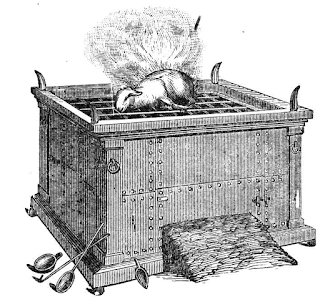
Altar of Sacrifice / Brazen Altar
The Word of God contains specifications for how the Hebrews could go about fulfilling a perpetual/continual sacrifice unto God (Numbers 28 & 29).
Altars play a central role in the Word of God. It is the place where man meets his Maker. It is a hallowed place necessary for the relationship between the man and his God to flourish.
The Law of Sacrifice is that we are to be in constant communication and prayer with God. Altars play an important role in fulfilling this law.
Exodus 20:24, “An altar of earth thou shalt make unto me, and shalt sacrifice thereon thy burnt offerings, and thy peace offerings, thy sheep, and thine oxen: in all places where I record my name I will come unto thee, and I will bless thee.”
According to Walter L. Wilson, “It is called an altar of earth because it belongs strictly to this earth. God makes no provision for forgiveness and salvation after death. No sacrifice of any kind is available to the lost sinner after he dies. There is no altar in hell.”[1]
There is no altar in hell! In hell you become totally and eternally cut-off from God.
There can be no relationship without communication.
Psalm 66:18-20, “18 If I regard iniquity in my heart, the Lord will not hear me: 19 But verily God hath heard me; he hath attended to the voice of my prayer. 20 Blessed be God, which hath not turned away my prayer, nor his mercy from me.”
To paraphrase this passage in a more common vernacular: “If I hold with affection an evil or unjust act, God will not listen to me.” God is not going to listen to my prayer when He knows that I am insincere about my relationship with Him and that I enjoy sin.
The Apostle Paul put it another way when writing of those who “did not like to retain God in their knowledge” and were “full of all unrighteousness,” by stating: “Who knowing the judgment of God, that they which commit such things are worthy of death, not only do the same, but have pleasure in them that do them” (See: Romans 1:18-32).
These regarders of iniquity and seekers of sinful pleasures will not be heard by God when they pray to Him in their insincerity, but for the sincere the psalmist did write, “But verily God hath heard me; he hath attended to the voice of my prayer” (Ps. 66:19). Why? Because the psalmist cried out to God and extolled Him (Ps. 66:17). He was retaining God in his knowledge – – acknowledging God and prioritizing Him above all else.
Ps. 84:1-4, “1 How amiable are thy tabernacles, O LORD of hosts! 2 My soul longeth, yea, even fainteth for the courts of the LORD: my heart and my flesh crieth out for the living God. 3 Yea, the sparrow hath found an house, and the swallow a nest for herself, where she may lay her young, even thine altars, O LORD of hosts, my King, and my God. 4 Blessed are they that dwell in thy house: they will be still praising thee. Selah.”
Vs. 3 = A Deserted Altar
Again, Wilson writes, “God’s people had forsaken both the worship and the service of the Lord to such an extent that the fires had gone out, the altar was cold, and no priest was near. The birds felt so much at home around these altars that they built their nests where the priests should have been serving, and the fires should have been burning.”[2]
The people of the Name failed to make Him the true Lord and King of their life and lost their intimacy with Him.
They allowed idols to replace their time at the altar of God. When do you pray? Where do you pray? How often do you pray? Have you a specific place of prayer? Is your daily and continual desire to be in constant communion with the Lord? What is the constant in your daily affairs?
You can’t hear God clearly if you are not listening to Him.
Active Listening is part and parcel of continual prayer, which is why the Apostle admonished the early Church to “pray without ceasing” (1 Thess. 5:17).
However, it is often too true that we allow the cares and troubles of life to gather in the place we once dedicated to God and now those birds and nests live in the place where once we came regularly for fellowship, repentance, communication, and relationship with God.
2 Cor. 10:3-6 contains what should be our response to the nesting birds that attempt to lodge themselves into our lives: “3 For though we walk in the flesh, we do not war after the flesh: 4 (For the weapons of our warfare are not carnal, but mighty through God to the pulling down of strong holds;) 5Casting down imaginations, and every high thing that exalteth itself against the knowledge of God, and bringing into captivity every thought to the obedience of Christ; 6 And having in a readiness to revenge all disobedience, when your obedience is fulfilled.
Two men in the Old Testament found themselves in opposite positions of relationship to God due entirely upon their habits regarding the altar and the law of sacrifice.
ABRAHAM:
Gen. 19:27, “And Abraham gat up early in the morning to the place where he stood before the LORD.”
Do you have a place where you daily stand before the Lord? A lifestyle of faithfulness in communion with the Lord?
The Akedah (binding of Isaac) & The Seven-Fold Blessing of Abraham (Gen. 22). Abraham prioritized his relationship with God above all things, and the Lord revealed to him an attribute of His character – Jehovah-jireh (“Jehovah sees”).[3]
Abraham is known in Scripture as the friend of God.
JOAB:
1 Kings 2:28, “Then tidings came to Joab: for Joab had turned after Adonijah, though he turned not after Absalom. And Joab fled unto the tabernacle of the LORD, and caught hold on the horns of the altar.”
There is no other passage in the OT where a pattern of prayer and sacrifice was established by Joab.
He had no resources to pull from because he had no relationship with God. He attempted to gain the mercy and the authority of the altar without first building a foundation of relationship with God.
God was not his priority.
Joab’s first allegiance was to himself.
Jesus Christ has paved the way for our access to the Divine with His sacrifice on the altar of Calvary. He said, “And I, if I be lifted up from the earth, will draw all men unto me” (Jn. 12:32). This “lifting” refers to the lifting up of the sacrifice upon the brazen altar by the priests. Because of Christ’s sacrifice we have been granted an avenue of access to God that Man lost in the Garden of Eden.
Hebrews 4:14-16, “14 Seeing then that we have a great high priest, that is passed into the heavens, Jesus the Son of God, let us hold fast our profession. 15 For we have not an high priest which cannot be touched with the feeling of our infirmities; but was in all points tempted like as we are, yet without sin. 16 Let us therefore come boldly unto the throne of grace, that we may obtain mercy, and find grace to help in time of need.”
Heb. 13:15-16, “By him therefore let us offer the sacrifice of praise to God continually, that is, the fruit of our lips giving thanks to his name. But to do good and to communicate forget not: for with such sacrifices God is well pleased.”
The continual faithfulness of Abraham carried eternal significance for himself, his lineage, and the rest of mankind. Our prayer habits also carry eternal weight, not only for ourselves but for others as well. When we begin to comprehend this truth we can understand the wisdom of that great missionary Billy Cole, who espoused the following ideology: “The reward for sacrifice is more sacrifice.” He also opined that “Until Jesus Christ comes there is no end to sacrifice,” which is, in this author’s opinion, the definition of the law of sacrifice because it contains the necessary ingredient of constancy.[4]
__________________
SOURCE: [1] Wilson, Walter L. (1957, 1999). A Dictionary of Bible Types. Peabody, MA: Hendrickson Publishers, Inc. p. 9-11.
Romans 5:12-21 12 Wherefore, as by one man sin entered into the world, and death by sin; and so death passed upon all men, for that all have sinned: 13 (For until the law sin was in the world: but sin is not imputed when there is no law. 14 Nevertheless death reigned from Adam to Moses, even over them that had not sinned after the similitude of Adam’s transgression, who is the figure of him that was to come. 15 But not as the offence, so also is the free gift. For if through the offence of one many be dead, much more the grace of God, and the gift by grace, which is by one man, Jesus Christ, hath abounded unto many. 16 And not as it was by one that sinned, so is the gift: for the judgment was by one to condemnation, but the free gift is of many offences unto justification. 17 For if by one man’s offence death reigned by one; much more they which receive abundance of grace and of the gift of righteousness shall reign in life by one, Jesus Christ.) 18 Therefore as by the offence of one judgment came upon all men to condemnation; even so by the righteousness of one the free gift came upon all men unto justification of life. 19 For as by one man’s disobedience many were made sinners, so by the obedience of one shall many be made righteous. 20 Moreover the law entered, that the offence might abound. But where sin abounded, grace did much more abound: 21 That as sin hath reigned unto death, even so might grace reign through righteousness unto eternal life by Jesus Christ our Lord.
In the beginning God made Man perfect and complete in His image and after His likeness (Gen. 1:26).
Man (Adam & Eve) was absolute in his spirit, soul, & body.
ABSOLUTE = “Perfect in quality or nature; complete. Not mixed; pure. Something regarded as the ultimate basis of all thought and being.” [1]
There are absolutes of truth, which are held by all true orthodox Christians (Christians who follow the teachings of Jesus, first century Apostles, and the prophets), and these truths include:
The eternality of the Word of God: “For Ever, O LORD, thy word is settled in heaven” (Ps. 119:89).
One God
The Bible standard of salvation: “…Repent, and be baptized every one of you in the name of Jesus Christ for the remission of sins, and ye shall receive the gift of the Holy Ghost” (Acts 2:38).
The necessity of the “born again” experience: “Jesus answered…Except a man be born again, he cannot see the kingdom of God” (Jn. 3:3).
With the existence of these (and other) absolutes, there is also another truth. The devil wishes to pervert the beauty of Man’s original design and separate him completely from his Maker.
The spirit of perversion is at work today and began with Lucifer and his rebellion against God, moved to the Garden of Eden and the serpent’s tactic of questioning and corrupting the relationship between Man and God.
PERVERSION in 1388 was defined as “action of turning aside from truth, corruption, distortion (originally of religious beliefs).”[3]
This is the devil’s tactic; to subvert, corrupt, bend, misshape, and distort what God calls “good” into something perverse. Perversion is not, of necessity sexual in connotation, but it is the turning of something pure into a wrong use.
The Fall of Man resulted in the perversion of our original state into a nature – – the Adamic nature. Because Man has fallen so far from his original state we find examples in the bible of many types of perverseness (one such illustration is the Jezebel spirit found in 1 Kings 16:31-21:25; 2 Kings 9:7-37; & Rev. 2:20-23). Trinitarianism, cessationism, & the Jezebel spirit are all perversions, but Jesus has given the Church the power and authority to help bring those stuck in error back to completeness in God and in truth.
Sin is the state of perversion from the original design and purpose of Man. The account of the Good Samaritan can be viewed as Jesus’ attempt to warn the Apostles and Church of the dangers of perversion.
Jesus came to return what was once perverted back to its original state, by His love: “For when we were yet without strength, in due time Christ died for the ungodly. For scarcely for a righteous man will one die: yet peradventure for a good man some would even dare to die. But God commendeth his love toward us, in that, while we were yet sinners, Christ died for us” (Ro. 5:6-8).
Because of Jesus Christ we now have the opportunity to walk in right relationship with Him. You’ve never met a man like Jesus. He never withdrew Himself from the lost sinners of the world (as many in the church do once they are “saves”). Instead, He went to the perverted (in spirit, soul, and body) who were looking for a change and a return to purity. He did not condemn the world, but He saved it through the work of redemption and reconciliation. He did not revile the perverse, but He removed the crookedness in them and returned them to a state of completeness. He, as the Potter, took the misshapen clay and created vessels of honor. Jesus heals, delivers, sets the captive free, restores broken homes, and places His love into right relationships.
Although tempted in all things, Jesus is our perfect example of a sinless life, and His obedience is what has reconciled Man to God. This ministry of reconciliation is the recovery of purity in our relationship with God.
“Therefore if any man be in Christ, he is a new creature: old things are passed away; behold, all things are become new. And all things are of God, who hath reconciled us to himself by Jesus Christ, and hath given to us the ministry of reconciliation; To wit, that God was in Christ, reconciling the world unto himself, not imputing their trespasses unto them; and hath committed unto us the word of reconciliation. Now then we are ambassadors for Christ, as though God did beseech you by us: we pray you in Christ’s stead, be ye reconciled to God. For he hath made him to be sin for us, who knew no sin; that we might be made the righteousness of God in him” (2 Cor. 5:17-21).
The psalmist David wrote, “The LORD trieth the righteous: but the wicked and him that loveth violence his soul hateth.”[1]
In this passage, when we read that God “trieth” it simply means that this is God’s way of “examining, scrutinizing, proving, and testing” the hearts of those who are His people, and these tests are for the purpose of preparing us for greater responsibility and spiritual growth.[2]
The apostle Paul makes it quite clear that the process of being approved by God follows a particular process: “Therefore being justified by faith, we have peace with God through our Lord Jesus Christ: By whom also we have access by faith into this grace wherein we stand, and rejoice in hope of the glory of God. And not only so, but we glory in tribulations also: knowing that tribulation worketh patience; And patience, experience; and experience, hope: And hope maketh not ashamed; because the love of God is shed abroad in our hearts by the Holy Ghost which is given unto us.”[3]
As this process takes place we witness the varying degrees of preparation God places us in as they accomplish, work out, and achieve God’s purpose for our lives. Therefore, in the end, what we think of as pressures, stressors, or trials are tools God uses as a means to bring about a patient, enduring, sustaining, perseverant, and steadfast quality to our Christian character. When this quality is part of our spiritual nature we have become God-proven because our character has been tried and He can then trust us for greater measures of responsibility and authority.
This experience results in the establishment of hope in our lives, which is the “joyful and confident expectation of eternal salvation” and the understanding that because I came through previous trials intact then I’ll make it through this one as well because God is with me.[4]



 The Pillar and Ground of Truth