Categories
Bible Teaching

Law of Sacrifice

Ex. 29:38-46, “38 Now this is that which thou shalt offer upon the altar; two lambs of the first year day by day continually. 39 The one lamb thou shalt offer in the morning; and the other lamb thou shalt offer at even: 40 And with the one lamb a tenth deal of flour mingled with the fourth part of an hin of beaten oil; and the fourth part of an hin of wine for a drink offering. 41 And the other lamb thou shalt offer at even, and shalt do thereto according to the meat offering of the morning, and according to the drink offering thereof, for a sweet savour, an offering made by fire unto the LORD. 42 This shall be a continual burnt offering throughout your generations at the door of the tabernacle of the congregation before the LORD: where I will meet you, to speak there unto thee. 43 And there I will meet with the children of Israel, and the tabernacle shall be sanctified by my glory. 44 And I will sanctify the tabernacle of the congregation, and the altar: I will sanctify also both Aaron and his sons, to minister to me in the priest’s office. 45 And I will dwell among the children of Israel, and will be their God. 46 And they shall know that I am the LORD their God, that brought them forth out of the land of Egypt, that I may dwell among them: I am the LORD their God.”
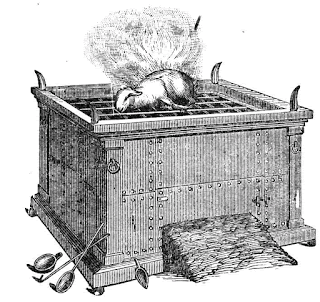
Altar of Sacrifice / Brazen Altar

The Word of God contains specifications for how the Hebrews could go about fulfilling a perpetual/continual sacrifice unto God (Numbers 28 & 29).

Altars play a central role in the Word of God. It is the place where man meets his Maker. It is a hallowed place necessary for the relationship between the man and his God to flourish.

The Law of Sacrifice is that we are to be in constant communication and prayer with God. Altars play an important role in fulfilling this law.

Exodus 20:24, “An altar of earth thou shalt make unto me, and shalt sacrifice thereon thy burnt offerings, and thy peace offerings, thy sheep, and thine oxen: in all places where I record my name I will come unto thee, and I will bless thee.”

According to Walter L. Wilson, “It is called an altar of earth because it belongs strictly to this earth. God makes no provision for forgiveness and salvation after death. No sacrifice of any kind is available to the lost sinner after he dies. There is no altar in hell.”[1]

There is no altar in hell! In hell you become totally and eternally cut-off from God.

There can be no relationship without communication.

Psalm 66:18-20, “18 If I regard iniquity in my heart, the Lord will not hear me: 19 But verily God hath heard me; he hath attended to the voice of my prayer. 20 Blessed be God, which hath not turned away my prayer, nor his mercy from me.”

To paraphrase this passage in a more common vernacular: “If I hold with affection an evil or unjust act, God will not listen to me.” God is not going to listen to my prayer when He knows that I am insincere about my relationship with Him and that I enjoy sin.

The Apostle Paul put it another way when writing of those who “did not like to retain God in their knowledge” and were “full of all unrighteousness,” by stating: “Who knowing the judgment of God, that they which commit such things are worthy of death, not only do the same, but have pleasure in them that do them” (See: Romans 1:18-32).

These regarders of iniquity and seekers of sinful pleasures will not be heard by God when they pray to Him in their insincerity, but for the sincere the psalmist did write, “But verily God hath heard me; he hath attended to the voice of my prayer” (Ps. 66:19). Why? Because the psalmist cried out to God and extolled Him (Ps. 66:17). He was retaining God in his knowledge – – acknowledging God and prioritizing Him above all else.

Ps. 84:1-4, “How amiable are thy tabernacles, O LORD of hosts! 2 My soul longeth, yea, even fainteth for the courts of the LORD: my heart and my flesh crieth out for the living God. 3 Yea, the sparrow hath found an house, and the swallow a nest for herself, where she may lay her young, even thine altars, O LORD of hosts, my King, and my God. 4 Blessed are they that dwell in thy house: they will be still praising thee. Selah.”

Vs. 3 = A Deserted Altar

Again, Wilson writes, “God’s people had forsaken both the worship and the service of the Lord to such an extent that the fires had gone out, the altar was cold, and no priest was near. The birds felt so much at home around these altars that they built their nests where the priests should have been serving, and the fires should have been burning.”[2]

The people of the Name failed to make Him the true Lord and King of their life and lost their intimacy with Him.

They allowed idols to replace their time at the altar of God.
When do you pray?
Where do you pray?
How often do you pray?
Have you a specific place of prayer?
Is your daily and continual desire to be in constant communion with the Lord?
What is the constant in your daily affairs?

You can’t hear God clearly if you are not listening to Him.

Active Listening is part and parcel of continual prayer, which is why the Apostle admonished the early Church to “pray without ceasing” (1 Thess. 5:17).

However, it is often too true that we allow the cares and troubles of life to gather in the place we once dedicated to God and now those birds and nests live in the place where once we came regularly for fellowship, repentance, communication, and relationship with God.

2 Cor. 10:3-6 contains what should be our response to the nesting birds that attempt to lodge themselves into our lives: “3 For though we walk in the flesh, we do not war after the flesh: (For the weapons of our warfare are not carnal, but mighty through God to the pulling down of strong holds;) 5 Casting down imaginations, and every high thing that exalteth itself against the knowledge of God, and bringing into captivity every thought to the obedience of Christ6 And having in a readiness to revenge all disobedience, when your obedience is fulfilled.

Two men in the Old Testament found themselves in opposite positions of relationship to God due entirely upon their habits regarding the altar and the law of sacrifice.

ABRAHAM:

  1. Gen. 19:27, “And Abraham gat up early in the morning to the place where he stood before the LORD.”
  2. Do you have a place where you daily stand before the Lord? A lifestyle of faithfulness in communion with the Lord?
  3. The Akedah (binding of Isaac) & The Seven-Fold Blessing of Abraham (Gen. 22).
    Abraham prioritized his relationship with God above all things, and the Lord revealed to him an attribute of His character – Jehovah-jireh (“Jehovah sees”).[3]
  4. Abraham is known in Scripture as the friend of God.

JOAB:

  1. 1 Kings 2:28, “Then tidings came to Joab: for Joab had turned after Adonijah, though he turned not after Absalom. And Joab fled unto the tabernacle of the LORD, and caught hold on the horns of the altar.”
  2. There is no other passage in the OT where a pattern of prayer and sacrifice was established by Joab.
  3. He had no resources to pull from because he had no relationship with God. He attempted to gain the mercy and the authority of the altar without first building a foundation of relationship with God.
  4. God was not his priority.
  5. Joab’s first allegiance was to himself.

Jesus Christ has paved the way for our access to the Divine with His sacrifice on the altar of Calvary. He said, “And I, if I be lifted up from the earth, will draw all men unto me” (Jn. 12:32). This “lifting” refers to the lifting up of the sacrifice upon the brazen altar by the priests. Because of Christ’s sacrifice we have been granted an avenue of access to God that Man lost in the Garden of Eden.

Hebrews 4:14-16, “14 Seeing then that we have a great high priest, that is passed into the heavens, Jesus the Son of God, let us hold fast our profession. 15 For we have not an high priest which cannot be touched with the feeling of our infirmities; but was in all points tempted like as we are, yet without sin. 16 Let us therefore come boldly unto the throne of grace, that we may obtain mercy, and find grace to help in time of need.”

Heb. 13:15-16, “By him therefore let us offer the sacrifice of praise to God continually, that is, the fruit of our lips giving thanks to his name. But to do good and to communicate forget not: for with such sacrifices God is well pleased.”

The continual faithfulness of Abraham carried eternal significance for himself, his lineage, and the rest of mankind. Our prayer habits also carry eternal weight, not only for ourselves but for others as well. When we begin to comprehend this truth we can understand the wisdom of that great missionary Billy Cole, who espoused the following ideology: “The reward for sacrifice is more sacrifice.” He also opined that “Until Jesus Christ comes there is no end to sacrifice,” which is, in this author’s opinion, the definition of the law of sacrifice because it contains the necessary ingredient of constancy.[4]

__________________

SOURCE:
[1] Wilson, Walter L. (1957, 1999). A Dictionary of Bible Types. Peabody, MA: Hendrickson Publishers, Inc. p. 9-11.

[2] Ibid.

[3] Brown, Driver, Briggs and Gesenius. “Hebrew Lexicon entry for Y@hovah yireh”. “The KJV Old Testament Hebrew Lexicon”. Retrieved: 1 June 2007. http://www.biblestudytools.net/Lexicons/Hebrew/heb.cgi?number=3070&version=kjv.

[4] Cole, W.H. “Billy.” (2006). Teachings By Billy Cole. InstantPublisher.com

[Originally posted on 1 June 2007 at http://thepillarandgroundoftruth.blogspot.com/2007/06/law-of-sacrifice.html]

Categories
Consider this...

Redeeming the Time

Ephesians 5:15-16, “See then that ye walk circumspectly, not as fools, but as wise, redeeming the time, because the days are evil.”

It is healthy for a soul to want to do more for God and to be in a perpetual state of personal improvement and spiritual maturity.  There are 168 hours in a week, and if you tithe your time to God as you do your monetary increase then that leaves you with nearly 17 hours a week that you can dedicate solely to God.

Assuming you are faithful in your church attendance, an average service is 2 hours, then you have 11 hours left to invest in your relationship with God in a week, and the real question becomes: “What do you do with these 11 hours of great Spiritual potential?”  Consider these suggestions:

1.      Pray.  You don’t have to start out praying an hour a day, but whatever time you invest in prayer will bring results.  Prayer is essential to growing in the Lord.  Learn to intercede, but don’t let intercession overwhelm you and rob you of joy.

2.      Read.  Read the Word of God.  Some people spend so much time studying and chasing down rabbit tracks in the Bible that they fail to simply read the Bible.  Pray, clear your mind, then read.  Let His written Word be as food to your spirit and absorb it. Remember: The greatest and final source of self-examination is the Word of God.

3.      Study.  This is the time to follow those rabbit trails. This is the time to look into the deeper meaning of the Scriptures. This is the time to search the Scriptures.

4.      Listen.  Invest time in active listening.  Many people talk to God in prayer, but ignore the richest half of prayer time — listening to what Jesus is saying to them.  He hears your prayer, but do you hear His?  Prayer is dialogue, not monologue.

5.      Fast.  You want to draw closer to God? Fast one day a week, one meal a day, or three days (typically, 3 days is what it takes to crucify the flesh). You can also fast by setting aside time spent on things that you enjoy (other than food), like the Internet, movies, Starbucks, chocolate, etc.

6.      Praise.  There needs to be some time in your week, or day, where you loudly and demonstratively praise God.  Dance before Him in secret prayer; sing in the Holy Ghost loudly as you’re sweeping the carpet; let tears of praise flow. We praise God for what He’s done. Shout! Clap! Jump! Sing! Extol!

7.     Worship.  Worship is different than praise.  Study the difference and then apply it to your life.  We worship God for who He is. Lie prostrate before God.

8.      Obey.  Whatever God tells you to do in His Word, in prayer, or by His messengers (Pastor, preachers, teachers…) do!  Remember: God will never ask/tell you to do something that violates His written Word.
Of course, there will be days when you feel like you’ve been with God all day, and others when He seems to be unavailable, but every day is full of potential investment opportunities in your relationship with your Lord and Savior Jesus Christ as you tithe your time to Him.


Original post on 9 March 2011 on https://thepillarandgroundoftruth.blogspot.com/2011/03/tithing-your-time.html

Categories
Consider this...

Revitalization Movements

In the middle of the last century (1900s) Anthony F. C. Wallace, the historian and anthropologist, developed the concept of “Revitalization Movements.” Here are a few of his ideas:

  • A revitalization movement is defined as a deliberate, organized, conscious effort by members of a society to construct a more satisfying culture. Revitalization is thus, from a cultural standpoint, a special kind of culture change phenomenon: the persons involved in the process of revitalization must perceive their culture, or some major areas of it, as a system (whether accurately or not); they must feel that this cultural system is unsatisfactory; and they must innovate not merely discrete items, but a new cultural system, specifying new relationships as well as, in some cases, new traits.
  • …Cultures can change within one generation; and the process…is the revitalization process.
  • The term “revitalization” implies an organismic analogy.
  • “Stress is defined as a condition in which some part, or the whole, of the social organism is threatened with more or less serious damage.”
  • “Messianic Movements” emphasize the participation of a divine savior in human flesh in the mazeway transformation.

The presence of these movements are seen throughout history, and it can even be argued that the Scriptures make reference to language and events that are Revitalistic in nature. For example, Isaiah 30:19-23 (vs. 21, “…the is the way, walk ye in it, when ye turn to the right hand, and when ye turn to the left”).

Wallace coined the term “revitalization movements” to explain some particular historical phenomena that have taken place in the past, and according to Wallace, revitalization movements have specific identifiers:

  1. When a culture has reached its lowest point a prophet/statesman will arise to help the people gain what has been lost.
  2. This leader makes a plea and call to return to the conservative and fundamentalist ideas of the past.
  3. The result is the formation of a religious method that renews the culture and continues to grow even after the prophet dies.

Some examples would be:

  • Handsome Lake, the Seneca Prophet (1799), called for an end on reliance of European goods, and a return to traditional ways.
  • Jonathan Edwards preached “Sinners in the Hands of an Angry God” at a normal tone of voice at a wicked and perverse time in New England and universal repentance erupted in the audience.
  • John Wesley and his methodism was a call to renewed holiness.
  • Jesus Christ formed a new method that hearkened back to some of the principles and spirit of the Old Testament (i.e. Golden Rule) and boldly declared, “I am the way, the truth, and the life…” (John 14:6) while establishing Himself as the only “divine savior in human flesh.”

Moses reminded the Hebrews of Jehovah’s directive to them concerning their responsibility to Him and their reward for obedience and faithfulness: “Ye shall observe to do therefore as the LORD your God hath commanded you: ye shall not turn aside to the right hand or to the left. Ye shall walk in all the ways which the LORD your God hath commanded you, that ye may live, and that it may be well with you, and that ye may prolong your days in the land which ye shall possess” (Deut. 5:32-33).

Unfortunately, Jewish history is rife with stories of their backsliding and falling headlong into idolatry and depravity. They did not cherish their faith, not wholly, which is why the Lord said, “All day long I have stretched forth my hands unto a disobedient and gainsaying people” (Ro. 10:21).

The Old Testament prophets even took pains to draw the backslidden people of the Divided Kingdom back to Jehovah through language that echoes the idea of what Wallace called “a religious revival.” Jeremiah does so with this portion of text: “…stand ye in the ways, and see, and ask for the old paths, where is the good way, and walk therein, and ye shall find rest for your souls. But they said, We will not walk therein” (Jer. 6:16). the problem here was that the call was made for revitalization but the people did not want it. The result for their rebellion was captivity and dispersion.

Thankfully, God had another plan and through His prophets prepared a way out of captivity and a return to Jerusalem for a remnant, who would help to usher in the arrival of the only true Savior of Mankind — Jesus Christ. This God-man divested Himself of His Heavenly glory to manifest Himself in flesh and become the Savior, but even He spoke out when he addressed Jerusalem and said (Matt. 23:37), “O Jerusalem, Jerusalem, thou that killest the prophets, and stonest them which are sent unto thee, how often would I have gathered thy children together, even as a hen gathereth her chickens under her wings, and ye would not!”

In today’s society it is vital that we continue to move forward without letting loose of core faith values. This can only take place when each generation of Oneness Pentecostals has a first generation experience, which, I think, will continue the march of revitalization and revival in our movement and the world.

The modern Apostolic Movement is more than a subculture. It is a counter-culture – – a new culture based on the teachings of our Messiah – the Lord Jesus Christ.


SOURCE: http://www.garfield.library.upenn.edu/classics1990/A1990EL74700001.pdf

[Originally posted on 21 July 2007 at http://thepillarandgroundoftruth.blogspot.com/2007/07/fyi-revitalization-movements.html]

Categories
church history

Pre-1900 Examples of Apostolic Doctrine in North America

The following is derived from a symposium paper co-authored by Stewart A. Bertram and myself in the Spring of 2005 and presented to Parkersburg Bible College (Parkersburg, WV) during their annual colloquium.

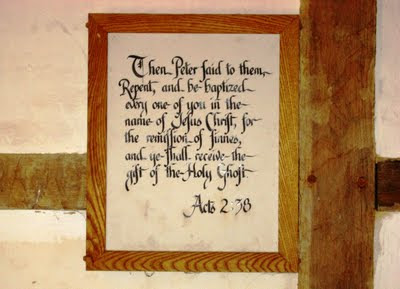
The oldest permanent English settlement in America was established on April 26, 1607, in Jamestown, Virginia. This plaque was posted on the wall of the lobby of the first church built there – Acts 2:38.

History undeniably records various elements of distinctly Orthodox Apostolic doctrine in North America as early as 1677, which was only 70 years after the first permanent settlement was established in Jamestown.[1]  What we will attempt to show is a chronological outline of these various apostolic doctrines and practices as they appear in the index of North American history.  While many will view this as a restoration of Apostolic Pentecostal experience we maintain that it actually proves the continued existence and growth of the orthodox teaching of the book of Acts.  We further assert that there have always been pockets of true believers in every century following and obeying the true message of the New Birth.  Some examples record partial alignment with the Apostles’ doctrine, the following is a list of some of those instances:

  • Society of Friends (Quakers) – “…our tongues loosed and our mouths opened, and we spake with new tongues as the Lord gave utterance, and as His Spirit led us.”[2]
  • John Wesley (1703-1791) – “What so impressed and encouraged John Wesley and his followers, what so shocked, startled, and bewildered his contemporaries, is no mystery to the modern psychologist, to whom it is known as glossolalia…”[3]
  • Charles G. Finney (1783-1875) – “I received a mighty baptism in the Holy Ghost…No words can express the wonderful love that was shed abroad in my heart.  I wept aloud with joy and love; and I do not know but I should say, I literally bellowed out the unutterable gushings of my heart.”[4]
  • John Miller – a Presbyterian minister wrote Is God a Trinity in 1876 and “believed that the doctrine of the trinity was not biblical and that it greatly hindered the Church….He emphatically declared the full deity of Jesus Christ.”[5]
  • D. L. Moody (1837-1899) – According to R. A. Torrey, Moody’s friend and associate, he once witnessed Moody walk to the pulpit to preach but instead of addressing the crowd in English he began to speak in another language.  This occurred one more time before he was able to gain control and preach to the audience, but “only after much prayer and praise.”[6]
  • Lowell, Ohio (1835) – a group of Camisards and/or French Huguenots establish an Orthodox Apostolic Acts 2:38 believing Church, but article IX of the church constitution changes the baptismal formula from Jesus’ name to the trinitarian formula in 1847.  In 1980 Dr. Nelson preaches the Apostolic message to the congregation and they convert back to the orthodox message of Acts 2:38.[7]
  • Dan Huntington (1850) – baptized people in Boston, Massachusetts in Jesus’ name.[8]
  • Canada (1854) – “There was an organization of Acts 2:38 clergymen in Canada.”[9]
  • America (1865) – More than 160,000 Americans spoke in tongues.[10] [11]
  • Alvin E. Velie (1884-1904) – all pre-1900:[12]

1)      Wrote the book Safety First Acts 2:38.

2)      Baptized over 1,500 people in Jesus’ name in Wisconsin.

3)       Preached in various locations along the Mississippi River.

4)      Preached a considerable amount of the time in the Salvation Army.

  • Charles Fox Parham – “the first leader in the twentieth century Pentecostal movement, began to administer water baptism in Jesus’ name, although he apparently did not link this practice with an explicit denial of trinitarianism.”[13]  Parham also “formulated the basic Pentecostal doctrine of ‘initial evidence’ after a student in his Bethel Bible School, Agnes Ozman, experienced glossolalia in January, 1901.”[14] 

[1] Weisser, Thomas. After the Way Called Heresy. 1981.

[2] Bresson, Bernard L. Studies in Ecstasy. New York: Vintage Press. 1966. p. 48-52.

[3] Bowen, Marjorie. Wrestling Jacob: a study of the life of John Wesley. London: Watts & Co. 1948.

[4] Finney, Charles G. Memoirs of Charles G. Finney, being an Autobiography. New York.
1876.

[5] Bernard, David K. The Oneness of God. Hazelwood: Pentecostal Publishing House. 1993. 31 May 2005.

[6] Darbee, Lennard. Tongues: the Dyanmite of God.

[7] Nelson, Joseph. Church History. Parkersburg Bible College. Lecture given and Church Constitution shown to class on 18 November 2002.

[8] Synan, V. Aspects of Pentecostal-Charismatic Origins, NJ: Logos. 1975.

[9] Arnold, Marvin M.  Apostolic History Outline. Arno Publications, Inc. 1985.

[10]Ibid.

[11] Blunt, John H. Dictionary Of Sects, Heresies, Ecclesiastical Parties, And Schools Of Religious Thought. Ann Arbor: Gryphon Books. 1971.

[12] Nelson, Joseph. Church History. Parkersburg Bible College. Lecture on 18 November 2002.

[13] Bernard, David K. The Oneness of God. Hazelwood: Pentecostal Publishing House. 1993. 31 May 2005.

[14] Synan, V. Pentecostalism. 16 April 2005. http://mb-soft.com/believe/txc/pentecos.htm.

[Originally posted on 17 August 2011 on https://thepillarandgroundoftruth.blogspot.com/2011/08/pre-1900-examples-of-apostolic-doctrine.html]

Categories
Consider this...

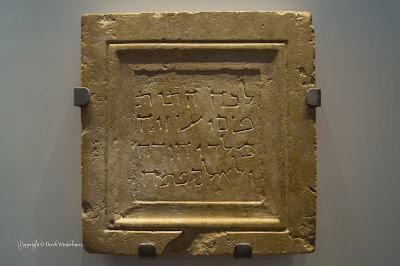
Uzziah’s Epitaph

Inscription:
“Hither were brought
The bones of Uzziah
King of Judah.
Do not open!”

Uzziah, also called Azariah, became king of Judah at the tender age of sixteen (2 Chronicles 26:1) and ruled for 52 years (2 Kings 15:2).

During his reign he made significant contributions to the realm and was successful in many endeavors, but his life ends with a mark upon him that history has not been able to erase – he died a leper.

If we take a look at Uzziah’s leadership style we will discover early influences that molded him into the leader he was, his positive and negative characteristics as a ruler, and the affect his leadership had on his son and grandson.

It would be impossible to reflect on the direction Uzziah took as a leader without first looking to his upbringing. The adage is still as true today as it was when originally penned, “Train up a child in the way he should go: and when he is old, he will not depart from it” (Pr. 22:6).

The closest and most influential people in anyone’s life will usually be their parents. Amaziah was Uzziah’s father and a great influence on his life. The Bible speaks of Amaziah as a man who “did that which was right in the sight of the LORD, yet not like David his father” (2 Kings 14:3).

Another passage records, “he did that which was right in the sight of the LORD, but not with a perfect heart” (2 Chronicles 25). The reason this is written is due to the fact that towards the end of his reign he turned to the idols of the people of Seir and because he decided to “turn away from following the LORD” the LORD decided to destroy him. It was this failure to recognize who was truly responsible for Judah’s victory over the Edomites that caused Amaziah’s downfall. He rejected the prophet of God and did as he wanted by worshipping other gods and hiring soldiers from Israel. His was a sin of pride, disobedience, and a divided heart.

As Uzziah enters the pages of the Scriptures we see him as a king to be admired. In fact, one writer informs us that, according to 2 Chronicles chapter 26, Azariah ruled “with God’s help (verse 7) he became very successful as a builder (verse 9), farmer (verse 10) and a military leader (verse 11). So much so, that his fame spread far and wide.

The Bible issues a statement that gives us an idea of why Uzziah began to fall when it states, “he was marvellously helped, till he was strong. But when he was strong, his heart was lifted up to his destruction: for he transgressed against the LORD his God, and went into the temple of the LORD to burn incense upon the altar of incense” (2 Chronicles 26:15-16).


John L. Kachelman, Jr. offers us an accounting of Uzziah’s characteristics and accomplishments before his downfall:

1. His respect for God’s messenger (2 Chron. 26:5). A key to Uzziah’s success is his desire to seek God. It seems that the influence for this is attributable to a prophet or priest named “Zachariah.” This unknown prophet was able to know, understand, and explain God’s will so the King (and others) would understand and obey. As long as Uzziah was influenced by these forces to follow God’s will, he knew success and happiness. It was a good time for Judah! 2. His role as STATESMAN (2 Chron. 26:6-15). No politician could dream of a better tenure as a chief executive of a nation. Prosperity was enjoyed in all areas of life.a. POLITICALLY Uzziah’s leadership resulted in amazing successes. His armies were victorious (v. 6-8). His projects and programs were successful (v. 9-10).b. MILITARILY Uzziah’s leadership was superb (v. 11-15). He was an amazing military mind – organized, prepared, and inventive. Everyone studied his maneuvers and learned brilliant strategies of warfare.c. PERSONALLY Uzziah’s fame spread throughout then entire known world. He was famous and recognized. His “strength” was envied by other Kings (v. 8b, 15b).

In the midst of all this success we find that Uzziah rebelled against his God when he failed to acknowledge the source of his strength, and in so doing he attempted to presumptuously and proudly take God’s glory by offering incense in the Temple instead of allowing the priests to do their duty. We would do well to steer clear of the sin of presumption and pride becasue the Bible clearly states “that no flesh should glory in His (God’s) presence” (1 Corinthians 1:29).

Uzziah failed to realize that you don’t own God’s glory or favor because it is a gift from Him to you.

Why this change in Uzziah? The qualities that he learned from his father manifested themselves when Uzziah took his eyes off of the LORD and allowed pride to rule him.

Kachelman writes that Uzziah’s rebellion appears when we read the word “until”. Many times it appears that people are doing well and serving God faithfully “until” they forget who the source of their strength is. The irony is that Uzziah’s very name – “my strength is Jehovah” – was not enough to remind him of God’s hand on his life because pride will always take your eyes off of God and onto self.

God cursed Uzziah with leprosy because of his pride. It is significant that we never read of Uzziah repenting for his sin and it is possible to become so wrapped up in self and in our own arrogancy that we, like Uzziah, find that we cannot turn from sin.

One writer, Wilbur Wright, says that “the antidote for pride is humility. Humility is the measure of a leader whom God can use and it should be an ever-growing quality in their life and ministry. God places a very high premium on humility and its close companion of meekness (Matthew 5:5) and lowliness (Matthew 11:29).”

All Uzziah had to do was obey a simple principle, but he did not and consequently he was not healed of his leprosy. “Humble yourselves therefore under the mighty hand of God, that he may exalt you in due time” (1 Peter 5:6).

It is interesting that Jotham, as king of Judah following his father Uzziah, never went to the Temple. He was a mighty man and “he did that which was right in the sight of the LORD, according to all that his father Uzziah did: howbeit he entered not into the temple of the LORD” (2 Chronicles 27:1-2). Perhaps this was due to a fear that he deveolped as a result of what happened to his father. Sometimes people see the Church as a place of wrath and fail to realize that sin is what brings judgment because God loves those who he chastens. In actuality, Uzziah’s judgment was an opportunity for mercy, but he failed to take advantage and passed onto his son a mistrust of God.

Jotham was a man who prepared, set-up, erected, established, and set forth his ways before God, but he allowed the people of Judah to continue in their corruption (idol worship and backsliding). Because of his father’s rebellion and judgment he did not see the house of God as a place of worship, but of wrath and attributed that to God instead of to his father’s self-glory.
As we follow the path of Uzziah’s faithlessness we come to his grandson Ahaz. The Bible informs us that Ahaz was a wicked an unjust king who “did not that which was right in the sight of the LORD” (2 Chronicles 28:1).

Ahaz not only sinned against God at every opportunity but he also sacrificed his children to other gods and “gathered together the vessels of the house of God, and cut in pieces the vessels of the house of God, and shut up the doors of the house of the LORD, and he made him altars in every corner of Jerusalem. And in every several city of Judah he made high places to burn incense unto other gods, and provoked to anger the LORD God of his fathers” (2 Chronicles 28:3, 24-25).

This then is the final end of all those who lift themselves up in pride against the LORD – destruction of self and others.

It mattered not how great Uzziah was or even how many accomplishments are attributed to him because his pride was a catalyst that spawned a family and a nation of rebellious backsliders. All he had to do to remove this possibility was repent, but he did not.

“But when he was strong, his heart was lifted up to his destruction: for he transgressed against the LORD his God, and went into the temple of the LORD to burn incense upon the altar of incense” (2 Chronicles 26:16).

Who do you attribute your strength to today?


Originally posted on 20 February 2007 on http://thepillarandgroundoftruth.blogspot.com/2007/02/uzziahs-epitaph.html

Categories
Bible Teaching

The Recovery of Purity

Romans 5:12-21
12  Wherefore, as by one man sin entered into the world, and death by sin; and so death passed upon all men, for that all have sinned:
13 (For until the law sin was in the world: but sin is not imputed when there is no law.
14 Nevertheless death reigned from Adam to Moses, even over them that had not sinned after the similitude of Adam’s transgression, who is the figure of him that was to come.
15 But not as the offence, so also is the free gift. For if through the offence of one many be dead, much more the grace of God, and the gift by grace, which is by one man, Jesus Christ, hath abounded unto many.
16 And not as it was by one that sinned, so is the gift: for the judgment was by one to condemnation, but the free gift is of many offences unto justification.
17 For if by one man’s offence death reigned by one; much more they which receive abundance of grace and of the gift of righteousness shall reign in life by one, Jesus Christ.)
18 Therefore as by the offence of one judgment came upon all men to condemnation; even so by the righteousness of one the free gift came upon all men unto justification of life.
19 For as by one man’s disobedience many were made sinners, so by the obedience of one shall many be made righteous.
20 Moreover the law entered, that the offence might abound. But where sin abounded, grace did much more abound:
21 That as sin hath reigned unto death, even so might grace reign through righteousness unto eternal life by Jesus Christ our Lord.

In the beginning God made Man perfect and complete in His image and after His likeness (Gen. 1:26).

Man (Adam & Eve) was absolute in his spirit, soul, & body.

ABSOLUTE = “Perfect in quality or nature; complete. Not mixed; pure. Something regarded as the ultimate basis of all thought and being.” [1]

Synonyms include “unadulterated, undiluted, uncontaminated, total, unconditional, unquestionable finality, unequivocal, definite, sure.”[2]

There are absolutes of truth, which are held by all true orthodox Christians (Christians who follow the teachings of Jesus, first century Apostles, and the prophets), and these truths include:

  1. The eternality of the Word of God: “For Ever, O LORD, thy word is settled in heaven” (Ps. 119:89).
  2. One God
  3. The Bible standard of salvation: “…Repent, and be baptized every one of you in the name of Jesus Christ for the remission of sins, and ye shall receive the gift of the Holy Ghost” (Acts 2:38).
  4. The necessity of the “born again” experience: “Jesus answered…Except a man be born again, he cannot see the kingdom of God” (Jn. 3:3).

With the existence of these (and other) absolutes, there is also another truth. The devil wishes to pervert the beauty of Man’s original design and separate him completely from his Maker.

The spirit of perversion is at work today and began with Lucifer and his rebellion against God, moved to the Garden of Eden and the serpent’s tactic of questioning and corrupting the relationship between Man and God.

PERVERSION in 1388 was defined as “action of turning aside from truth, corruption, distortion (originally of religious beliefs).”[3]

This is the devil’s tactic; to subvert, corrupt, bend, misshape, and distort what God calls “good” into something perverse. Perversion is not, of necessity sexual in connotation, but it is the turning of something pure into a wrong use.

The Fall of Man resulted in the perversion of our original state into a nature – – the Adamic nature. Because Man has fallen so far from his original state we find examples in the bible of many types of perverseness (one such illustration is the Jezebel spirit found in 1 Kings 16:31-21:252 Kings 9:7-37; & Rev. 2:20-23). Trinitarianism, cessationism, & the Jezebel spirit are all perversions, but Jesus has given the Church the power and authority to help bring those stuck in error back to completeness in God and in truth.

Sin is the state of perversion from the original design and purpose of Man. The account of the Good Samaritan can be viewed as Jesus’ attempt to warn the Apostles and Church of the dangers of perversion.

Jesus came to return what was once perverted back to its original state, by His love: “For when we were yet without strength, in due time Christ died for the ungodly. For scarcely for a righteous man will one die: yet peradventure for a good man some would even dare to die. But God commendeth his love toward us, in that, while we were yet sinners, Christ died for us” (Ro. 5:6-8).

Because of Jesus Christ we now have the opportunity to walk in right relationship with Him. You’ve never met a man like Jesus. He never withdrew Himself from the lost sinners of the world (as many in the church do once they are “saves”). Instead, He went to the perverted (in spirit, soul, and body) who were looking for a change and a return to purity. He did not condemn the world, but He saved it through the work of redemption and reconciliation. He did not revile the perverse, but He removed the crookedness in them and returned them to a state of completeness. He, as the Potter, took the misshapen clay and created vessels of honor. Jesus heals, delivers, sets the captive free, restores broken homes, and places His love into right relationships.

Although tempted in all things, Jesus is our perfect example of a sinless life, and His obedience is what has reconciled Man to God. This ministry of reconciliation is the recovery of purity in our relationship with God.

“Therefore if any man be in Christ, he is a new creature: old things are passed away; behold, all things are become new. And all things are of God, who hath reconciled us to himself by Jesus Christ, and hath given to us the ministry of reconciliation; To wit, that God was in Christ, reconciling the world unto himself, not imputing their trespasses unto them; and hath committed unto us the word of reconciliation. Now then we are ambassadors for Christ, as though God did beseech you by us: we pray you in Christ’s stead, be ye reconciled to God. For he hath made him to be sin for us, who knew no sin; that we might be made the righteousness of God in him” (2 Cor. 5:17-21).

[Originally Posted on 27 October 2007. http://thepillarandgroundoftruth.blogspot.com/2007/10/recovery-of-purity.html]
____________
SOURCES:
[1] Absolute. (n.d.). The American Heritage® Dictionary of the English Language, Fourth Edition. Retrieved October 26, 2007, from Dictionary.com website: http://dictionary.reference.com/browse/absolute
[2] Absolute. (n.d.). Dictionary.com Unabridged (v 1.1). Retrieved October 26, 2007, from Dictionary.com website: http://dictionary.reference.com/browse/absolute
[3] Perversion. (n.d.). Online Etymology Dictionary. Retrieved October 26, 2007, from Dictionary.com website: http://dictionary.reference.com/browse/perversion

Categories
Bible Teaching

Why Does God Try the Righteous?

The psalmist David wrote, “The LORD trieth the righteous: but the wicked and him that loveth violence his soul hateth.”[1]

In this passage, when we read that God “trieth” it simply means that this is God’s way of “examining, scrutinizing, proving, and testing” the hearts of those who are His people, and these tests are for the purpose of preparing us for greater responsibility and spiritual growth.[2]

The apostle Paul makes it quite clear that the process of being approved by God follows a particular process: “Therefore being justified by faith, we have peace with God through our Lord Jesus Christ: By whom also we have access by faith into this grace wherein we stand, and rejoice in hope of the glory of God. And not only so, but we glory in tribulations also: knowing that tribulation worketh patience; And patience, experience; and experience, hope: And hope maketh not ashamed; because the love of God is shed abroad in our hearts by the Holy Ghost which is given unto us.”[3]

As this process takes place we witness the varying degrees of preparation God places us in as they accomplish, work out, and achieve God’s purpose for our lives. Therefore, in the end, what we think of as pressures, stressors, or trials are tools God uses as a means to bring about a patient, enduring, sustaining, perseverant, and steadfast quality to our Christian character. When this quality is part of our spiritual nature we have become God-proven because our character has been tried and He can then trust us for greater measures of responsibility and authority.

This experience results in the establishment of hope in our lives, which is the “joyful and confident expectation of eternal salvation” and the understanding that because I came through previous trials intact then I’ll make it through this one as well because God is with me.[4]

____________

Sources:
[1] Psalm 11:5

[2] Brown, Driver, Briggs and Gesenius. “Hebrew Lexicon entry for Bachan”. “The KJV Old Testament Hebrew Lexicon”. http://www.biblestudytools.net/Lexicons/Hebrew/heb.cgi?number=974&version=kjv.

[3] Romans 5:1-5

[4] Thayer and Smith. “Greek Lexicon entry for Elpis”. “The KJV New Testament Greek Lexicon”. http://www.biblestudytools.net/Lexicons/Greek/grk.cgi?number=1680&version=kjv.

[Originally posted as God “Tries” the Righteous on 20 August 2007 at http://thepillarandgroundoftruth.blogspot.com/2007/08/god-tries-righteous_20.html]

Categories
Bible Teaching

Why Is Obed Called Naomi’s Son?

Why is Obed called Naomi’s son, and what did Boaz mean by this statement?

Moreover Ruth the Moabitess, the wife of Mahlon, have I purchased to be my wife, to raise up the name of the dead upon his inheritance, that the name of the dead be not cut off from among his brethren, and from the gate of his place: ye are witnesses this day” (Ruth 4:10).  

He was actually stating here that part of his intention for marrying Ruth is to restore the family lineage of Mahlon who was the deceased son of Naomi.  Thus, when the child is born the people and elders of the city remember that they had made themselves witnesses to the intention of Boaz (Ruth 4:11). Acting as witnesses, the women neighbors name the child Obed, which means “a servant, to thee, to nourish, and comfort, and assist thee; which duty children owe to their progenitors.”[1]

            These same neighborly women also state, “There is a son born to Naomi” (Ruth 4:17). By this we deduce that these women knew of Naomi’s loss.  She had lost two sons and a husband and had nobody who would take their place as caretaker for her in her old age, continue her husband’s name, or receive her son’s inheritance.  Obed served in all three capacities and became a great joy to Naomi and one who would carry on the family name.  Thus, he became her son (grandson) by restoring Naomi’s family and their part in the lineage of King David and the Messiah.

According to the opinion of Mary Sisseck, “Naomi has now been given a child (a child is born) a grandchild from one of her dead sons! The law determined that Obed was Naomi’s child! Genealogy, under the law, determined that Obed was also her grandchild!”[2] The question then serves to teach us that Boaz, acting as the kinsman-redeemer, provided a miracle for Naomi, which is comparable to the miracle of salvation that Jesus Christ, our Kinsman-Redeemer, has given to us. Through Jesus Christ we have been given a new life through the miracle of restoration and He, like Obed was to Naomi, has become our nourishment, comfort, and assistance.


[1] Wesley, John. “Commentary on Ruth 4”. “John Wesley’s Explanatory Notes on the Whole Bible.” https://www.biblestudytools.com/commentaries/wesleys-explanatory-notes/ruth/ruth-4.html.

[2] Sisseck, Mary. Ruth: the Hidden Pictures. Accessed: 9-23-2004

. .

NOTE: I wrote this as part of a homework assignment on September 23, 2004, for a Women of the Bible class taught at Parkersburg Bible College by Sis. Nelson.

Categories
Consider this...

Stephen’s Defense (video)

Apostolic Life Cathedral | 8/14/2022, 10:00 AM
Categories
Bible Teaching

The Potter’s Work of Grace

Apostolic Life Cathedral | 7/19/2022, 7:00 PM

Text: Isaiah 64:8, “But now, O LORD, thou art our father; we are the clay, and thou our potter; and we all are the work of thy hand.”

The Potter’s Work of Grace

Jeremiah 18:1-6

(1)  The word which came to Jeremiah from the LORD, saying,

(2)  Arise, and go down to the potter’s house, and there I will cause thee to hear my words.

(3)  Then I went down to the potter’s house, and, behold, he wrought a work on the wheels.

(4)  And the vessel that he made of clay was marred in the hand of the potter: so he made it again another vessel, as seemed good to the potter to make it.

(5)  Then the word of the LORD came to me, saying,

(6)  O house of Israel, cannot I do with you as this potter? saith the LORD. Behold, as the clay is in the potter’s hand, so are ye in mine hand, O house of Israel.

GRACE is more than just a prayer we say before we eating a meal.

The Grace of God has been understood simply as “unmerited favour,” but such a definition robs the grace of God of its true meaning, purpose, and intent.

Some say that since we live in this “age of grace,” or the “church age,” and that God is not going to judge a believer as strictly as He did in other periods of time, but this flies in the face of many passages in the New Testament that defy such a wrongheaded view.

In our time, Grace, and the “age of grace,” has been relegated to some kind of “get out of jail free” card where the individual can act, do, live and be whatever they’re able get by with as long as they say, “I’m sorry,” somewhere along the way between their birth and their death.

This is not the case.

The notion that God’s grace never comes with judgment is incorrect.

Grace is a teacher, and as all students know, sometimes the best lessons learned came from encounters with discipline, and grace is the discipline God uses to instruct His people.

How many remember the “rod of correction,” the “board of education,” or the dreaded words “go to the principal’s office?”

These, sometimes drastic measures came about, usually, because a student/child would not listen, follow instructions, or behave properly.

So, in order to find a quicker way to get a student to be more, shall we say, “cooperative with the learning process,” various forms of discipline were applied.

Some might say that I am forgetting that God loves us and would not punish us, but that in itself is erroneous.

Let’s take a look at the Word of God:

  • 156 times in the New Testament the word GRACE (charis) is used, it means “the divine influence upon the heart, and its reflection in the life; including gratitude.”[1]
    • When a child of God is properly educated by grace, the heart of the student has been changed and molded by the Holy Ghost (our counselor, guide, and help) inside of us, and the proof of that divine influence is reflected in how we live our lives. We live a life of grace.
    • When we say that we live a life of grace we are saying, “We live disciplined lives,” because grace is discipline.
    • And just to be sure: DISCIPLINE can also be called “chastisement, reproof, a warning, restraint, correction, doctrine, instruction, or rebuke.”
    • The person that has allowed grace to teach them, influence their heart, and manifest itself their life is going to naturally be filled with gratitude.
  • Titus 2:11-14, “(11)  For the grace of God that bringeth salvation hath appeared to all men,  (12)  Teaching us that, denying ungodliness and worldly lusts, we should live soberly, righteously, and godly, in this present world;  (13)  Looking for that blessed hope, and the glorious appearing of the great God and our Saviour Jesus Christ;  (14)  Who gave himself for us, that he might redeem us from all iniquity, and purify unto himself a peculiar people, zealous of good works.”
    • I want you to catch that tonight. God’s primary method of instruction for the believer in the New Testament is Grace.
    • Grace is the great teacher of self-denial, and as we submit ourselves to God’s influence we learn how to deny “ungodliness [wickedness] and worldly lusts [desire],” and how to “live soberly” (moderately [balanced] with a sound mind), “righteously, and godly, in this present world.”
    • Why? Because Jesus is coming for us.
  • Lift your arm and with your opposite hand pinch that pink stuff we call skin. If your neighbor won’t give them a gentle pinch tonight and tell them, “You’re fleshy.” Now, tell someone else, “You’re carnal.”
  • There’s nothing wrong with admitting that. In fact, Paul wrote to the church in Rome and said, “I am carnal, sold under sin” (Ro. 7:14).
  • So, being human, we are predisposed to rebellion and sin because of this flesh, even the believer, even the saint of God, sometimes has to be instructed by God through grace in some way other than a pleasant reminder to BE GOOD.
  • In some way other than just a feel good, goosebump, run the aisle, dance all over the church.
  • Your praise
  • There are some who revel in a cheap sort of grace that reveals their selfish desire to receive the benefits of serving God without changing their lifestyle of sin.
  • Then there are others who are simply ignorant of the disciplines that come from grace. So, God, in His love, disciplines the erring member to bring about a positive change in their life.
  • Hebrews 12:5-11, “(5)  And ye have forgotten the exhortation which speaketh unto you as unto children, My son, despise not thou the chastening of the Lord, nor faint when thou art rebuked of him:  (6)  For whom the Lord loveth he chasteneth, and scourgeth every son whom he receiveth.  (7)  If ye endure chastening, God dealeth with you as with sons; for what son is he whom the father chasteneth not?  (8)  But if ye be without chastisement, whereof all are partakers, then are ye bastards, and not sons.  (9)  Furthermore we have had fathers of our flesh which corrected us, and we gave them reverence: shall we not much rather be in subjection unto the Father of spirits, and live?  (10)  For they verily for a few days chastened us after their own pleasure; but he for our profit, that we might be partakers of his holiness.  (11)  Now no chastening for the present seemeth to be joyous, but grievous: nevertheless afterward it yieldeth the peaceable fruit of righteousness unto them which are exercised thereby.”
    • If you have felt the chastisement of God, you should rejoice. He loves you. He wants you to live holy, and be ready for His coming.
    • Grace is the discipline of love God uses to teach you.

The Sign of Being Born Again

The Evidence of Being Born Again

Taking on the Divine Nature – the Grace of God: 2 Peter 1:1-11

(1)  Simon Peter, a servant and an apostle of Jesus Christ, to them that have obtained like precious faith with us through the righteousness of God and our Saviour Jesus Christ:

(2)  Grace and peace be multiplied unto you through the knowledge of God, and of Jesus our Lord,

(3)  According as his divine power hath given unto us all things that pertain unto life and godliness, through the knowledge of him that hath called us to glory and virtue:

(4)  Whereby are given unto us exceeding great and precious promises: that by these ye might be partakers of the divine nature, having escaped the corruption that is in the world through lust.

(5)  And beside this, giving all diligence, add to your faith virtue; and to virtue knowledge;

(6)  And to knowledge temperance; and to temperance patience; and to patience godliness;

(7)  And to godliness brotherly kindness; and to brotherly kindness charity.

(8)  For if these things be in you, and abound, they make you that ye shall neither be barren nor unfruitful in the knowledge of our Lord Jesus Christ.

(9)  But he that lacketh these things is blind, and cannot see afar off, and hath forgotten that he was purged from his old sins.

(10)  Wherefore the rather, brethren, give diligence to make your calling and election sure: for if ye do these things, ye shall never fall:

(11)  For so an entrance shall be ministered unto you abundantly into the everlasting kingdom of our Lord and Saviour Jesus Christ.

No wonder the definition includes the idea of GRATITUDE.

GRACE (charis) is “the divine influence upon the heart, and its reflection in the life; including gratitude.”[2]


[1] Strong’s Exhaustive Concordance. G5485

[2] Ibid.