1 Timothy 3:15, "...that thou mayest know how thou oughtest to behave thyself in the house of God, which is the church of the living God, the pillar and ground of the truth."
I spent some time in South Bend, IN at my grandmother’s home (Helen Virginia Kuntzman) back in March 2009.
As is my custom when I’m there, I spent a considerable amount of time in my grandfather’s library looking, reading, and studying his collection.
Edwin Eugene Kuntzman
My grandfather (Pastor E. E. Kuntzman) was an Apostolic preacher and went to his eternal reward many years ago. I treasure the library he left behind and the notes he jotted in books, pamphlets, Bibles, and sermons. They are always a blessing to me and their truths are ageless.
My grandparents have several books and pamphlets written by, or about, some of our early pioneers and proponents of the Oneness Pentecostal message. While I didn’t take pictures of them all, the ones below I read this weekend.
The following essay is from a wonderful and revelatory book written by Bishop Garfield Thomas (G.T.) Haywood, who was the Presiding Bishop of the Pentecostal Assemblies of the World from 1925-1931. Haywood was a pioneer of truth and an influential leader of the Oneness Pentecostal movement in the early years of its restoration in North America. I thank God for men of his high caliber.
Man is a threefold creature, consisting of Spirit, soul, and body. All that is visible is the body. Man is the masterpiece of God’s workmanship, and is “wonderfully and fearfully” made. Nothing like him has ever been brought into being.
The body was formed from the dust of the ground. God breathed into his nostrils the breath (spirit) of life, and he became a living soul. The union of the Spirit and the body apparently produced the soul. (Gen 2:7.)
The soul is never separated from the body. It is the seat of affections. It is the subconscious realm of human activity. On it is impressed the desires, or affections gathered by the spirit through the mental realm, and afterwards carried into actions by the body. The soul is to the body what the records are to the phonograph. (See Rom. 1:20.) Whatever is imprinted on the soul will be acted out unconsciously by the body.
When the spirit of man begins to reach out after evil things, evil impressions are stamped upon the soul, thus resulting in evil deeds, wicked works and practices. The Psalmist says man is “estranged from the womb; they go astray as soon as they are born, speaking lies.” Psa. 58:3. The soul is often spoken of as the “heart”. (Gen. 6:5; Psa. 51:10; 84:2.)
The preaching of the gospel stirs one’s spirit to seek after righteousness. Though the spirit may be inclined towards righteousness, yet it cannot do the things they desire to do on the account of the soul being, as it were, filled with evil engravings of past affections. Hence there is a struggle between the spirit and the body, because the body is inclined to fulfill deeds recorded on the soul, while the spirit endeavors to perform the works of righteousness. (Rom. 7:9-24.) This is genuine conviction unto godly sorrow, working repentance unto salvation.
There is nothing that can remove those evil records engraved upon the soul, or heart, but faith in the blood of Jesus, the Bishop of our souls. The true cry of a penitent spirit is, “0 wretched man that I am! who shall deliver me from the body of this death?” “Create in me a clean heart, 0 God; and renew a right spirit within me!” “What must I do to be saved?” When a soul reaches that state he should be taught full faith and obedience in the command of God, “Repent and be baptized in the name of Jesus Christ for the remission of sins, and ye shall receive the gift of the Holy Spirit,” and God will confirm His word.
When the soul is cleansed the Holy Spirit comes in to help the spirit to place new records on the soul, that the body might perform the will of God, walking in the newness of life. Through the Holy Spirit He will “put My laws in their minds (spirit), and write them upon their hearts” (soul). See John 14:26; 16:13; Heb. 8:10. The mind is the realm of the spirit’s activity, while the heart is the seat of the soul’s affections. Thus by having new records on the soul it becomes as easy for a man to walk and live righteous as it was for him to live wickedly in his former life. Many are cleansed and filled with the Spirit, but fail to get God’s truth hidden, or engraved in their hearts. Psa. 119:11; Hos. 4:6. They need the TRUTH, and not tradition! John 8:32; 17:17.
The modern purchasing plan beautifully illustrates the purpose of spirit, soul, and body, and their final disposition. Whenever an article is purchased the salesman writes out the price, date, and description of the article on two bills at one writing,—an original and a duplicate bill. When the goods are delivered the duplicate goes with the article purchased, while the original is signed and returned to the Company that gave it. Should any question arise over the goods they are returned with the duplicate, which is immediately compared with the original, and judgment is rendered according to the records of the two bills. Thus it is with the spirit, soul and body.
The body is the article of purchase. The spirit and the soul are the two bills,—original and duplicate, respectively. The records of bodily action originate with the spirit, and are duplicated on the soul. When the body is delivered up to death and the grave, the deeds of the body are still imprinted on the soul. The soul and body enter the grave together. (Job 33:18, 22, 28, 30; Psa. 16:10, and Acts 2:27, 31. Psa. 49:14, 15.) But the spirit returns to the God that gave it. (Ecc. 3:21; 12:7; Lu. 23:14, and Acts 2:31; Acts 7:59, 60.) The dead know not anything that is transpiring in this life after their departure, but they do know what is transpiring in the realm wherein they are confined. The spirit of the wicked is tormented by remorse, being conscious of his future destiny. His soul is harassed while sleeping, like a man with wicked, horrible, tormenting dreams, but unable to awake. And when he awakes on the morning of the second resurrection (Rev. 20:10-15), he will awake expecting relief, but will find that his punishment has in reality just begun. (See Luke 16:22-31.)
As for the righteous their spirit departs to be with Christ in Paradise (Phil. 1:23), while the soul is at rest sweetly sleeping in Christ like “one who has folded the drapery of his couch about him and laid down to pleasant dreams.” And in the resurrection morning he “shall be satisfied when he awakes with His likeness.” His spirit and soul will be united in “a glorious body” and shall enter into that realm of life eternal, where there shall be no death, no night, no sleep, no sorrow to break in on the feast of unending joy in the presence of the Lord. (See Psa. 17:15; Isa. 26:19; Dan. 12:1-3; 1 Cor. 15:49-55; 1 Thes. 4:13-17.)
[1] Haywood, G.T. (n.d.). The Finest of the Wheat. “God’s Masterpiece.” Christ Temple Book Store:Indianapolis, IN. Ch. IV. P. 12-15.
In the middle of the last century (1900s) Anthony F. C. Wallace, the historian and anthropologist, developed the concept of “Revitalization Movements.” Here are a few of his ideas:
A revitalization movement is defined as a deliberate, organized, conscious effort by members of a society to construct a more satisfying culture. Revitalization is thus, from a cultural standpoint, a special kind of culture change phenomenon: the persons involved in the process of revitalization must perceive their culture, or some major areas of it, as a system (whether accurately or not); they must feel that this cultural system is unsatisfactory; and they must innovate not merely discrete items, but a new cultural system, specifying new relationships as well as, in some cases, new traits.
…Cultures can change within one generation; and the process…is the revitalization process.
The term “revitalization” implies an organismic analogy.
“Stress is defined as a condition in which some part, or the whole, of the social organism is threatened with more or less serious damage.”
“Messianic Movements” emphasize the participation of a divine savior in human flesh in the mazeway transformation.
The presence of these movements are seen throughout history, and it can even be argued that the Scriptures make reference to language and events that are Revitalistic in nature. For example, Isaiah 30:19-23 (vs. 21, “…the is the way, walk ye in it, when ye turn to the right hand, and when ye turn to the left”).
Wallace coined the term “revitalization movements” to explain some particular historical phenomena that have taken place in the past, and according to Wallace, revitalization movements have specific identifiers:
When a culture has reached its lowest point a prophet/statesman will arise to help the people gain what has been lost.
This leader makes a plea and call to return to the conservative and fundamentalist ideas of the past.
The result is the formation of a religious method that renews the culture and continues to grow even after the prophet dies.
Some examples would be:
Handsome Lake, the Seneca Prophet (1799), called for an end on reliance of European goods, and a return to traditional ways.
Jonathan Edwards preached “Sinners in the Hands of an Angry God” at a normal tone of voice at a wicked and perverse time in New England and universal repentance erupted in the audience.
John Wesley and his methodism was a call to renewed holiness.
Jesus Christ formed a new method that hearkened back to some of the principles and spirit of the Old Testament (i.e. Golden Rule) and boldly declared, “I am the way, the truth, and the life…” (John 14:6) while establishing Himself as the only “divine savior in human flesh.”
Moses reminded the Hebrews of Jehovah’s directive to them concerning their responsibility to Him and their reward for obedience and faithfulness: “Ye shall observe to do therefore as the LORD your God hath commanded you: ye shall not turn aside to the right hand or to the left. Ye shall walk in all the ways which the LORD your God hath commanded you, that ye may live, and that it may be well with you, and that ye may prolong your days in the land which ye shall possess” (Deut. 5:32-33).
Unfortunately, Jewish history is rife with stories of their backsliding and falling headlong into idolatry and depravity. They did not cherish their faith, not wholly, which is why the Lord said, “All day long I have stretched forth my hands unto a disobedient and gainsaying people” (Ro. 10:21).
The Old Testament prophets even took pains to draw the backslidden people of the Divided Kingdom back to Jehovah through language that echoes the idea of what Wallace called “a religious revival.” Jeremiah does so with this portion of text: “…stand ye in the ways, and see, and ask for the old paths, where is the good way, and walk therein, and ye shall find rest for your souls. But they said, We will not walk therein” (Jer. 6:16). the problem here was that the call was made for revitalization but the people did not want it. The result for their rebellion was captivity and dispersion.
Thankfully, God had another plan and through His prophets prepared a way out of captivity and a return to Jerusalem for a remnant, who would help to usher in the arrival of the only true Savior of Mankind — Jesus Christ. This God-man divested Himself of His Heavenly glory to manifest Himself in flesh and become the Savior, but even He spoke out when he addressed Jerusalem and said (Matt. 23:37), “O Jerusalem, Jerusalem, thou that killest the prophets, and stonest them which are sent unto thee, how often would I have gathered thy children together, even as a hen gathereth her chickens under her wings, and ye would not!”
In today’s society it is vital that we continue to move forward without letting loose of core faith values. This can only take place when each generation of Oneness Pentecostals has a first generation experience, which, I think, will continue the march of revitalization and revival in our movement and the world.
The modern Apostolic Movement is more than a subculture. It is a counter-culture – – a new culture based on the teachings of our Messiah – the Lord Jesus Christ.
The following is derived from a symposium paper co-authored by Stewart A. Bertram and myself in the Spring of 2005 and presented to Parkersburg Bible College (Parkersburg, WV) during their annual colloquium.
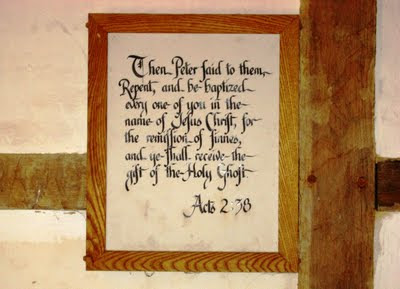
The oldest permanent English settlement in America was established on April 26, 1607, in Jamestown, Virginia. This plaque was posted on the wall of the lobby of the first church built there – Acts 2:38.
History undeniably records various elements of distinctly Orthodox Apostolic doctrine in North America as early as 1677, which was only 70 years after the first permanent settlement was established in Jamestown.[1] What we will attempt to show is a chronological outline of these various apostolic doctrines and practices as they appear in the index of North American history. While many will view this as a restoration of Apostolic Pentecostal experience we maintain that it actually proves the continued existence and growth of the orthodox teaching of the book of Acts. We further assert that there have always been pockets of true believers in every century following and obeying the true message of the New Birth. Some examples record partial alignment with the Apostles’ doctrine, the following is a list of some of those instances:
Society of Friends (Quakers) – “…our tongues loosed and our mouths opened, and we spake with new tongues as the Lord gave utterance, and as His Spirit led us.”[2]
John Wesley (1703-1791) – “What so impressed and encouraged John Wesley and his followers, what so shocked, startled, and bewildered his contemporaries, is no mystery to the modern psychologist, to whom it is known as glossolalia…”[3]
Charles G. Finney (1783-1875) – “I received a mighty baptism in the Holy Ghost…No words can express the wonderful love that was shed abroad in my heart. I wept aloud with joy and love; and I do not know but I should say, I literally bellowed out the unutterable gushings of my heart.”[4]
John Miller – a Presbyterian minister wrote Is God a Trinity in 1876 and “believed that the doctrine of the trinity was not biblical and that it greatly hindered the Church….He emphatically declared the full deity of Jesus Christ.”[5]
D. L. Moody (1837-1899) – According to R. A. Torrey, Moody’s friend and associate, he once witnessed Moody walk to the pulpit to preach but instead of addressing the crowd in English he began to speak in another language. This occurred one more time before he was able to gain control and preach to the audience, but “only after much prayer and praise.”[6]
Lowell, Ohio (1835) – a group of Camisards and/or French Huguenots establish an Orthodox Apostolic Acts 2:38 believing Church, but article IX of the church constitution changes the baptismal formula from Jesus’ name to the trinitarian formula in 1847. In 1980 Dr. Nelson preaches the Apostolic message to the congregation and they convert back to the orthodox message of Acts 2:38.[7]
Dan Huntington (1850) – baptized people in Boston, Massachusetts in Jesus’ name.[8]
Canada (1854) – “There was an organization of Acts 2:38 clergymen in Canada.”[9]
America (1865) – More than 160,000 Americans spoke in tongues.[10][11]
2) Baptized over 1,500 people in Jesus’ name in Wisconsin.
3) Preached in various locations along the Mississippi River.
4) Preached a considerable amount of the time in the Salvation Army.
Charles Fox Parham – “the first leader in the twentieth century Pentecostal movement, began to administer water baptism in Jesus’ name, although he apparently did not link this practice with an explicit denial of trinitarianism.”[13] Parham also “formulated the basic Pentecostal doctrine of ‘initial evidence’ after a student in his Bethel Bible School, Agnes Ozman, experienced glossolalia in January, 1901.”[14]
[1] Weisser, Thomas. After the Way Called Heresy. 1981.
[2] Bresson, Bernard L. Studies in Ecstasy. New York: Vintage Press. 1966. p. 48-52.
[3] Bowen, Marjorie. Wrestling Jacob: a study of the life of John Wesley. London: Watts & Co. 1948.
[4] Finney, Charles G. Memoirs of Charles G. Finney, being an Autobiography. New York. 1876.
[5] Bernard, David K. The Oneness of God. Hazelwood: Pentecostal Publishing House. 1993. 31 May 2005.
[6] Darbee, Lennard. Tongues: the Dyanmite of God.
[7] Nelson, Joseph. Church History. Parkersburg Bible College. Lecture given and Church Constitution shown to class on 18 November 2002.
[8] Synan, V. Aspects of Pentecostal-Charismatic Origins, NJ: Logos. 1975.
[9] Arnold, Marvin M. Apostolic History Outline. Arno Publications, Inc. 1985.


 The Pillar and Ground of Truth