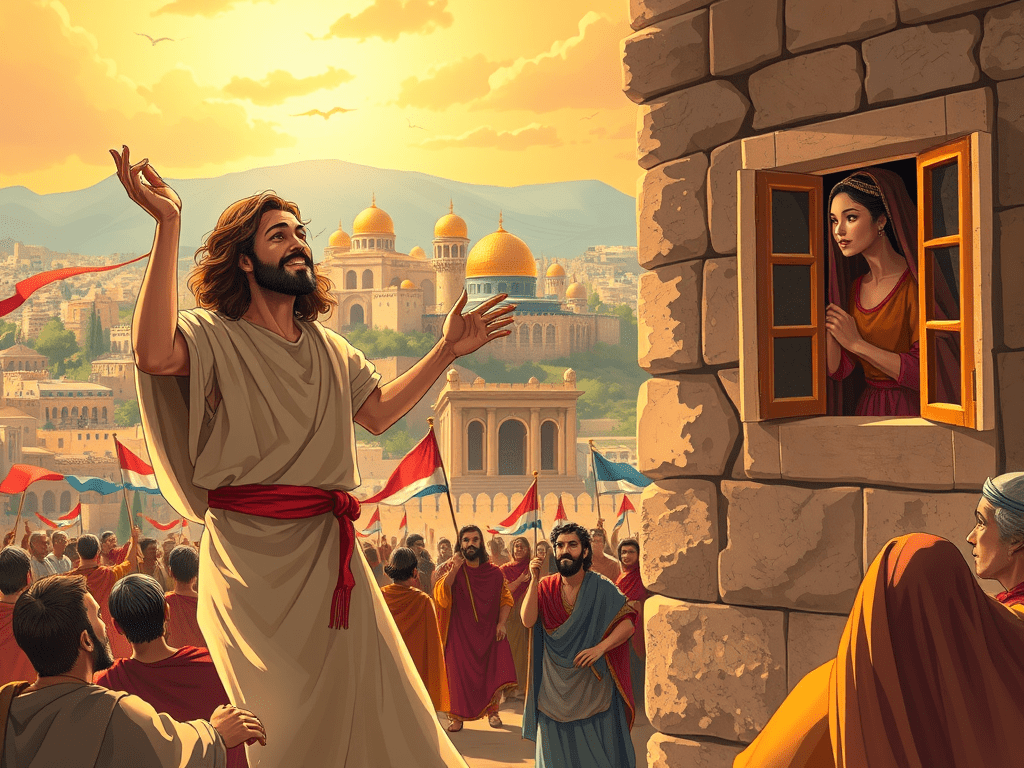
Text: 2 Samuel 6:16-23, “(16) And as the ark of the LORD came into the city of David, Michal Saul’s daughter looked through a window, and saw king David leaping and dancing before the LORD; and she despised him in her heart. (17) And they brought in the ark of the LORD, and set it in his place, in the midst of the tabernacle that David had pitched for it: and David offered burnt offerings and peace offerings before the LORD. (18) And as soon as David had made an end of offering burnt offerings and peace offerings, he blessed the people in the name of the LORD of hosts. (19) And he dealt among all the people, even among the whole multitude of Israel, as well to the women as men, to every one a cake of bread, and a good piece of flesh, and a flagon of wine. So all the people departed every one to his house. (20) Then David returned to bless his household. And Michal the daughter of Saul came out to meet David, and said, How glorious was the king of Israel to day, who uncovered himself to day in the eyes of the handmaids of his servants, as one of the vain fellows shamelessly uncovereth himself! (21) And David said unto Michal, It was before the LORD, which chose me before thy father, and before all his house, to appoint me ruler over the people of the LORD, over Israel: therefore will I play before the LORD. (22) And I will yet be more vile than thus, and will be base in mine own sight: and of the maidservants which thou hast spoken of, of them shall I be had in honour. (23) Therefore Michal the daughter of Saul had no child unto the day of her death.
Picture the moment:
- The ark of the covenant is being returned to Jerusalem to the city of David (on a hill south of Mt. Moriah, the Temple Mount, where Solomon’s Temple will one day stand to permanently house it).
- It was been away from Israel for 20 year.
- 7 months with the Philistines
- Then the Ark was taken to Abinadab’s house in Kiriath-Jearim, where his son Eleazar, watched over it for 20 years.
- Then the house of Obededom cared for it for 3 months.
- “And it was told king David, saying, The LORD hath blessed the house of Obededom, and all that pertaineth unto him, because of the ark of God. So David went and brought up the ark of God from the house of Obededom into the city of David with gladness. And it was so, that when they that bare the ark of the LORD had gone six paces, he sacrificed oxen and fatlings. And David danced before the LORD with all his might; and David was girded with a linen ephod. So David and all the house of Israel brought up the ark of the LORD with shouting, and with the sound of the trumpet” (2 Samuel 6:12-15).
- “With gladness” = with joyful music, jubilant dancing and passionate singing.
Peering from their home, Michal watched David and despised him for his worship to God.
She so reviled him that the moment he came into the courtyard shemet him and with words dripping with sarcasm, irony, disrespect and even hate, she mocked him for his act of worship –
for making himself small in humble worship to His Lord.
True worshippers forget their surroundings.
They forget what their positions, titles, and roles
They got lost in adoration of the One who fills all space and time.
True worshippers don’t take into account others may think or say, they simply want to offer their praise and worship to their God.
Michal was bitter and like her father, Saul, she was more concerned about the people’s opinion than she was that her husband worshipped his God.
So, in a move of manipulation, she tried to shame David with words that she thought would reduce his joy and gladness, but David had already faced this attack before.
Years before, Saul dangled his daughter as a prize. It was witchcraft anf manipulation.
One day Saul said to David, “I am ready to give you my older daughter, Merab [Michal], as your wife. But first you must prove yourself to be a real warrior by fighting the LORD’s battles.” For Saul thought, “I’ll send him out against the Philistines and let them kill him rather than doing it myself.”[1]
Not an offer out of friendship or good will, but a trap.
Saul’s main struggle was his overwhelming concern with what the people would think of him, which is why he said, “Let not mine hand be upon him, but let the hand of the Philistines be upon him.”
In other words, let them do my dirt work for me so that the people won’t think badly of me.
Manipulation and control – witchcraft.
The struggle every leader faces is “their faces” (Jer. 1:4-10), and Saul failed miserably in this area.
You will remember what the LORD said to Jeremiah:
Then the word of the LORD came unto me, saying, Before I formed thee in the belly I knew thee; and before thou camest forth out of the womb I sanctified thee, and I ordained thee a prophet unto the nations. Then said I, Ah, Lord GOD! behold, I cannot speak: for I am a child. But the LORD said unto me, Say not, I am a child: for thou shalt go to all that I shall send thee, and whatsoever I command thee thou shalt speak. Be not afraid of their faces: for I am with thee to deliver thee, saith the LORD. Then the LORD put forth his hand, and touched my mouth. And the LORD said unto me, Behold, I have put my words in thy mouth. See, I have this day set thee over the nations and over the kingdoms, to root out, and to pull down, and to destroy, and to throw down, to build, and to plant.[2]
Saul’s attempt in trying to persuade David to wear his armor in his fight with Goliath was for the same reason he wanted Samuel to worship with him after God rejected him.
He was more interested in what the people thought. He was terrified of public opinion.
Saul thought that David wearing his armor would be good for Saul.
Saul was two years into his kingship when he showed his fear of public opinion and it was here that he lost the dynasty:
“And Samuel said, What hast thou done? And Saul said, Because I saw that the people were scattered from me, and that thou camest not within the days appointed, and that the Philistines gathered themselves together at Michmash; therefore said I, The Philistines will come down now upon me to Gilgal, and I have not made supplication unto the LORD: I forced myself therefore, and offered a burnt offering. And Samuel said to Saul, Thou hast done foolishly: thou hast not kept the commandment of the LORD thy God, which he commanded thee: for now would the LORD have established thy kingdom upon Israel for ever. But now thy kingdom shall not continue: the LORD hath sought him a man after his own heart, and the LORD hath commanded him to be captain over his people, because thou hast not kept that which the LORD commanded thee.”[3]
In 1 Samuel 15 it looks as if God was willing to give Saul a second chance of sorts, but his disobedience led to his ruin and it was partly due to fear of public opinion:
“And Saul said unto Samuel, I have sinned: for I have transgressed the commandment of the LORD, and thy words: because I feared the people, and obeyed their voice.”[4]
Later Saul lies to Samuel, but still asked for special favor before the people:
“Now therefore, I pray thee, pardon my sin, and turn again with me, that I may worship the LORD. And Samuel said unto Saul, I will not return with thee: for thou hast rejected the word of the LORD, and the LORD hath rejected thee from being king over Israel. And as Samuel turned about to go away, he laid hold upon the skirt of his mantle, and it rent. And Samuel said unto him, The LORD hath rent the kingdom of Israel from thee this day, and hath given it to a neighbour of thine, that is better than thou. And also the Strength of Israel will not lie nor repent: for he is not a man, that he should repent. Then he said, I have sinned: yet honour me now, I pray thee, before the elders of my people, and before Israel, and turn again with me, that I may worship the LORD thy God.”
Saul’s worship wasn’t from his heart to God, but from his mind to manipulate the peoples’ perception.
This was what Saul taught Michal.
If David had never laid down his kingly robes, but instead marched stoically before the Ark, Michal would have been thrilled with this display of Royal pomp and circumstance.
The key difference between Saul and David is here:
“And Samuel said, When thou [Saul] wast little in thine own sight, wast thou not made the head of the tribes of Israel, and the LORD anointed thee king over Israel?” (1 Samuel 15:17)
Humility – the willingness to make himself “MORE VILE” – is what separated David from Saul and distinguished him in God’s eyes as “a man after his own heart.”
David laid down his kingly robes and returned to his humble origins where he first met God as a shepherd boy.
In the Ancient Hebrew, vile also means “gathering to the staff.”
When the shepherd called the sheep they swiftly came to him.
The staff of the shepherd was his tool of authority. With it he would direct, discipline and protect the flock.[5]
David heard the voice of the Shepherd and gathered himself to His Staff in an offering both of animal sacrifices or worship and in a spirited display of a Living Sacrifice.
David learned worship shepherding in the fields long before he became a king, it was east to lay aside his kingly robe to worship his King.
“I beseech you therefore, brethren, by the mercies of God, that ye present your bodies a living sacrifice, holy, acceptable unto God, which is your reasonable service. And be not conformed to this world: but be ye transformed by the renewing of your mind, that ye may prove what is that good, and acceptable, and perfect, will of God” (Romans 12:1-2).
You must make yourself More Vile.
It’s easy in our multigenerational Pentecostal culture to think that worship is in the dance, the shout, the jump, the tongues,
BUT real worship is when you become vile and base to yourself.
You submit your self in an act or personal requirement to lay down your pride, personal rights, what you consider “justice” — lay down your gift and be reconciled.
Why? Because someone has ought against you, not you against them.
We wear robes of dignity, pride, position (that’s beneath me), entitlement, religion, but Jesus is looking for His robe on you: garments of praise, robes of righteousness.
More Vile:
- But it doesn’t make any sense
- What will people think
- Costs you something – a sacrifice
- Requires a demonstration of true leadership – a true shepherd (Jesus at Calvary became “more vile”)
Michal, if she ever had it, lost it that day when she reviled and mocked a true worshipper because of her fear of what others might say,
But David, that shepherd-king gave it all in worship.
Jesus is here and He knows what it is like to humble Himself and be seen as vile:
Philippians 2:5-11, “(5) Let this mind be in you, which was also in Christ Jesus: (6) Who, being in the form of God, thought it not robbery to be equal with God: (7) But made himself of no reputation, and took upon him the form of a servant, and was made in the likeness of men: (8) And being found in fashion as a man, he humbled himself, and became obedient unto death, even the death of the cross. (9) Wherefore God also hath highly exalted him, and given him a name which is above every name: (10) That at the name of Jesus every knee should bow, of things in heaven, and things in earth, and things under the earth; (11) And that every tongue should confess that Jesus Christ is Lord, to the glory of God the Father.”
[1] 1 Samuel 18:17, NLT.
[2] Jeremiah 1:4-10
[3] 1 Samuel 13:11-14
[4] 1 Samuel 15:24
[5] H7043. Ancient Hebrew Lexicon of the Bible.

 The Pillar and Ground of Truth