Text: John 18:40, “Then cried they all again, saying, Not this man, but Barabbas. Now Barabbas was a robber.”
John 18:28-40
(28) Then led they Jesus from Caiaphas unto the hall of judgment: and it was early; and they themselves went not into the judgment hall, lest they should be defiled; but that they might eat the passover.
(29) Pilate then went out unto them, and said, What accusation bring ye against this man?
(30) They answered and said unto him, If he were not a malefactor, we would not have delivered him up unto thee. <<they were defensive>>
(31) Then said Pilate unto them, Take ye him, and judge him according to your law. The Jews therefore said unto him, It is not lawful for us to put any man to death:
(32) That the saying of Jesus might be fulfilled, which he spake, signifying what death he should die.
(33) Then Pilate entered into the judgment hall again, and called Jesus, and said unto him, Art thou the King of the Jews?
(34) Jesus answered him, Sayest thou this thing of thyself, or did others tell it thee of me?
(35) Pilate answered, Am I a Jew? Thine own nation and the chief priests have delivered thee unto me: what hast thou done?
(36) Jesus answered, My kingdom is not of this world: if my kingdom were of this world, then would my servants fight, that I should not be delivered to the Jews: but now is my kingdom not from hence.
(37) Pilate therefore said unto him, Art thou a king then? Jesus answered, Thou sayest that I am a king. To this end was I born, and for this cause came I into the world, that I should bear witness unto the truth. Every one that is of the truth heareth my voice.
(38) Pilate saith unto him, What is truth? And when he had said this, he went out again unto the Jews, and saith unto them, I find in him no fault at all.
(39) But ye have a custom, that I should release unto you one at the passover: will ye therefore that I release unto you the King of the Jews?
(40) Then cried they all again, saying, Not this man, but Barabbas. Now Barabbas was a robber.
Charles Jackson French was a twenty-three-year-old African American from Arkansas who just before World War II enlisted in the Navy.
During the war, French served as a cook on the USS Gregory, a high-speed transport that patrolled the South Pacific.
On patrol, near the Solomon Islands, on the night of September 4, 1942, Japanese submarines surprised the Gregory and opened fire. Before the night was over, the Gregory was sunk.
Fifteen survivors, including Charles French, floated helplessly on the dark waters in an inflatable raft, and things got even worse.
Enemy ships opened fire on the life raft. So, Seaman French made a choice and tied the raft’s rope around his waist and jumped into the dark waters as his feet brushed up against the fins of teeming sharks.
French swam for eight hours in the deep, towing the raft alone against the tide to make sure it never came within range of the distant gunfire.
Charles Jackson French made a choice that saved fourteen souls at the risk of his own life.
At Gethsemane Jesus chose to follow the will of the Father .
It was on the cross where Jesus took our place.
It is your decision to choose Jesus, or someone…something else.
You can decide to choose Jesus, no matter the choice.
It is Your Choice[1]
Jesus’ sacrificial choice was made for everyone.
Barabbas = “Son of Abba.”[2]
Barabbas is the New Testament equivalent of a “John Doe.”
The name literally means “son of a father,” which is not really a name. It essentially means “any man.”
Jesus’ death was a substitution, a sacrifice, for “any man.”
- If any man thirst, let him come unto me…[3]
- …If any man will come after me, let him deny himself, and take up his cross daily, and follow me.[4]
- I am the door: by me if any man enter in, he shall be saved, and shall go in and out, and find pasture.[5]
- Whosoever will come after me, let him deny himself, and take up his cross, and follow me.[6]
- Any man, or woman, who determines to choose and come to Jesus
- Deny = “to forget one’s self, lose sight of one’s self and one’s own interests.”[7]
- Take up your cross = “Embrace the will of God, however painful, daily, hourly, continually.”[8]
- Follow me = become Jesus’ disciple
- Sacrifice is the common denominator for all men who will come after Jesus.
- Any man, or woman, who determines to choose and come to Jesus
What Does It Mean to Sacrifice?
Sacrifice is the choice you make to willingly lose or give up something personal what that cannot be regained.
The loss of something irreplaceable will not come back for the purpose of reconciliation, understanding or appeasement = Sacrifice
Jesus chose sacrifice by blood: “He saved others; himself he cannot save” (Matthew 27:42; Mark 15:31). He chose not to save Himself.
Sacrifice frees the recipient but binds the one who is sacrificing.
“Sacrifice is the language of Heaven.”[9]
Jesus’ Body Was Prepared for Sacrifice
A man who had lost his right arm rolled up his sleeve to reveal the gnarled remnant of his arm. Only four inches of mangled skin and cartilage remained below the shoulder. He held up the stub of his arm and said,
“A lot of people feel sorry for me. They try to look away and make sure I don’t see them looking at me funny. But you should not feel sorry for me. You know why God gave me the arm I lost? Because God knew I’d be in a car accident one day and my son would be sitting next to me. And just as a shaft of metal was headed for his face, I would have that right arm to shield his face and take the blow. I lost my arm; shards of metal went straight through the bone. But that arm saved my son. That’s why God gave me a right arm. That was its main purpose. He gave it to me so I could give it away to save the boy. No, don’t feel sorry for me. No man’s right arm has ever served a better purpose. A son for a right arm. I would do the same thing every time. And when I wake up in the morning and feel the arm I’ve lost, I give glory to God for the son it gained.”
Look at Hebrews 10:4-7,
“For it is not possible that the blood of bulls and of goats should take away sins. Wherefore when he [Jesus] cometh into the world, he saith, Sacrifice and offering thou wouldest not, but a body hast thou prepared me: in burnt offerings and sacrifices for sin thou hast had no pleasure. Then said I, Lo, I come (in the volume of the book it is written of me,) to do thy will, O God.”
- “…a body hast thou prepared me” = David’s messianic prophecy in Psalm 40.
- These words are attributed to Christ, the Son of David “when he cometh into the world, he saith.”
- God in flesh, the incarnation, Jesus Christ came for one purpose – to redeem us through His sacrifice and bring reconciliation between God and Man:
“But when the fulness of the time was come, God sent forth his Son, made of a woman, made under the law, To redeem them that were under the law, that we might receive the adoption of sons.”[10]
Only Jesus’ Sacrifice Would Work
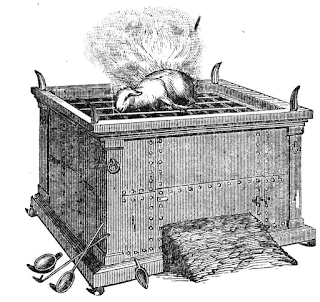
The sacrifice of animals in the Old Testament was insufficient. They could not solve the problem of sin; they could not save Man from the ravages of sin.
So a body was made—a body for God Himself, but to what end?
The Spirit of God is omnipotent; He can do anything by mere decree.
That is why He chose the limitations of flesh, a body, because for a sacrifice to be a true sacrifice it must free the recipient while binding the one who sacrifices.
Jesus, God in flesh, limited Himself to a body for the purpose of sacrifice:
Philippians 2:5-8, “(5) Let this mind be in you, which was also in Christ Jesus: (6) Who, being in the form of God, thought it not robbery to be equal with God: (7) But made himself of no reputation, and took upon him the form of a servant, and was made in the likeness of men: (8) And being found in fashion as a man, he humbled himself, and became obedient unto death, even the death of the cross.”
He humbled Himself.
His body had to depend upon a human mother. His body was susceptible to microbes, sweated through fever, was nourished by mere water, and required a blanket for warmth.
His body could misjudge a step and fall, forget the name of someone He met last week, and be crippled by grief.
His body would lose its freedoms to the men He made and be fastened with nails to a tree He grew.
His body would bleed, His lungs suffocate, His body would die – a choice He made for you…for me…a willing sacrifice.
When Jesus, God in flesh, met the blind, His touch healed them and gave them sight.
With one word, Jesus raised a child from the dead: “Little girl, get up.”[11]
Lazarus lay in a tomb for four days, Jesus called him by name, and he came out the tomb.
He spoke to the lepers and they were healed and cleansed.
But to heal you of your sins, Jesus could not just speak your sins away.
He could not wish your sins away, touch your sins away, or command your sins away.
No, your sins required a body:
“A body hast thou prepared me” (Hebrews 10:5).
His Body!
Like the father who sacrificed his arm to save his son, Jesus chose to sacrifice His body for you: “This is my body, which is given for you” (Luke 22:19).
Because we do not like pain, if it were up to us we would have been tempted to prepare a body that would have withstood the pain of sacrifice before it was formed in Mary’s womb:
- A body with a forehead that would not feel thorns and a back that would not feel the soldiers’ whip.
- Hands and wrists without nerves that would not feel the pain of the iron nails penetrating them.
- A tongue made that would not swell, be parched, or need to beg for water.
But this was not the will of God. God Incarnate assumed a body just like ours:
“For we have not an high priest which cannot be touched with the feeling of our infirmities; but was in all points tempted like as we are, yet without sin” (Hebrews 4:15).
Hebrews 2:18, “For in that he himself hath suffered being tempted, he is able to succour them that are tempted.”
Succour = aid, relieve
You Should Rejoice in Jesus’ Sacrifice for You
How should we respond to Jesus’ sacrifice? We should rejoice.
Without the cross, we have no hope, but thanks to the cross and the empty tomb, we have hope of salvation.
Our sins can be forgiven, and we can be made right with God.
Jesus was not caught or trapped by scheming Roman soldiers or jealous chief priests—He willingly laid down His life for us.
He lived His own words: “Greater love hath no man than this, that a man lay down His life for his friends” (John 15:13).
On Jesus’ Last Day He Ministered to Others
What would you do it were your last day to live?
- Would you go to a place you have always dreamed of going?
- Would you see something you have always wanted to see?
- Would you eat your favorite meal?
- Would you talk you your favorite people?
- What would you do if you knew you only had one day left?
What did Jesus do? He chose to serve, minister, and love others:
He washed His disciples’ feet; prayed all night for them; healed the ear of the man who came to arrest Him; carried your cross to Calvary; pardoned a thief while nailed to your cross and took him to Paradise; had compassion on His mother and the disciple who was with her; forgave all His murderers.[12]
On the day of His sacrifice at Calvary, Jesus chose to give Himself, to sacrifice Himself, all day long.
Billy Cole said, “God’s reward for sacrifice is more sacrifice.”
Before Jesus chose the ultimate sacrifice of Calvary He had to choose other little sacrifices beforehand.
Those ongoing sacrificial choices led Him to choose to sacrifice His life for YOU.
Sacrifice is Your Choice, It is Trading Your Will for God’s Will
You, like Jesus and His apostles, have been called to a life of sacrifice:
“I beseech you therefore, brethren, by the mercies of God, that ye present your bodies a living sacrifice, holy, acceptable unto God, which is your reasonable service” (Romans 12:1).
Just as a body was prepared for Christ, your body has been prepared for you to make a choice to sacrifice yourself, or to choose convenience, complacency, mediocrity.
Some problems cannot be solved by wishing them solved, or praying them away.
Some problems require you to lay down your comfort, convenience, security, safety, health and wealth.
Some problems require your body.
“A body hast thou prepared me.”
On that dark Passover weekend, Jesus died so Barabbas could live.
History has no record of Barabbas after that fateful day, but your story is still being written.
Today, as on Jesus’ last day, you have a choice: Jesus or anything else in this world.
You must get this choice right – – Your Choice
Choose abundant life.
Choose eternal life.
Choose to live for the one who died for us.
Choose Jesus.
[1] Source: God’s Word for Life. Lesson 3.3 – Jesus, or Barabbas? PPH. 2/16/2025.
[2] Strong’s Hebrews and Greek Dictionaries. G912.
[3] John 7:37.
[4] Luke 9:23.
[5] John 10:9.
[6] Mathew 8:34.
[7] Thayer’s Greek Definitions. G533
[8] Adam Clarke’s Commentary on the Bible. Matthew 8:34.
[9] Ken Gurley
[10] Galatians 4:4-5.
[11] Mark 5:21-43; Luke 8:40-56.
[12] John 13; 17; 18; Matthew 27; Luke 22; John 19, Luke 22
 The Pillar and Ground of Truth