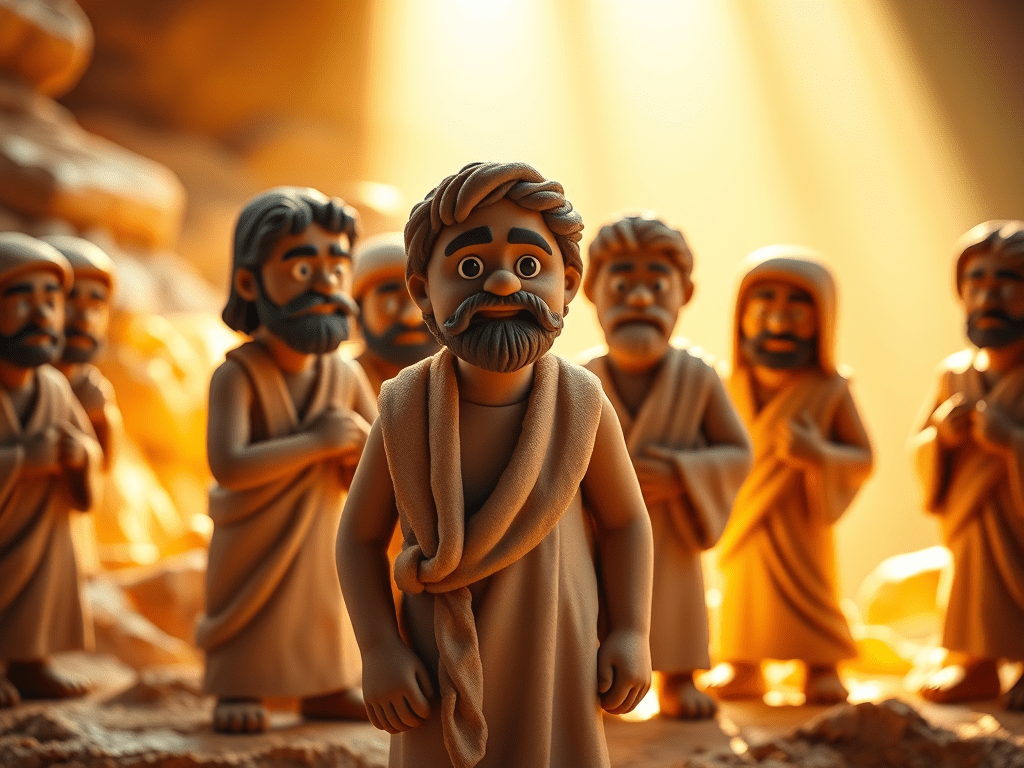
Text: Genesis 50:15-21
(15) And when Joseph’s brethren saw that their father was dead, they said, Joseph will peradventure hate us, and will certainly requite us all the evil which we did unto him. (16) And they sent a messenger unto Joseph, saying, Thy father did command before he died, saying, (17) So shall ye say unto Joseph, Forgive, I pray thee now, the trespass of thy brethren, and their sin; for they did unto thee evil: and now, we pray thee, forgive the trespass of the servants of the God of thy father. And Joseph wept when they spake unto him. (18) And his brethren also went and fell down before his face; and they said, Behold, we be thy servants. (19) And Joseph said unto them, Fear not: for am I in the place of God? (20) But as for you, ye thought evil against me; but God meant it unto good, to bring to pass, as it is this day, to save much people alive. (21) Now therefore fear ye not: I will nourish you, and your little ones. And he comforted them, and spake kindly unto them.
First time “Forgive” is found in the Bible.
<<Tell the story of Joseph and his brethren>>
He wept because his ten elder brothers had forgotten his forgiveness.
He had forgiven them 17 years ago, but they were in bondage to their own sordid past, fearful emotions and unbelief.
Joseph had released them, but they could not enjoy their freedom.
They were physically free, but spiritually bound.
“Joseph was a type of Christ in the Old Testament. The famine was an event designed to bring the brothers to repentance and a saving knowledge, both physically and spiritually. The tragedy of the famine created the circumstances that led to freedom for these men, for they had been in bondage to a wicked crime against their brother for many years. It was forgiveness from Joseph that led to that freedom.”
-Os Hillman
Freedom
-President Franklin D. Roosevelt named Four Freedoms in his State of the Union Address to the Congress on January 6, 1941:
- Freedom of speech, and expression—everywhere in the world.
- Freedom of every person to worship God in his own way—everywhere in the world.
- Freedom from want—which, translated into world terms, means economic understandings which will secure to every nation a healthy peacetime life for its inhabitants—everywhere in the world.
- Freedom from fear—which, translated into world terms, means a world-wide reduction of armaments to such a point and in such a thorough fashion that no nation will be in a position to commit an act of physical aggression against any neighbor—anywhere in the world.
It was that last fear that bond those ten brothers.
The fear was, “Now that Dad is dead, what will Joseph do?”
They did not judge Joseph as he was, but as they were.
The reason so many people continue to live in bondage and cannot enjoy the freedom that Jesus offers is because they have never truly received His forgiveness.
When you are truly free your priorities change and you are no longer drowning in a quagmire of past regrets
True freedom means you trust God’s mercy and, grow in His grace, and your relationship with Jesus becomes intimate, close and full of trust.
When you have truly accepted the forgiveness of God the chains fall and you experience true freedom:
1. Freedom from hate, unconditionally.
2. Freedom from self-pity.
3. Freedom from fear of possibly doing something that may help someone else more than it would help you.
4. Freedom from the kind of pride that could make a man feel that he is better than his brother.[1]
Gal. 4:21-5:1, “Stand fast therefore in the liberty wherewith Christ hath made us free, and be not entangled again with the yoke of bondage.”
- Paul is referring to the bondage of the flesh versus the freedom of the Spirit referring to Ishmael and Isaac: “But he who was of the bondwoman was born after the flesh; but he of the freewoman was by promise…. we are not children of the bondwoman, but of the free.”
- Then Paul refers to the liberty – freedom – Christ grand us with as He frees, liberates, and releases us from:
- “…the yoke of bondage”
- Liberty from the power and guilt of sin, which nothing but the grace of Christ can take away[2]
Romans 8:1-2, “There is therefore now no condemnation to them which are in Christ Jesus, who walk not after the flesh, but after the Spirit. For the law of the Spirit of life in Christ Jesus hath made me free from the law of sin and death.”
When you truly know Jesus – The Truth – you are free from sin:
(31) Then said Jesus to those Jews which believed on him, If ye continue in my word, then are ye my disciples indeed; (31) And ye shall know the truth, and the truth shall make you free. (32) They answered him, We be Abraham’s seed, and were never in bondage to any man: how sayest thou, Ye shall be made free? (34) Jesus answered them, Verily, verily, I say unto you, Whosoever committeth sin is the servant of sin. (35) And the servant abideth not in the house for ever: but the Son abideth ever. (36) If the Son therefore shall make you free, ye shall be free indeed.[3]
Bondage
Over the last twenty years, I have seen a rising infatuation with inspiration, but an aversion to real anointing.
“Inspiration does not break the yoke of bondage. Only the anointing breaks the yoke of bondage.”[4]
And it shall come to pass in that day, that his burden shall be taken away from off thy shoulder, and his yoke from off thy neck, and the yoke shall be destroyed because of the anointing.[5]
You can tell how bound a person is by the way they speak. In 1956 Evangelist T. L. Osborn wrote Faith’s Testimony: and it is a true today as it was then:
The Importance of Confession
You said that you could not do it, and the moment you said it you were whipped.
You said you did not have faith, and in that moment, doubt arose like a giant and bound you.
Perhaps you never realized that, to a great extent, you are ruled by your words.
You talked failure, and failure held you in bondage.
You talked fear, and fear increased its grip on you.
Solomon said, “Thou art snared with the words of thy mouth. Thou art taken (captive) with the words of thy mouth” (Pr. 6:2).
Testifying – Witnessing – Confessing
Few Christians have recognized the importance of confession and the place it holds in their lives. Whenever the word “confession” is used, they automatically think of confessing sin, weakness, and failure. But this is only the negative side of the subject.[6]
Positive Confessions:
- “I can do all things through Christ who strengthens me” (Philippians 4:13).
- “God has not given me a spirit of fear, but of power and of love and of a sound mind” (2 Timothy 1:7).
- “I am fearfully and wonderfully made” (Psalm 139:14).
- “My God shall supply all my needs according to His riches in glory by Christ Jesus” (Philippians 4:19).
- “I am more than a conqueror through Him who loves me” (Romans 8:37).
Forgiveness
Scars (mentally, emotionally, physically) are reminders of
past hurts that have healed.
You carry the reminder as a lesson in life, but that reminder need not paralyze you.
Forgiveness releases you from the feelings and bondage associated with the pain.
Forgiveness is not saying that what happened was/is ok, but it’s releasing you from the pain associated with the hurt so
that you can move on.
The scar then becomes a gentle reminder that you are a survivor and you can overcome anything.
It ain’t easy forgiving God, people, or yourself sometimes, but it’s a decision that you make and then keep.
So, when that old pain flares up you remind yourself, “Wait, I choose to forgive and I refuse to fall back into that trap of turmoil, pain, and hurt.”
You do that enough times and eventually all that remains is a scar, and as time passes the scar fades.
“One of my wise teachers, Dr. Orr, told me, ‘There is only one thing evil cannot stand, and that is forgiveness.’”
-Fred Rogers
Forgiveness Doesn’t Allow Abuse
Joseph’s own brothers had attacked him, thrown him into a cistern and sold him into slavery (see Genesis 37:12 – 28) — causing him to be separated from his loving father for over 20 years.
And though Joseph had much to forgive, he did not dwell on the offenses. He gained grace from God and let go of what others had done to him.
His response is a healthy model for us when we’ve been hurt or sinned against: we need to let it go and then get what we need from God and people who can give.
That is a better life.
Unforgiveness destroys a good life. Forgiveness creates it.
Forgiveness is not denial. We need to name the sin against us to forgive it, as Joseph did (see Genesis 45:4 – 5; 50:20). He worked through it. He named it. He expressed his feelings about it. And then he let it go.
We need to watch out for the resistance that will want us to stay in the past, trying to collect a debt that will never be paid.[7]
Forgiving People have been put in positions where they had to learn forgiveness. Have you been betrayed? Hurt? Offended?
“Wherefore I say unto thee, Her sins, which are many, are forgiven; for she loved much: but to whom little is forgiven, the same loveth little” (Luke 7:47).
Forgiving is Releasing, you must learn to forgive and be free (Luke 6:27-38):
(27) But I say unto you which hear, Love your enemies, do good to them which hate you,
(28) Bless them that curse you, and pray for them which despitefully use you.
(29) And unto him that smiteth thee on the one cheek offer also the other; and him that taketh away thy cloke forbid not to take thy coat also.
(30) Give to every man that asketh of thee; and of him that taketh away thy goods ask them not again.
(31) And as ye would that men should do to you, do ye also to them likewise.
(32) For if ye love them which love you, what thank have ye? for sinners also love those that love them.
(33) And if ye do good to them which do good to you, what thank have ye? for sinners also do even the same.
(34) And if ye lend to them of whom ye hope to receive, what thank have ye? for sinners also lend to sinners, to receive as much again.
(35) But love ye your enemies, and do good, and lend, hoping for nothing again; and your reward shall be great, and ye shall be the children of the Highest: for he is kind unto the unthankful and to the evil.
(36) Be ye therefore merciful, as your Father also is merciful.
(37) Judge not, and ye shall not be judged: condemn not, and ye shall not be condemned: forgive, and ye shall be forgiven:
(38) Give, and it shall be given unto you; good measure, pressed down, and shaken together, and running over, shall men give into your bosom. For with the same measure that ye mete withal it shall be measured to you again.
[1] Source: Duke Ellington. (4/29/1969). Four Major Freedoms to Live By and Enjoy.
[2] Adam Clarke’s Commentary on the Bible. Galatians 4:21-5:1.
[3] John 8:31-36
[4] Lee Stoneking
[5] Isaiah 10:27
[6] T. L. Osborn. (1956). Faith’s Testimony : the Important Secret of Confession Unveiled and How to Keep Your Healing. https://archives.northwestu.edu/handle/nu/56853.
[7] Source: Forgive, Grow and Find God’s Path for You (21-Day Plan). @YouVersion plan http://bible.com/r/Xv
 The Pillar and Ground of Truth